



Did you know that mitochondria do more than generate cellular energy and can also release signaling peptides like MOTS-c that influence metabolic pathways and glucose regulation in the human body? In recent years, scientists have identified mitochondrial-derived peptides (MDPs), small signaling molecules encoded by mitochondrial DNA that influence metabolic pathways. One of the most studied peptides in this category is MOTS-c (Mitochondrial Open Reading Frame of the 12S rRNA-c).
Modern metabolic science continues to uncover new ways the body regulates energy at the cellular level. At Vita Bella, personalized health programs integrate evidence-based treatments designed to support metabolic health, hormone balance, and overall wellness. MOTS-c peptide functions as a mitochondrial signaling molecule involved in metabolic regulation and glucose balance.
What Is MOTS-c?
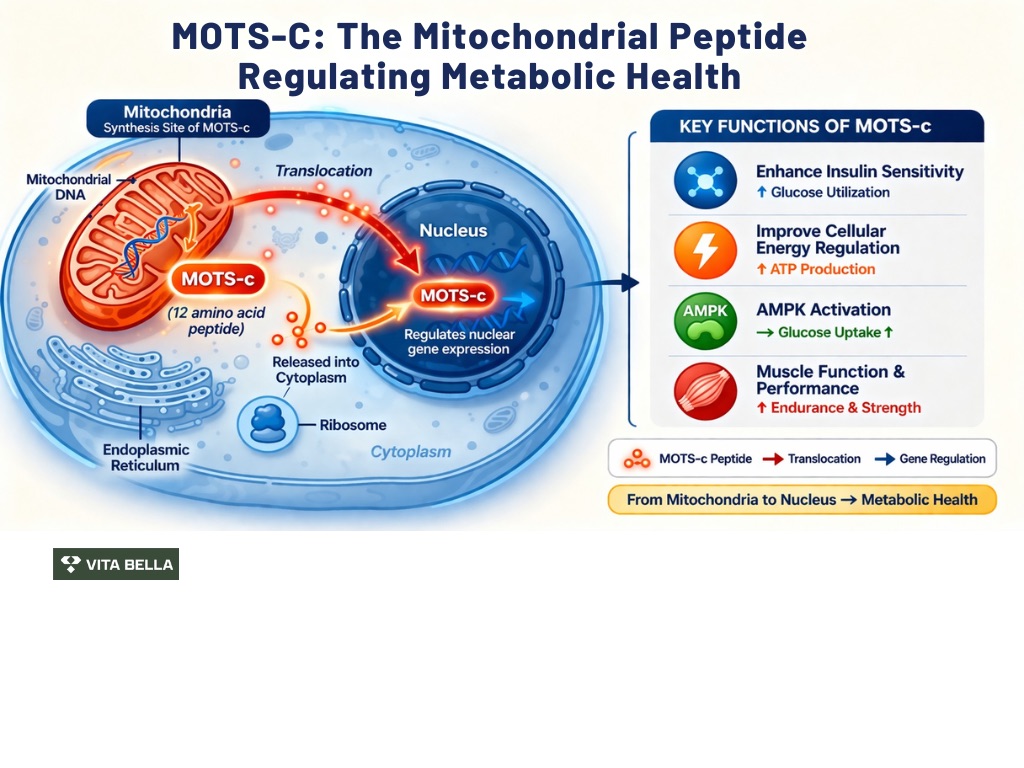
MOTS-c is a 16-amino-acid peptide encoded within mitochondrial DNA. Unlike many mitochondrial molecules that remain inside the organelle, MOTS-c can move into the nucleus and regulate genes involved in metabolism and stress responses. It has been shown that MOTS-c participates in metabolic signaling by modulating pathways involved in glucose metabolism and cellular energy production. Researchers 1 have observed links between circulating MOTS-c levels and metabolic conditions such as obesity and type 2 diabetes in human populations.
How MOTS-c Supports Metabolic Function?
MOTS-c supports metabolic function by regulating cellular pathways involved in glucose utilization and energy balance. It activates key metabolic regulators such as AMPK, which helps cells improve glucose uptake and maintain metabolic stability. MOTS-c also influences gene expression related to energy metabolism. The following are the properties of MOTS-s that support metabolic function.
1- Enhancing Insulin Sensitivity
One of the most widely reported functions of MOTS-c is its ability to support insulin sensitivity, a key factor in metabolic health. Research 2 shows that MOTS-c can activate metabolic signaling pathways that improve glucose utilization in skeletal muscle. In particular, the peptide influences pathways associated with the AMP-activated protein kinase (AMPK) system, often referred to as a central metabolic regulator.
2- Improving Cellular Energy Regulation
MOTS-c also helps regulate how cells produce and distribute energy. By influencing mitochondrial signaling and metabolic gene expression, the peptide contributes to efficient energy production in tissues with high metabolic demand, such as skeletal muscle. Study 3 describes MOTS-c as a metabolic regulator that coordinates nuclear gene expression related to energy metabolism, enabling cells to adapt to metabolic stress. These regulatory functions may support:
Cellular energy production
Mitochondrial efficiency
Adaptation to metabolic stress
What is the relationship between MOTS-c and exercise?
Exercise represents one of the most powerful stimuli for metabolic adaptation, and human research suggests that MOTS-c may participate in this process. Clinical investigations 4 examine exercise and metabolic signaling molecules, researchers identified MOTS-c as a mitochondrial peptide associated with metabolic responses to physical activity. The peptide stimulates pathways that promote glucose utilization and lipid metabolism during metabolic demand.
How Does MOTS-c Relate to Muscle Function in Humans?
According to human observational studies 5 have also explored the relationship between circulating MOTS-c levels and muscle performance indicators. Healthy individuals reported that higher serum MOTS-c concentrations correlated with greater muscle mass and stronger muscle performance, including higher force and power during jumping tests. This association highlights the peptide’s potential role in supporting skeletal muscle metabolism.
What is the potential Role of MOTS-c in Metabolic Health Research?
Researchers continue to investigate how MOTS-c interacts with metabolic pathways associated with chronic metabolic conditions. Research study 6 indicates that plasma MOTS-c levels are often reduced in individuals with metabolic disorders such as diabetes, suggesting a possible connection between mitochondrial signaling peptides and metabolic disease progression. Peptides may play a role in metabolic regulation through various mechanisms, such as:
Improving glucose uptake in muscle cells
Supporting insulin signaling pathways
Regulating metabolic gene expression
Supercharge Your Body, and Amplify Your Day with Vita Bella
Many people experience declining energy, reduced stamina, and inconsistent metabolic performance. These challenges often persist even with healthy lifestyle habits. The underlying issue may stem from disruptions in cellular energy regulation. When mitochondria cannot efficiently manage metabolic pathways, overall energy balance may suffer.
Vita Bella specializes in personalized wellness strategies designed to support cellular function. Our science-guided approach helps restore metabolic balance at its core. By focusing on advanced metabolic solutions, we aim to improve energy regulation and overall well-being. Explore how Vita Bella can help you regain metabolic balance through MOTS-C.
Frequently asked questions
Yes, human research indicates that MOTS-c peptide plays a role in metabolic signaling pathways that regulate glucose utilization and cellular energy production. It influences processes related to insulin sensitivity and metabolic balance. Because mitochondria help control energy metabolism, peptides like MOTS-c may contribute to maintaining efficient metabolic function in the body.
Yes, MOTS-c is a mitochondrial-derived peptide that participates in cellular signaling pathways associated with energy metabolism. It helps regulate how cells utilize glucose and respond to metabolic stress. By influencing gene expression related to metabolic activity, MOTS-c contributes to maintaining efficient cellular energy production and metabolic regulation in human cells.
Yes, several human studies suggest that circulating MOTS-c levels may correlate with metabolic health indicators such as glucose regulation, insulin sensitivity, and muscle metabolism. Researchers have observed that variations in MOTS-c concentrations may reflect changes in metabolic status, making it an emerging area of interest in metabolic health research.
Yes, human research indicates that MOTS-c is linked with skeletal muscle metabolism and may influence pathways involved in glucose uptake and energy utilization within muscle cells. Because skeletal muscle is a major site of glucose consumption in the body, peptides like MOTS-c may support metabolic activity and overall cellular energy balance.
References
Kong, B. S., Lee, C., & Cho, Y. M. (2023). Mitochondrial-encoded peptide MOTS-c, diabetes, and aging-related diseases. Diabetes & Metabolism Journal, 47(3), 315–324. https://doi.org/10.4093/dmj.2022.0333
Pham, T., Taberner, A., Hickey, A., & Han, J.-C. (2025). Mitochondria-derived peptide MOTS-c restores mitochondrial respiration in type 2 diabetic heart. Frontiers in Physiology, 16, 1602271. https://doi.org/10.3389/fphys.2025.1602271
Zheng, Y., Wei, Z., & Wang, T. (2023). MOTS-c: A promising mitochondrial-derived peptide for therapeutic exploitation. Frontiers in Endocrinology, 14, 1120533. https://doi.org/10.3389/fendo.2023.1120533
Dieli-Conwright, C. M., Sami, N., Norris, M. K., Wan, J., Kumagai, H., Kim, S. J., & Cohen, P. (2021). Effect of aerobic and resistance exercise on the mitochondrial peptide MOTS-c in Hispanic and non-Hispanic White breast cancer survivors. Scientific Reports, 11(1), 16916. https://doi.org/10.1038/s41598-021-96419-z
Domin, R., Pytka, M., Stefańska, A., Słomko, J., Słomko, A., & Wesołowski, W. (2023). MOTS-c serum concentration positively correlates with lower-body muscle strength and is not related to maximal oxygen uptake—A preliminary study. International Journal of Molecular Sciences, 24(19), 14951. https://doi.org/10.3390/ijms241914951
Wang, M., Wang, G., Pang, X., Ma, J., Yuan, J., Pan, Y., Fu, Y., Laher, I., & Li, S. (2022). MOTS-c repairs myocardial damage by inhibiting the CCN1/ERK1/2/EGR1 pathway in diabetic rats. Frontiers in Nutrition, 9, 1060684. https://doi.org/10.3389/fnut.2022.1060684