Oxandrolone, sold under the brand name Anavar, has a half-life of approximately 9 to 10 hours, per the DailyMed prescribing information. That figure describes the rate at which plasma concentration drops by half after each administration. The anavar half life shapes two separate clinical questions: how a provider structures dosing frequency, and how long the compound or its metabolites remain measurable after the last dose. Vita Bella's short-term injury and recovery programs approach both through a framework built on labs and individualized provider oversight.
What is the half-life of Anavar?
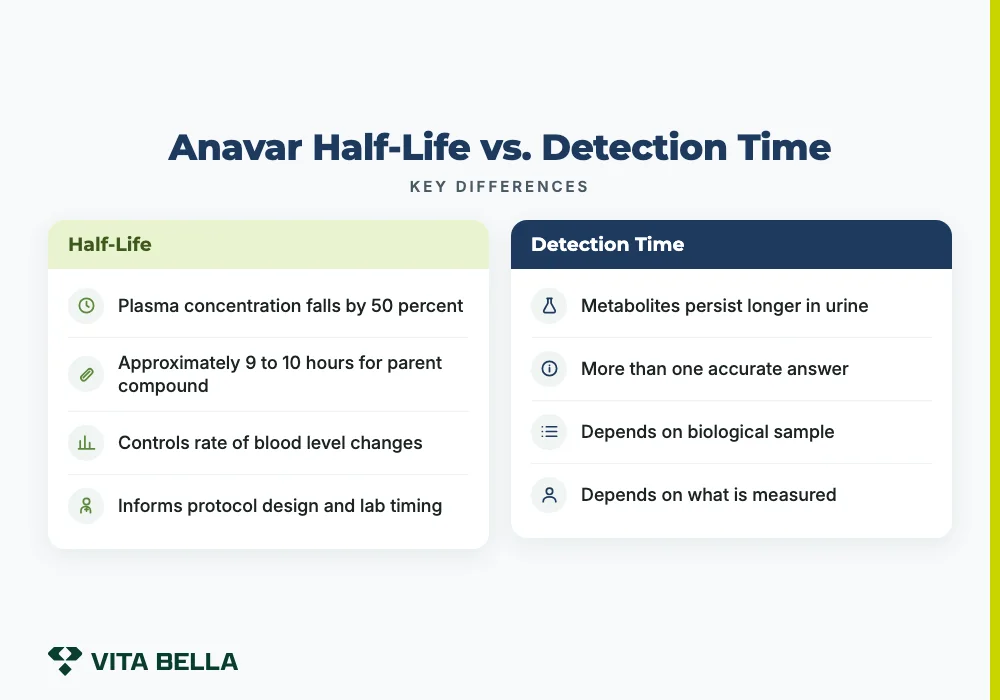
Patients approaching a provider consultation often ask, "What is the half life of Anavar?" The DailyMed prescribing information gives the clinical answer: approximately 9 to 10 hours. In pharmacokinetics, half-life measures how long it takes for plasma concentration to fall by exactly 50 percent from peak. After one half-life, half the compound remains active in plasma; after two, roughly a quarter remains; after four to five successive intervals, the concentration is near negligible.
Understanding the half life of anavar matters because it controls the rate at which blood levels change between administrations. A compound with a half-life measured in days, like a long-acting testosterone ester, maintains relatively flat plasma levels across a week. Oxandrolone clears in under 24 hours, which produces a different pattern of plasma concentration and a different set of considerations for providers structuring a protocol.
The 9-to-10-hour figure applies to the parent compound. Metabolites have their own pharmacokinetics and can persist significantly longer, particularly in urine. This is why the question of how long anavar stays in your system has more than one accurate answer, depending on the biological sample and what is specifically being measured.
Providers use the anavar half life as one input among many when designing a protocol. It informs the timing of lab draws, helps interpret plasma-level fluctuations, and shapes decisions about administration frequency. No single pharmacokinetic figure makes a protocol decision on its own.
Anavar half life vs. detection time: a key distinction
The anavar half life and the detection window are two distinct pharmacokinetic and analytical measures. Half-life describes concentration decay in plasma. Detection windows describe how long a given testing method can identify the compound or its metabolites in a biological sample such as blood, urine, or hair.
These two numbers do not scale together. The parent compound in plasma may be largely inactive within two to three days, while oxandrolone metabolites in urine can remain detectable for up to approximately three weeks. That gap exists because metabolites are structurally different from the parent molecule, processed and excreted at a different rate. Modern urine testing methods can identify them at low concentrations.
For providers and patients, the distinction is straightforward. Blood-based monitoring reflects current pharmacological activity. Urine-based testing reflects a longer window of prior exposure. Conflating the two leads to misinterpretation of what a result actually means.
| Measure | Approximate window | Clinical relevance |
|---|---|---|
| Plasma half-life | ~9–10 hours | Rate of concentration drop |
| Blood clearance (active compound) | ~2–3 days | When compound is largely inactive in circulation |
| Urine metabolite detection | Up to ~3 weeks | Metabolite persistence after clearance |
| Hair follicle detection | Months | Structural exposure record; rarely used clinically |
How long does Anavar stay in your system?
How long Anavar stays in your system has two answers. They depend on whether the question refers to the active parent compound or to the metabolites that persist after it has cleared.
The parent compound clears relatively quickly given the oxandrolone half life of 9 to 10 hours. Working through four to five successive half-life intervals brings the concentration to less than 10 percent of peak. The anavar half life of 9 to 10 hours means the active compound is largely absent from circulation within two to three days of the last dose.
Metabolites are a different matter. The liver processes oxandrolone into downstream compounds that have their own clearance rate and are structurally distinct from the parent molecule. These metabolites are detectable in urine for considerably longer. Modern urine testing methods are sensitive enough to identify them well after the compound has ceased to have any pharmacological activity.
This distinction is clinically significant. When a provider orders blood analysis during a protocol, the result reflects current activity. When a monitoring panel uses urine testing, the result reflects a longer window of prior exposure. Understanding which test is being used and what it measures is essential for correctly interpreting results.
Detection windows by test type: a clinical overview
Different testing methods measure different biological markers over different timeframes. The clinical relevance of each method depends on the specific question being asked.
- Blood analysis detects the parent compound and reflects current pharmacological activity; it is the most relevant measure during an active, provider-supervised protocol.
- Urine analysis detects metabolites and remains positive well beyond plasma clearance, making it the most sensitive standard detection approach for monitoring or regulatory purposes.
- Hair follicle analysis reflects cumulative exposure over weeks or months; it is not part of standard clinical protocol monitoring and has no role in day-to-day protocol management.
Oxandrolone in short-term clinical use
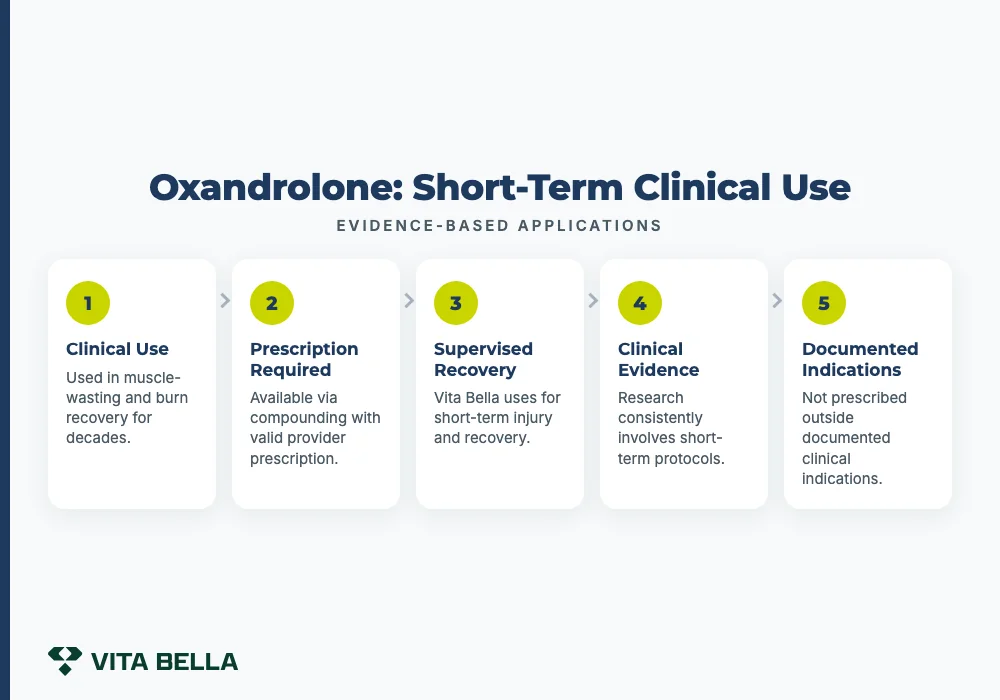
Clinics and hospitals have used oxandrolone in muscle-wasting and severe burn recovery settings for decades. Today the compound is available through compounding under a valid provider prescription. Vita Bella's application falls within a short-term injury and recovery context, under close provider supervision, consistent with how the clinical evidence describes appropriate use.
Oxandrolone is not prescribed outside of documented clinical indications. Use outside a documented indication is outside the legal scope of any legitimate provider.
What clinical evidence shows about short-term protocols
Peer-reviewed research on oxandrolone consistently involves short-term protocols with clearly defined clinical indications. The evidence defines where evidence-based use begins and ends, and what the research does and does not support.
- A 2025 systematic review and updated meta-analysis by Lou J et al., published in the World Journal of Emergency Surgery, found that oxandrolone can support lean mass preservation during the acute recovery phase of burn treatment, drawing on randomized controlled trial data spanning 2005 to 2025. (PubMed)
- A 2020 systematic review and meta-analysis by Ring J et al., published in the Journal of Burn Care and Research, reached consistent conclusions about oxandrolone's role in burn recovery, with protocols characterized by short durations and well-defined clinical endpoints. (PubMed)
- A 2019 Cochrane review by Mohamed S et al. examined oxandrolone in girls with Turner syndrome, illustrating the compound's studied role in documented clinical indications beyond burn and muscle-wasting settings. (PubMed)
- Clinical protocols in the published literature run short-term, no longer than 8 weeks, with ongoing provider oversight and lab-based monitoring throughout.
- Oxandrolone is not appropriate for non-clinical purposes; the studies cited here describe use in specific populations with documented medical indications, not general health optimization.
Vita Bella's injury and recovery programs are provider-led, starting with labs and a one-on-one provider consultation. Learn how the programs work before deciding on next steps.
Anavar and testosterone: understanding the paired approach
Vita Bella's injury and recovery protocol pairs oxandrolone with testosterone. From a pharmacokinetics standpoint, this requires a provider to manage two compounds with different half-lives and clearance curves simultaneously. Testosterone esters have half-lives measured in days rather than hours; the anavar half life of approximately 9 to 10 hours places oxandrolone clearance well within a single day.
That difference in timelines matters for protocol structure. A provider cannot use a single monitoring schedule that works equally well for both compounds without accounting for their distinct kinetics. Lab timing must reflect the short-acting nature of oxandrolone and the slower accumulation and clearance profile of testosterone separately.
There is also an endocrine interaction to account for. Oxandrolone and testosterone affect overlapping hormonal pathways. A provider managing both compounds must assess how each is influencing the clinical picture, adjusting the protocol based on lab results and patient response at each check-in rather than running a fixed schedule regardless of what the numbers show.
This paired approach is only appropriate under clinical supervision. Self-managed use of either compound introduces the risks of unmonitored hormonal effects and clearance interactions that providers specifically account for through regular lab review. For a broader look at why total testosterone measurement alone may not capture the full hormonal picture, the article on sex hormone-binding globulin and testosterone interpretation provides useful context.
Ready to explore provider-led recovery options?
Vita Bella's injury and recovery programs begin with a lab review and a 45-minute one-on-one provider consultation, not a preset protocol. A licensed provider assesses your clinical picture and builds a plan based on your results. Transform Your Life. You Owe It To Yourself.
Frequently asked questions
The half-life of Anavar (oxandrolone) is approximately 9 to 10 hours, per the DailyMed prescribing information. That figure describes how long it takes for plasma concentration to fall by half after each administration. Full clearance of the active compound takes several successive half-life intervals, with the parent compound reaching negligible levels within approximately two to three days.
The active parent compound is largely absent from circulation within two to three days of the last dose, given the 9-to-10-hour oxandrolone half life. Urine metabolites can remain detectable for up to approximately three weeks, well past the point when the compound has any pharmacological activity. These two figures answer different questions and are not interchangeable.
Yes. Because the half life of anavar is under 24 hours, a single daily administration produces a wider peak-to-trough swing in plasma concentration than a divided schedule. Providers factor this pharmacokinetic reality into protocol timing decisions, though the final approach is always based on labs and the patient's individual clinical history.
Yes, they are distinct measures. The anavar half life describes the rate at which plasma concentration declines after each dose, while detection windows describe how long testing methods can identify the compound or its metabolites in biological samples. A patient can be well past any pharmacological effect while urine testing still identifies metabolites.
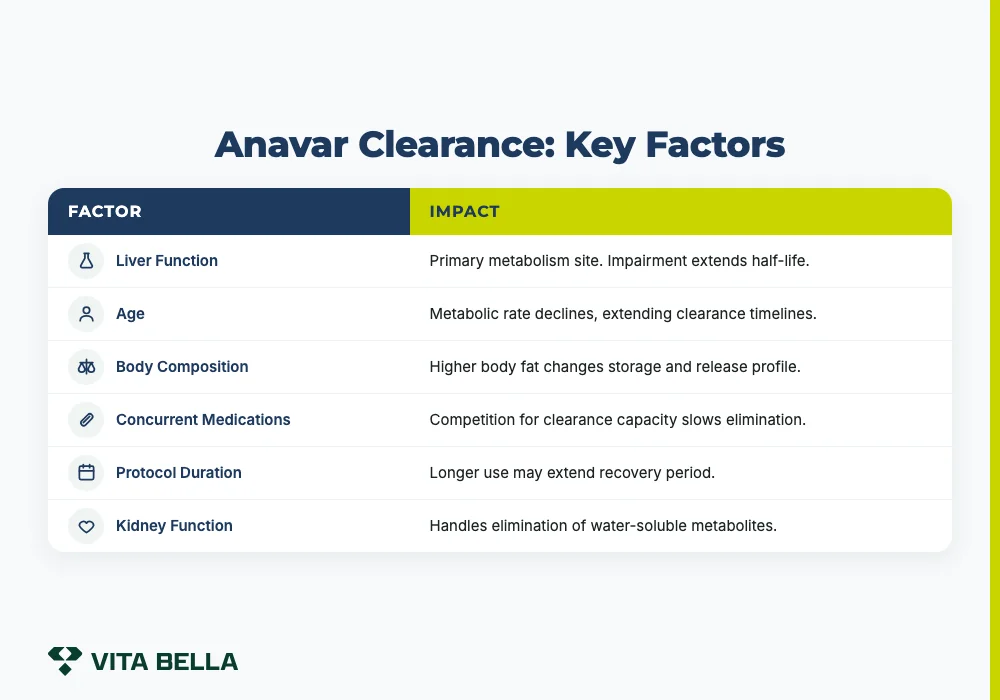
Liver function is the primary driver, since oxandrolone is metabolized hepatically. Age, body composition, concurrent medications that share hepatic clearance pathways, the duration of the protocol, and kidney function all contribute to individual variation in how quickly the compound and its metabolites are eliminated.
Sources
- Lou J et al. (2025). Oxandrolone for burn patients: a systematic review and updated meta-analysis of randomized controlled trials from 2005 to 2025. World Journal of Emergency Surgery. PubMed
- Ring J et al. (2020). Oxandrolone in the Treatment of Burn Injuries: A Systematic Review and Meta-analysis. Journal of Burn Care and Research. PubMed
- Mohamed S et al. (2019). Oxandrolone for growth hormone-treated girls aged up to 18 years with Turner syndrome. Cochrane Database of Systematic Reviews. PubMed
- DailyMed. Oxandrin (oxandrolone) tablet: prescribing information. U.S. National Library of Medicine. DailyMed