Peptide therapy benefits span tissue repair, muscle support, weight management, and healthy aging. Peptides are short amino acid chains that act as precise cellular messengers, and a 2018 review in Bioorganic & Medicinal Chemistry found their receptor specificity produces fewer off-target effects than most conventional drugs. Vita Bella works with licensed providers to build individualized programs around these compounds.
What are the benefits of peptide therapy?
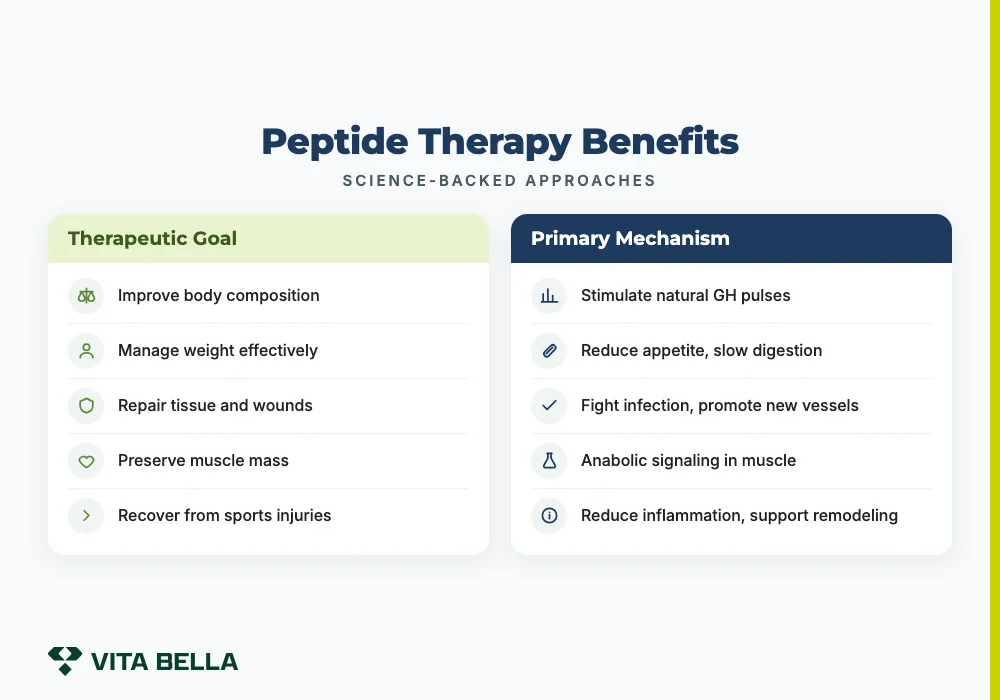
Peptide therapy benefits are broad because peptides are a structurally diverse class of molecules. Different compounds bind to different receptors, so a provider can design a program that targets several goals within one protocol.
| Therapeutic goal | Peptide class | Primary mechanism |
|---|---|---|
| Body composition | Growth hormone secretagogues | Stimulate natural GH pulses |
| Weight management | GLP-1 receptor agonists | Reduce appetite, slow gastric emptying |
| Tissue and wound repair | Antimicrobial and angiogenic peptides | Fight infection, promote new vessel growth |
| Muscle preservation | IGF-1-related peptides | Anabolic signaling in skeletal muscle |
| Sports injury recovery | Injectable peptides | Reduce inflammation, support tissue remodeling |
The recognized range of peptide therapy benefits continues to expand as clinical research matures. A 2026 review in The American Journal of Sports Medicine (Mayfield et al.) examined injectable peptide therapy specifically for orthopedic and sports medicine physicians, reflecting how quickly this class has moved from research into clinical settings. A separate 2025 analysis in Drug Discovery Today (Hao et al.) identified peptide-based approaches as promising candidates for acute kidney injury, extending the therapeutic reach further.
How do peptides work in the body?
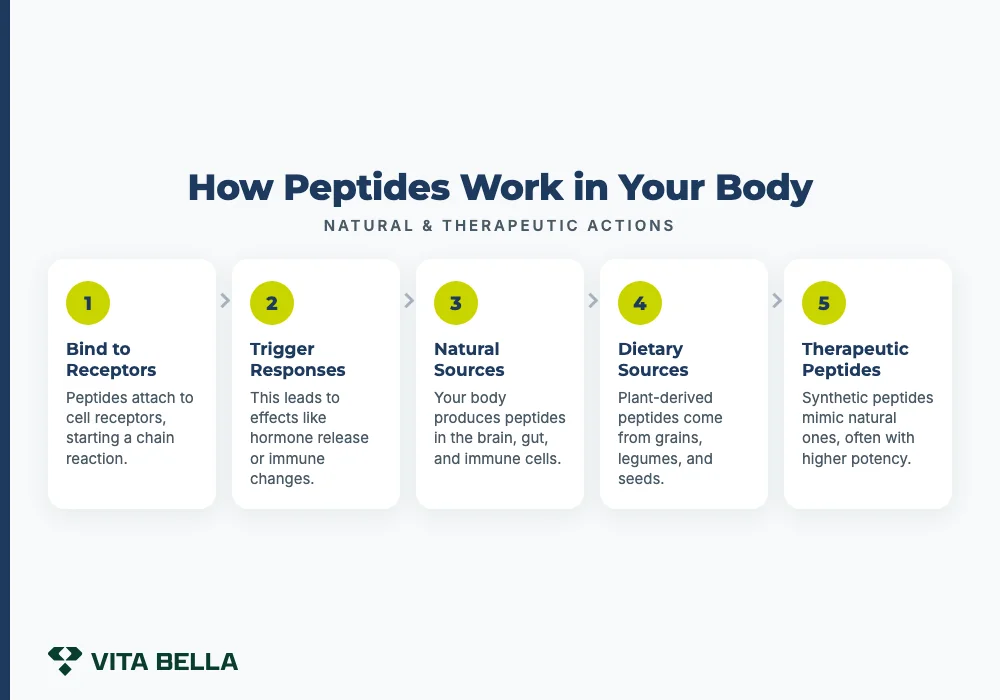
Peptides work by binding to surface or intracellular receptors and triggering downstream signaling cascades. That is how peptides work at the molecular level. The downstream effects range from releasing stored hormones to modulating immune responses and stimulating tissue repair.
Bioactive peptides and their sources
Bioactive peptides are specific protein fragments that produce measurable physiological effects. The Biopep database has catalogued more than 1,500 distinct bioactive peptides, as documented by Sánchez and Vázquez (2017). They are produced naturally throughout the body:
- In the brain, they regulate pain perception and mood signaling.
- In the gut, they control digestion and satiety responses.
- In immune cells, they modulate inflammation and pathogen defense.
Diet is another source. A 2025 review in the Journal of Agricultural and Food Chemistry (Chen et al.) described plant-derived bioactive peptides from grains, legumes, and seeds with documented anti-inflammatory and metabolic activities. Therapeutic peptides work within the same receptor system the body already uses daily.
Synthetic peptides are engineered to mimic natural ones but often carry higher potency or a longer duration of action. Insulin, isolated in the early 20th century, was the first peptide hormone used therapeutically. ACTH followed, treating Addison's disease, which had previously been fatal. Both examples illustrate the foundational principle: peptide therapy works by replicating or amplifying signals the body already recognizes.
What is the difference between peptides and hormones?
Peptides and hormones are not mutually exclusive categories. Many hormones are peptides: insulin (51 amino acids), GLP-1, and ACTH are all peptide hormones. The structural distinction comes down to length. Forbes and Krishnamurthy (2020) define a peptide as a chain of 2 to 50 amino acids joined by peptide bonds, making the peptide category a subset of the broader class of signaling molecules.
Endocrine hormones are defined by their origin and route of action. They are secreted by glands, including the pituitary, adrenal glands, thyroid, pancreas, and gonads, and travel through the bloodstream to distant tissues. McLaughlin and Jialal (2019) classify endocrine hormones into three structural categories: peptides, steroids, and tyrosine derivatives. Steroids such as testosterone and cortisol, along with thyroid hormones, are not peptides.
The peptides vs hormones distinction matters when choosing a treatment approach. Peptide-based therapies generally work by amplifying signals the body already produces. Steroid hormones, by contrast, replace or directly supplement endogenous levels. A licensed provider evaluates labs and goals to determine whether peptide therapy, hormone therapy, or a combination fits the patient.
Can peptides help with weight loss and recovery?
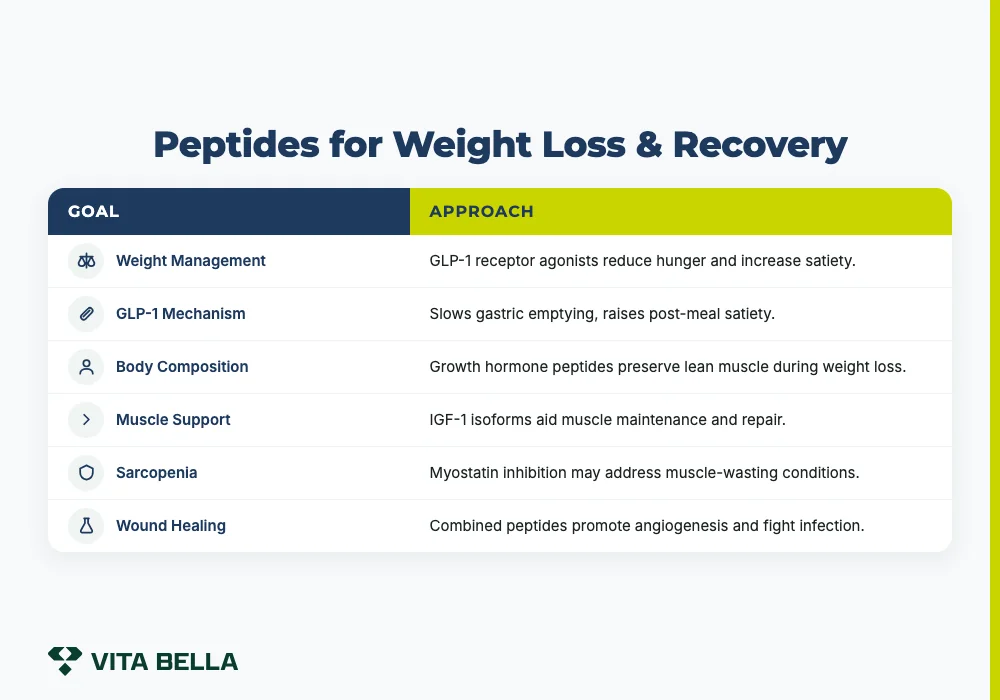
Yes, with the specifics depending on the goal. The evidence is strongest for weight management and muscle support.
Weight management
The best-documented peptides for weight management are GLP-1 receptor agonists. These compounds were first developed to treat type 2 diabetes. A 2021 review in Advances in Therapy (Ard et al.) explained their mechanism: reducing hunger signals, slowing gastric emptying, and raising post-meal satiety. Liraglutide was among the first in this class approved for obesity treatment, and GLP-1 therapy is now one of the most clinically studied areas in metabolic medicine.
Weight loss with peptide therapy often connects to body composition goals. Preserving lean muscle during caloric restriction is an active concern, and growth hormone peptides are one approach providers use to address it. For more on maintaining lean muscle during GLP-1 therapy, providers often layer peptide protocols to protect body composition throughout a weight loss program.
Peptides for recovery and muscle support
Research into peptides for recovery spans orthopedics, sports medicine, and age-related muscle loss. A 2019 study in Aging Cell (Ascenzi et al.) showed that different IGF-1 isoforms have distinct roles in muscle maintenance, differentiation, and repair. Myostatin inhibition is another active research direction: blocking the protein that limits muscle growth may address sarcopenia and muscle-wasting conditions.
Wound healing runs in parallel. Chen et al. (2025) reviewed antimicrobial, cell-penetrating, and extracellular matrix-mimetic peptides in Drug Discovery Today and found that combining these classes in a single hydrogel material can promote angiogenesis, fight infection, and support tissue scaffolding at the same time.
*Image source: Research paper*
Growth hormone peptides and long-term health
Growth hormone secretagogues prompt the pituitary to release GH rather than supplying it directly. They work within the body's existing GH feedback loops, not around them. That structural difference matters for long-term tolerability.
Tesamorelin, a synthetic GHRH analogue, is part of Vita Bella's peptide therapy offering. Sermorelin therapy is a related secretagogue in the same class. Both stimulate natural GH pulses with the goal of supporting body composition and tissue health over time. A licensed provider determines the dose after a full clinical intake; labs are recommended and help individualize the protocol, though they are not a universal requirement for every patient.
Are peptides safe to use?
Peptide safety is a legitimate concern. Short answer: yes, when prescribed by a licensed provider who monitors your response over time.
Mitra et al. (2020) reviewed nonclinical safety challenges in Regulatory Toxicology and Pharmacology and noted that dedicated regulatory frameworks for peptides remain limited, requiring the sector to adapt small-molecule and biologic guidelines. The FDA and the European Medicines Agency have responded by establishing specific evaluation criteria for immunogenicity and purity in market authorization applications.
Immunogenicity is the key variable. Some peptides can trigger the immune system to produce antidrug antibodies (ADAs), which may reduce efficacy over time. Achilleos et al. (2025) reported that roughly 600 therapeutic peptides are currently in preclinical testing and approximately 200 are in clinical trials, with immunogenicity assessment built into each evaluation. Under supervised care, risks are managed through provider monitoring and protocol adjustments. For context on how providers structure multi-cycle programs, see how peptide programs are structured and overseen.
Ready to explore peptide therapy?
Peptide therapy benefits are backed by decades of clinical use and an expanding body of research. The right program depends on your goals and a provider who can interpret them. Get Started to connect with a licensed provider at Vita Bella.
Frequently asked questions
Peptide therapy benefits include support for muscle maintenance, weight management, tissue repair, recovery from injury, and healthy aging. Different peptides target different receptors, so a provider can address several goals within one structured program. Clinical evidence supports their use across orthopedics, endocrinology, and metabolic medicine.
Peptides bind to specific cell receptors and trigger signaling cascades that regulate biological processes throughout the body. The body naturally produces thousands of bioactive peptides in tissues such as the gut, brain, and immune system. Therapeutic peptides are synthetic versions designed to mimic these natural signals with greater potency or stability.
Many hormones are peptides, so the categories overlap significantly. The structural distinction is that peptides are chains of 2 to 50 amino acids, while endocrine hormones also include steroids and tyrosine derivatives. In clinical practice, peptide therapy typically amplifies signals the body already produces rather than replacing steroid hormones.
Peptide therapy is considered safe when prescribed and monitored by a licensed provider. The main safety variable is immunogenicity: some patients may develop antibodies that reduce efficacy over time. Both the FDA and the European Medicines Agency review immunogenicity and purity data as part of the approval process for therapeutic peptides.
GLP-1 receptor agonists are well-established peptides for weight management, reducing appetite and slowing gastric emptying. For physical recovery, growth hormone secretagogues and IGF-1-related peptides support muscle repair and tissue remodeling. A licensed provider evaluates your goals to determine which peptide class fits your needs.
Sources
- Lau, J. L., & Dunn, M. K. (2018). Therapeutic peptides: Historical perspectives, current development trends, and future directions. Bioorganic & Medicinal Chemistry, 26(10), 2700–2707. PubMed
- Sánchez, A., & Vázquez, A. (2017). Bioactive peptides: A review. Food Quality and Safety, 1(1), 29–46. PubMed
- Forbes, J., & Krishnamurthy, K. (2020). Biochemistry, peptide. StatPearls. PubMed
- McLaughlin, M. B., & Jialal, I. (2019). Biochemistry, Hormones. StatPearls. PubMed
- Ard, J., et al. (2021). Weight loss and maintenance related to the mechanism of action of glucagon-like peptide 1 receptor agonists. Advances in Therapy, 38(6), 2821–2839. PubMed
- Ascenzi, F., et al. (2019). Effects of IGF-1 isoforms on muscle growth and sarcopenia. Aging Cell, 18(3), e12954. PubMed
- Chen, Z., et al. (2025). Peptide-driven approaches in advanced wound healing materials. Drug Discovery Today, 104440. PubMed
- Mitra, M. S., et al. (2020). Development of peptide therapeutics: A nonclinical safety assessment perspective. Regulatory Toxicology and Pharmacology, 117, 104766. PubMed
- Achilleos, K., et al. (2025). Beyond Efficacy: Ensuring Safety in Peptide Therapeutics through Immunogenicity Assessment. Journal of Peptide Science, 31(6), e70016. PubMed
- Mayfield, C. K., et al. (2026). Injectable Peptide Therapy: A Primer for Orthopaedic and Sports Medicine Physicians. The American Journal of Sports Medicine. PubMed
- Chen, Y., et al. (2025). Plant-Derived Bioactive Peptides: Extraction, Isolation, Purification, Pharmacological Activities, Structure-Activity Relationship, and Applications. Journal of Agricultural and Food Chemistry. PubMed
- Hao, H., et al. (2025). Peptide therapy: new promising therapeutics for acute kidney injury. Drug Discovery Today. PubMed