When you stop hormone replacement therapy, circulating estrogen and progesterone drop, and the symptoms the therapy was managing can return. How quickly and how severely that happens depends on whether you stop abruptly or work through a gradual, provider-supervised taper. Stopping suddenly tends to produce more intense symptoms faster, while tapering typically allows for a milder adjustment period spread across weeks.
Why people stop HRT
People discontinue HRT for several reasons: a fixed-duration protocol has ended, symptoms have resolved, costs have shifted, or a new health consideration changes the clinical picture. Some feel well and question whether they still need support. Others receive a new diagnosis that prompts reassessment.
No path is automatically right. Continuing HRT and stopping it both carry tradeoffs, and those tradeoffs depend on your labs, health history, and the specific formulation you use.
Should you stop HRT? Questions to ask your provider first
Stopping HRT is a clinical decision best made with a provider who has reviewed your labs and health history, not one to make on your own. Before you change your protocol, these questions are worth bringing to your next appointment.
Questions to ask before changing your HRT protocol:
- What does my current health history suggest about stopping now versus continuing?
- How should my specific dose and formulation be tapered?
- What symptoms should I monitor after stopping, and for how long?
- Are there non-hormonal options to manage symptoms if they return?
What happens when you stop HRT cold turkey
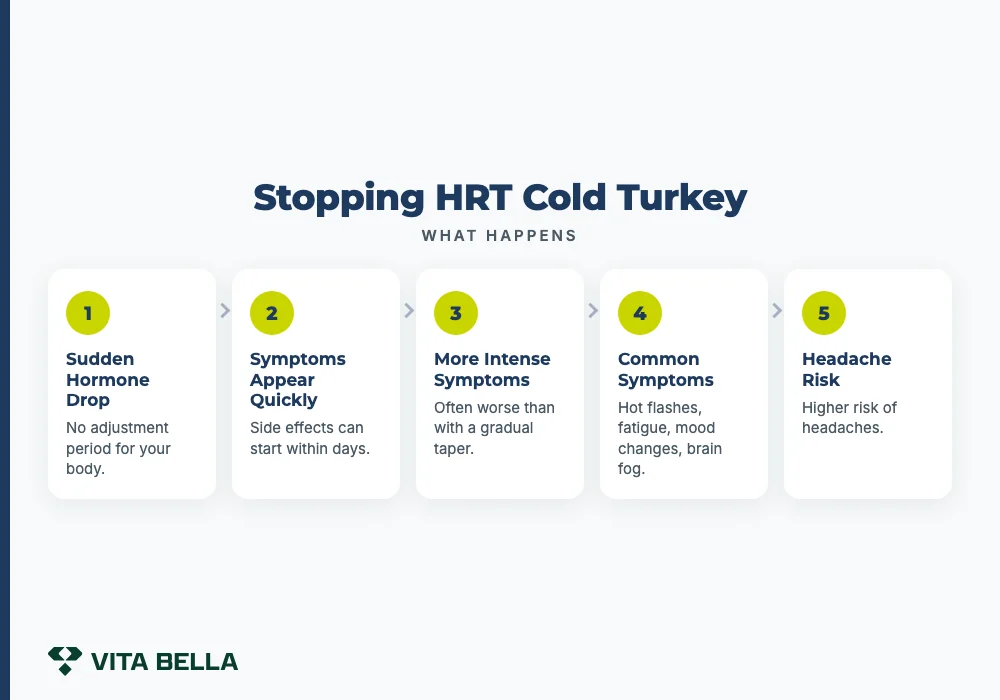
Stopping HRT cold turkey, abruptly, without a provider-supervised taper, causes a sharp, unmediated hormone drop with no adjustment period. Symptoms can appear within days. The side effects of stopping HRT suddenly tend to be more intense than with a gradual taper, a pattern consistent with the discontinuation guidance in a 2019 review in Minerva Ginecologica by Cagnacci et al.
Common symptoms after stopping HRT suddenly:
- Hot flashes and night sweats returning
- Sleep disruption and persistent fatigue
- Mood changes, irritability, or low mood
- Brain fog and difficulty concentrating
- Joint discomfort
- Headaches (see the dedicated section below)
- Vaginal dryness
| Factor | Cold turkey | Gradual taper |
|---|---|---|
| Hormone drop | Sudden | Stepwise over weeks |
| Symptom onset | Within days | Days to weeks |
| Symptom severity | Typically more intense | Typically milder |
| Headache risk | Higher | Lower |
| Provider supervision | Required | Required |
What happens when you taper off HRT gradually
A gradual dose reduction gives the body time to re-establish its own hormone baseline. Symptoms are typically milder and shorter-lived. The schedule is set by a licensed provider based on your current formulation, health history, and how your body responds at each step.
What happens when you stop taking HRT through a structured taper is meaningfully different from what most people experience with abrupt discontinuation. The transition takes longer. Peak discomfort is lower at each stage, and provider-directed adjustments can catch problems before they escalate.
Symptom timeline: what to expect week by week
A 2019 review in Minerva Ginecologica by Cagnacci et al. provides clinical context for how symptoms progress after stopping HRT. Most people follow a recognizable arc, though exact timing varies.
Days 1 through 7. The initial hormone drop occurs. With abrupt discontinuation, first symptoms appear quickly. With a taper, the first week is often manageable because reductions are incremental.
Weeks 2 through 4. This is typically the peak intensity window for cold-turkey cases. Hot flashes and sleep disruption are most pronounced here. People on a gradual taper may still be partway through their step-down schedule and experience fewer symptoms.
Weeks 5 through 8. Most people begin to stabilize as the body recalibrates its own hormone signals. Some variation extends beyond eight weeks, particularly for those who stopped abruptly.
Can stopping HRT cause headaches?
Yes, headaches are a documented side effect after stopping HRT, particularly with abrupt discontinuation. Estrogen influences vascular tone, and a rapid drop can trigger hormonal headaches, especially in people with a history of menstrual migraines. The Cagnacci et al. 2019 review notes that abrupt cessation produces sharper hormone profile changes, which corresponds to higher headache risk. These headaches typically resolve as levels stabilize over the following weeks.
Will I gain weight if I stop HRT?
Discontinuing HRT does not reliably cause weight gain, but fat distribution may shift toward the abdomen when estrogen levels fall. Metabolic rate and insulin sensitivity can also change without estrogen support. Diet and physical activity remain the dominant factors in body composition. A provider who reviews labs and your body composition data can build a plan that accounts for the hormonal shift; if you are also reconsidering your HRT management approach, that conversation belongs in a structured clinical evaluation.
Mood, sleep, and brain fog after stopping HRT
Sleep disruption and mood changes are among the most frequently reported effects after coming off HRT. Estrogen influences serotonin and norepinephrine pathways, affecting both mood regulation and sleep architecture. Brain fog and concentration difficulties often follow poor sleep rather than arising as independent symptoms.
These effects overlap with other conditions. Provider evaluation is the right next step rather than self-diagnosis.
Does your HRT type affect withdrawal?
Yes. Patch users experience a more gradual hormone decline because patches deliver hormones continuously through the skin, so removing the final patch produces a less sharp drop than stopping oral tablets. Pill users may notice a more abrupt shift because oral tablets create defined peaks and troughs throughout the day.
Estrogen-only and combined estrogen-progesterone therapies also carry different profiles when stopped. Combined users may experience progesterone-related changes, such as shifts in sleep and mood, alongside estrogen-related vasomotor symptoms. A 2019 analysis in Minerva Ginecologica (Cagnacci et al.) outlines formulation-specific considerations for discontinuation. Understanding which type you use helps your provider predict what stopping will feel like and structure the taper accordingly.
For a look at which lab markers are most relevant during a hormone transition, Essential Lab Testing for Peptide and Hormones covers what to track and when.
How to stop HRT safely
Provider-supervised tapering is the safest approach to discontinuing HRT. A licensed provider reviews your current labs, adjusts the dose in measured steps, and monitors how your body responds at each stage. The schedule is always individualized; a licensed provider determines the timing after reviewing your labs, not a one-size-fits-all formula.
Self-directed stopping, whether cold turkey or a self-managed reduction, removes the clinical oversight that allows for real-time adjustments when symptoms intensify or persist. Understanding where your baseline hormone levels actually sit, not just where they fall in the standard reference range, also helps guide the process. When "Normal" Labs Still Leave You Feeling Suboptimal explains why standard ranges often miss what matters clinically.
If you are ready to explore what a provider-guided approach to stopping or adjusting your HRT looks like, Get Started with a Vita Bella provider evaluation.
Talk to a provider about your hormone health
Any decision to stop, adjust, or restart HRT should involve a licensed provider who reviews your labs and health history before any protocol change is made. At Vita Bella, you work 1:1 with a real provider at every step. Labs are ordered and reviewed by your provider before any protocol change and billed separately. Access to member wholesale pricing on medications is part of the membership alongside ongoing provider support.
Frequently asked questions
Hormone levels drop and the symptoms HRT was managing, such as hot flashes, sleep disruption, and mood changes, can return. Severity and speed depend on whether you stop suddenly or taper gradually under provider guidance. Most symptoms ease within weeks to months as the body re-establishes its baseline.
Yes, feeling unwell after coming off HRT is common and expected. The body needs time to re-establish its own hormone baseline after relying on external support. If symptoms are severe or persist beyond a few months, a provider evaluation is warranted.
You can stop suddenly, but abrupt discontinuation typically produces more intense symptoms than a gradual taper because the hormone drop gives the body no adjustment period. A provider-supervised taper is the medically preferred approach for most people.
The clearance timeline depends on form: patches and gels typically clear within 24 to 48 hours of the last dose, and oral tablets follow a similar window. Symptoms from the hormonal shift, however, can persist for weeks to months after HRT itself has cleared.
Estrogen supports bone density, skin collagen, and cardiovascular health, and those protective effects diminish after stopping. Whether that translates to faster visible aging varies by individual genetics, lifestyle, and duration of prior HRT use. A provider can review your personal risk profile to put the tradeoffs in context.
Sources
- Cagnacci A, et al. (2019). Recommendations on menopausal hormone replacement therapy. Minerva Ginecologica. PubMed