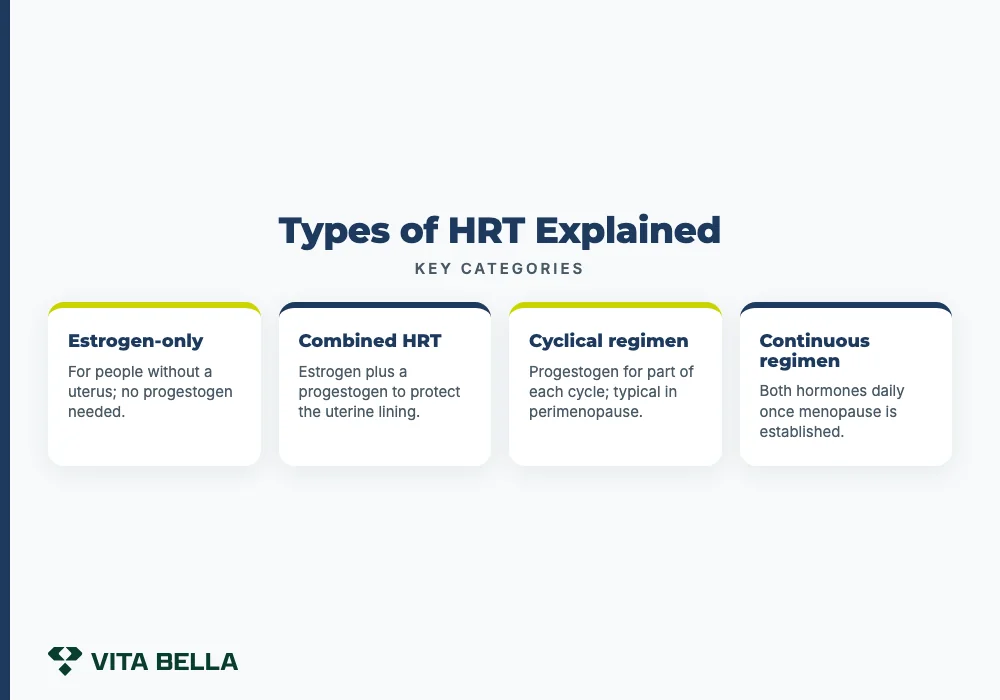
The types of HRT fall into two primary categories: estrogen-only and combined, which pairs estrogen with a progestogen. Delivery routes range from transdermal patches and gels to oral tablets and local vaginal formulations. Regimens follow two distinct patterns: cyclical adds progestogen for part of each cycle, while continuous delivers both hormones daily. In evidence-based hormone care, a licensed provider determines the right combination after reviewing labs and the complete clinical picture.
What are the different types of HRT?
The types of HRT break down first by hormonal composition, then by delivery route and regimen pattern. Estrogen-only and combined are the two foundational categories. Every other choice, from a transdermal patch to an intrauterine system, sits on top of that framework. A 2025 review in Medicinal Research Reviews by Yao et al. described how estrogen deficiency drives postmenopausal bone loss, one reason estrogen sits at the center of most hormone replacement therapy regimens.
Estrogen-only HRT
Estrogen-only HRT is typically considered for people who no longer have a uterus, most commonly after a hysterectomy. Without a uterus, there is no uterine lining to protect, so progestogen is usually not needed (exceptions, such as a history of endometriosis, are assessed by a provider). Vasomotor symptoms such as hot flashes and night sweats may be addressed through estrogen alone, and Yao et al. (2025) noted estrogen's role in supporting bone density after menopause.
Circumstances where estrogen-only HRT is typically considered:
- A person has had a hysterectomy and no longer has a uterus that requires endometrial protection from unopposed estrogen.
- Vasomotor symptoms such as hot flashes and night sweats, or related sleep disruption, are affecting daily quality of life.
- Bone density support is a clinical priority, as estrogen deficiency is linked to accelerated postmenopausal bone loss according to Yao et al. (2025).
- A provider has determined that adding a progestogen component is not indicated based on the individual's surgical and reproductive history.
Combined HRT: estrogen and progestogen
Combined HRT pairs estrogen with a progestogen. The progestogen component protects the endometrium from the stimulating effects of estrogen alone. This is the standard form of systemic hormone replacement therapy for perimenopausal and postmenopausal women who still have a uterus. For a broader look at how combined hormone replacement therapy types fit into women's health, a practical guide to HRT for women covers the benefits, safety data, and practical considerations in full.
Who combined HRT is typically considered for:
- A person is perimenopausal or postmenopausal, still has a uterus, and requires endometrial protection.
- Menopausal symptoms, including hot flashes, mood shifts, or sleep disruption, are significantly affecting daily function.
- Hormonal fluctuations during perimenopause are irregular and a structured regimen may provide symptomatic stability.
- A provider has reviewed lab results and medical history and determined that combined hormone replacement therapy types are appropriate.
- Individual tolerability of specific progestogen compounds is a factor the provider weighs.
The core difference between estrogen-only and combined HRT is whether progestogen is needed to protect the endometrium. Uterine status is the first clinical checkpoint in any HRT discussion.
What types of progesterone are used in HRT?
Two main categories of progestogen are used in combined HRT: synthetic progestins and body-identical (micronized) progesterone. Both protect the uterine lining, but they differ in molecular structure and tolerability profile. Comparing types of progesterone HRT options is one of the more nuanced decisions a provider works through, since individual tolerability can vary significantly between compounds. A 2025 review by Edelweishia et al. published in the Korean Journal of Family Medicine outlined this taxonomy of the different types of progesterone for HRT and their clinical applications.
Synthetic progestins
Synthetic progestins include compounds such as medroxyprogesterone acetate and norethisterone. They appear in many standardized HRT products and in large clinical research programs, including the Women's Health Initiative trials. For the clinical context behind that research, the Women's Health Initiative study explained covers what the data showed and how interpretation has developed over time.
Possible side effects may occur with synthetic progestins and vary by compound; a provider reviews individual history before selecting one. Goldštajn et al. (2023), in a systematic review published in Archives of Gynecology and Obstetrics, compared oral and transdermal estrogen routes and noted that the type of progestogen paired with estrogen may also influence outcomes such as clot risk, an area the authors flagged for further study.
Body-identical (micronized) progesterone
Body-identical progesterone, often called micronized progesterone, has the same molecular structure as the progesterone the body produces. Commercially manufactured, standardized products are available and have completed the regulatory review process. Compounded formulations, by contrast, are prepared by a licensed compounding pharmacy pursuant to a valid prescription and regulated through pharmacy oversight frameworks.
Some people report a different tolerability profile with micronized progesterone compared to synthetic progestins.
Is bioidentical HRT the same as conventional HRT?
The term "bioidentical" describes molecular structure, not a regulatory category. A bioidentical hormone has the same molecular structure as the hormone the body produces naturally. Standardized bioidentical products are commercially manufactured and have completed the standard regulatory review process.
Compounded bioidentical formulations are prepared by a licensed compounding pharmacy pursuant to a valid prescription, under pharmacy oversight frameworks. Which formulation fits is an individual decision a licensed provider makes after a clinical assessment. For a detailed look at how the different types of bioidentical hormone replacement therapy are actually administered, bioidentical hormone delivery methods breaks down the full range of options.
Delivery routes: systemic and local HRT options
HRT is either systemic, entering the bloodstream and producing a whole-body effect, or local, applied to a targeted area with minimal systemic absorption. Route can change the risk profile even when symptom relief is similar. Goldštajn et al. (2023) provided comparative evidence on transdermal versus oral postmenopause HRT, which informs how providers weigh hormone replacement therapy options across delivery methods today.
Types of estrogen HRT and progestogen delivery available include:
- Transdermal patches, gels, and sprays are systemic; they absorb through the skin and bypass hepatic first-pass metabolism.
- Oral tablets are systemic; they pass through the liver before reaching the bloodstream.
- Low-dose vaginal estrogen (cream, ring, or pessary) is local; it targets urogenital tissue with minimal systemic absorption.
- An intrauterine system delivers progestogen locally to the uterine lining and can function as the progestogen component in some combined regimens (an off-label use in the US).
- Injectable and subcutaneous implant forms are systemic options; provider-determined timing applies to each.
How the types of HRT delivery routes differ
Each route determines whether a hormone bypasses the liver and how quickly it reaches target tissues. Understanding these distinctions helps clarify why providers select one delivery method over another for a given clinical profile.
Transdermal: patches, gels, and sprays
Transdermal estrogen absorbs through the skin directly into the bloodstream. It bypasses hepatic first-pass metabolism, so the liver does not process it before it reaches circulation. That distinction matters clinically: Goldštajn et al. (2023) found that the transdermal route carries a different blood clot risk profile compared to oral estrogen. Application frequency is product-specific and set by the prescribing provider.
Oral tablets
Oral estrogen is convenient and widely studied. It undergoes hepatic first-pass metabolism, meaning the liver processes it before it enters circulation. That hepatic processing may affect triglyceride and lipid levels in some people, a factor Goldštajn et al. (2023) addressed in their comparative analysis. A provider weighs this alongside symptom profile and personal medical history when selecting a route.
Low-dose vaginal estrogen
Low-dose vaginal estrogen targets urogenital symptoms such as vaginal dryness, discomfort during intercourse, and urinary urgency. It is classified as local HRT, not systemic. Systemic absorption at typical doses is minimal, making it appropriate in some situations where systemic HRT is not indicated, and it can be used alongside systemic HRT when urogenital symptoms persist. Available forms include creams, rings, and pessaries; the specific type is determined by the provider.
IUS and local progestogen options
An intrauterine system delivers progestogen directly to the uterine lining. When used as the progestogen component in a combined HRT regimen, it reduces systemic progestogen exposure compared to oral options. A provider determines whether this delivery approach fits the individual's circumstances based on reproductive history, symptom profile, and clinical goals.
What is the difference between cyclical and continuous HRT?
Cyclical HRT, also called sequential HRT, adds progestogen for a set portion of each monthly cycle. A scheduled withdrawal bleed typically follows. Continuous combined HRT delivers both estrogen and progestogen daily and is used once menopause is established.
Cyclical HRT is typically chosen during perimenopause, when hormonal fluctuations are still occurring and periods may be irregular. Continuous HRT is typically chosen after periods have been absent for at least 12 consecutive months, at which point ovarian hormone production has usually declined enough that daily progestogen is less likely to cause irregular bleeding. Bleeding pattern, menopausal stage, and symptom history guide the regimen decision, and a licensed provider selects the approach after clinical evaluation. These two types of HRT regimen represent a continuum from late perimenopause through confirmed menopause, with each provider check-in an opportunity to reassess which pattern best fits the current clinical picture.
Testosterone in HRT: who may need it?
Testosterone is not a standard component of most HRT regimens, but it is sometimes discussed for women with specific symptom patterns. In the US, no standardized testosterone product exists specifically for women, so any clinical use is off-label and requires a prescription and ongoing provider monitoring. For men, testosterone therapy follows a dedicated TRT pathway; the clinical difference between HRT and TRT explains how those two approaches diverge in practice.
Factors a provider may review when testosterone comes up (international consensus guidance supports testosterone for women mainly for low sexual desire after menopause and is limited for the other factors below):
- Low libido that has not responded to estrogen optimization alone may prompt a provider to assess androgen levels.
- Persistent fatigue and reduced motivation, where thyroid and other contributing causes have been evaluated, may factor into the clinical picture.
- Mood changes and a reduced sense of well-being that coincide with the menopausal transition can be part of the provider's assessment.
- Testosterone labs are used mainly to set a safe baseline and monitor levels during treatment, since no single testosterone value reliably identifies who will benefit.
A licensed provider determines the dose after labs. No single threshold applies universally.
How does a provider choose the right HRT type?
Several factors shape the clinical decision, and reviewing the available types of HRT with a licensed provider is the clearest way to navigate them. Menopausal or perimenopausal status determines whether cyclical or continuous regimens are appropriate. Uterine status determines whether a progestogen component is needed. Symptom profile, personal and family medical history, and current lab results all inform which hormone, delivery route, and regimen are most likely to produce benefit without adding unnecessary risk.
Choosing between types of HRT is not a one-size-fits-all decision, and patient preference also matters. Some people prioritize the convenience of a daily tablet; others prefer to minimize systemic exposure through a transdermal route. Understanding what your labs mean before that first provider conversation is useful. Essential lab testing for hormones and peptides covers the key markers providers review when individualizing hormone care.
A licensed provider determines the type, delivery route, and regimen after labs and a clinical evaluation. That is not a formality. Lab values can redirect the entire recommendation.
Vita Bella pairs 1:1 provider care with a provider-led membership and member wholesale pricing on medications, where labs are ordered and reviewed as part of the evaluation process and billed separately from the membership fee. Quarterly provider check-ins give members a regular point to review labs and symptoms with a provider.
Ready to discuss your hormone therapy options?
Choosing the right hormone therapy type takes more than a checklist. A Vita Bella provider reviews your labs and symptom history and discusses which options, if any, fit your situation, with quarterly provider check-ins for members. Labs are billed separately, and members get wholesale pricing on medications, billed separately from the membership fee. Get Started to begin the conversation with a licensed provider.
Frequently asked questions
No single type of HRT is universally optimal. The types of HRT described across this article each serve different clinical profiles, and the most appropriate one fits the individual's menopausal status, uterine status, symptom profile, and health history. A licensed provider determines the best approach after reviewing labs and completing a clinical evaluation.
Oral estrogen undergoes hepatic first-pass metabolism and may affect triglyceride and lipid levels in some people. Transdermal estrogen bypasses the liver and generally produces a different lipid profile as a result. A provider may review lipid levels during follow-up when personal history or the chosen route makes it relevant.
Estrogen-only HRT is typically prescribed for people who have had a hysterectomy and no longer have a uterus to protect. Combined HRT adds a progestogen to reduce the risk of changes to the uterine lining that can occur with estrogen alone. The appropriate type depends on surgical and reproductive history as assessed by a licensed provider.
Cyclical combined HRT is commonly used during perimenopause to accommodate the hormonal fluctuations that occur before periods stop. Progestogen is added for a scheduled portion of each cycle, and a withdrawal bleed typically follows. A provider selects the regimen based on symptom pattern and how recently periods have occurred.
Standardized hormone therapy products are commercially manufactured and have undergone the standard regulatory review process. Compounded formulations are prepared by a licensed compounding pharmacy pursuant to a valid prescription and are regulated through pharmacy oversight frameworks. A provider determines which formulation fits the individual's clinical needs.
Sources
- Goldštajn MŠ et al. (2023). Effects of transdermal versus oral hormone replacement therapy in postmenopause: a systematic review. Archives of Gynecology and Obstetrics. PubMed
- Yao Y et al. (2025). Estrogen deficiency-mediated osteoimmunity in postmenopausal osteoporosis. Medicinal Research Reviews. PubMed
- Edelweishia M et al. (2025). Review of hormonal replacement therapy options for the treatments of menopausal symptoms. Korean Journal of Family Medicine. PMC