Tesamorelin benefits are most clearly seen in visceral fat reduction, the metabolically dangerous fat stored around internal organs that resists conventional diet and exercise. A synthetic growth hormone-releasing hormone (GHRH) analogue, tesamorelin prompts the pituitary to increase growth hormone output, which raises IGF-1 and drives preferential breakdown of visceral adipose tissue (VAT). In randomized controlled trials, VAT fell by approximately 15% at 26 weeks and 18% at 52 weeks versus placebo. Before exploring hormone therapy options for body composition, it helps to understand exactly what the evidence shows.
What does tesamorelin do for the body?
Tesamorelin works by stimulating the pituitary gland to release growth hormone in natural pulses. That GH surge raises IGF-1 in the liver. Together, elevated GH and IGF-1 drive lipolysis with a strong preference for visceral adipose tissue over subcutaneous fat. That selectivity is what makes the compound distinct from general weight loss approaches.
The GH-IGF-1 shift does more than reduce visceral fat. Trial data shows increased muscle density across truncal muscle groups, including the rectus abdominis, after 26 weeks of treatment, measured as greater radiological density. This reflects less intramuscular fat, not added muscle mass per se. Lipid profiles also improved in responding patients. What does tesamorelin do in practice: it resets the hormonal axis driving metabolically harmful fat accumulation while preserving lean tissue quality.
Key tesamorelin benefits
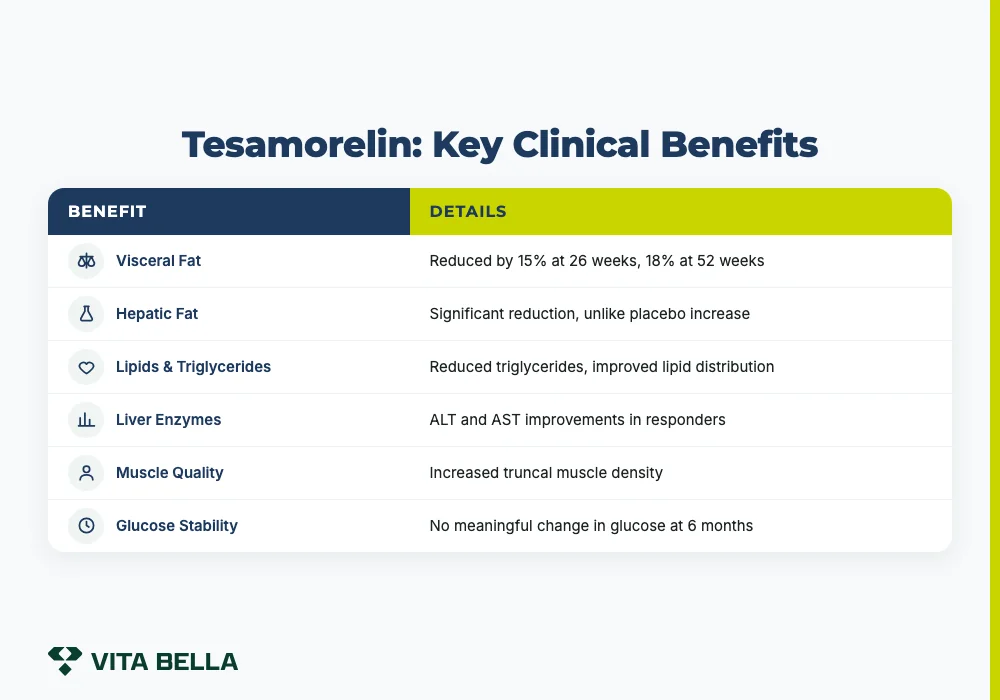
Clinical data, including a 2026 meta-analysis by Badran et al. in Obesity Research & Clinical Practice, confirms these outcomes across randomized controlled trials:
| Benefit | Evidence |
|---|---|
| Visceral fat reduction | ~15% at 26 weeks, ~18% at 52 weeks vs. placebo |
| Hepatic fat | Significant reduction vs. 27% increase in the placebo group |
| Lipids and triglycerides | Reduced triglycerides, improved lipid distribution in VAT responders |
| Liver enzymes | ALT and AST improvements in visceral fat responders |
| Muscle quality | Increased truncal muscle density indicating less intramuscular fat |
| Glucose stability | No clinically meaningful change in fasting or 2-hour glucose at 6 months |
These tesamorelin benefits are driven by the GH-IGF-1 mechanism, not caloric restriction or appetite suppression. They come primarily from studies in HIV-infected adults with abdominal lipodystrophy.
Does tesamorelin work for belly fat?
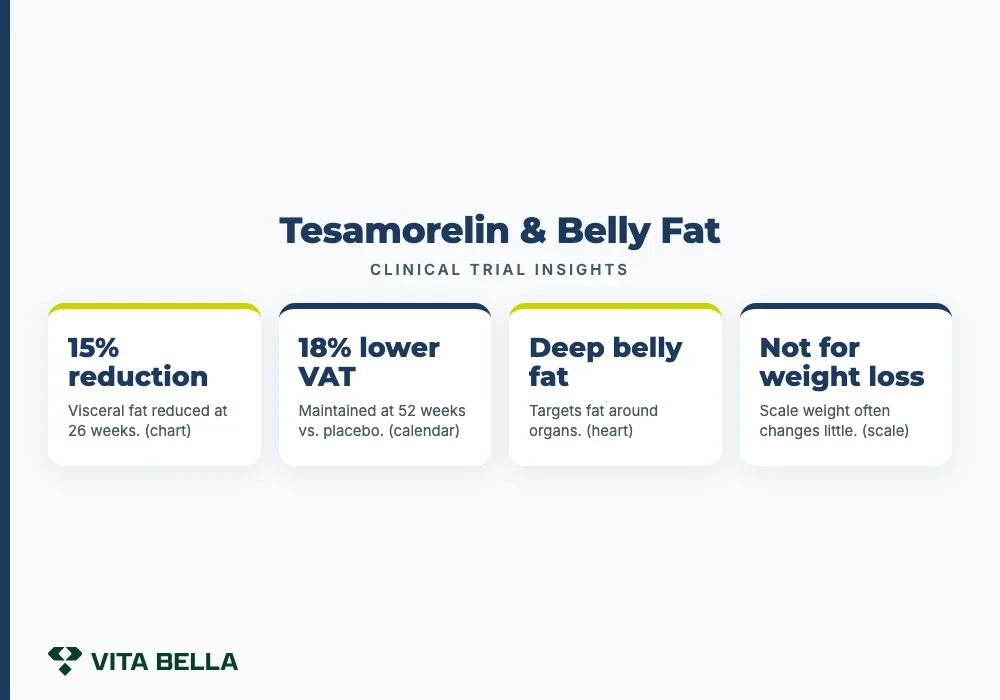
Yes. Tesamorelin visceral fat trials measured abdominal fat using imaging, not just waist circumference. A 2020 randomized clinical trial (Stanley et al., JAMA) reported a 15% reduction in visceral abdominal fat at 26 weeks. Participants who continued to 52 weeks maintained roughly 18% lower VAT versus placebo, while the untreated group continued to accumulate fat. The imaging data makes the effect concrete.
The reduction targets deep belly fat around organs. Subcutaneous fat distribution was largely unchanged. That reflects the mechanics of the GH-IGF-1 axis: growth hormone drives lipolysis most strongly in visceral depots.
People researching tesamorelin for weight loss should note it is not a conventional weight loss drug. Scale weight often changes little because lean mass is preserved or modestly increased while VAT falls. A 2026 systematic review by Ditta et al. confirmed consistent VAT reductions across multiple trials. The target is metabolic risk reduction, not the number on the scale.
How long does it take for tesamorelin to work?
Clinical trials confirm that tesamorelin benefits for visceral fat reduction become measurable within 3 to 6 months of consistent treatment. IGF-1 levels rise earlier, typically within the first weeks, confirming the hormone axis is responding before fat loss shows on imaging.
Individual timelines vary. Baseline IGF-1, degree of visceral fat accumulation, adherence to the injection schedule, and overall metabolic health all affect how quickly outcomes appear. There is no universal timeline. How body composition data informs treatment decisions matters more here than scale weight alone, since VAT can shift without meaningful changes in total body weight.
What are the side effects of tesamorelin?
Common tesamorelin side effects include injection-site reactions: redness, bruising, and discomfort at the subcutaneous injection point. These improve with technique and site rotation for most people.
Systemic reactions reported in trials include joint pain, fluid retention, and tingling or numbness in the extremities. These reflect GH-axis activation and often resolve with provider-guided dose adjustment. Tesamorelin is not associated with significant liver enzyme elevations, contrary to a common assumption.
Glucose monitoring is standard throughout treatment. Elevated GH can influence insulin sensitivity, and people with pre-existing insulin resistance require closer tracking. In trials running to 52 weeks, no clinically meaningful worsening of fasting or 2-hour glucose occurred under provider supervision.
Is tesamorelin safe for long-term use?
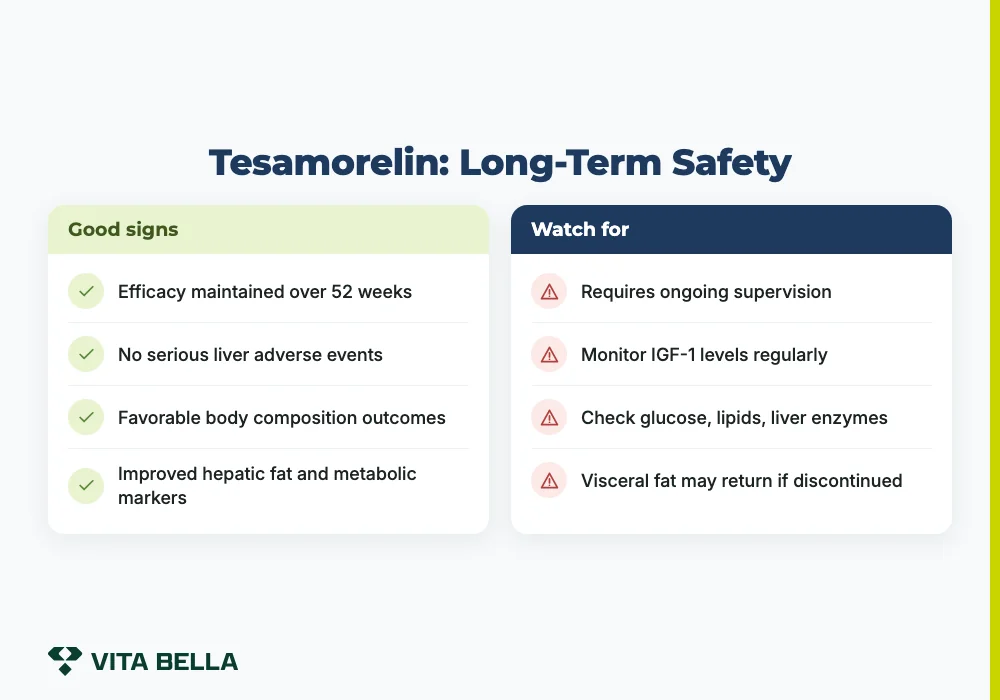
52-week trial data shows maintained efficacy without significant metabolic deterioration. A 2026 meta-analysis by Badran et al. covering multiple randomized controlled trials reported favorable outcomes for body composition, hepatic fat, and metabolic markers, with no pattern of serious adverse events tied to liver function.
Long-term use requires ongoing supervision. IGF-1 levels are monitored to keep them within healthy ranges. Glucose, lipids, and liver enzymes are checked at regular intervals. Tracking how tesamorelin benefits progress at each follow-up guides whether to maintain or adjust the protocol. If treatment is discontinued, visceral fat tends to return over time. That reversibility is part of the clinical conversation before you start.
Tesamorelin dosage: how a provider determines your dose
Tesamorelin dosage is not self-determined. A licensed provider evaluates your labs, health history, and existing metabolic status before recommending any protocol. Individual factors including IGF-1 baseline, current glucose control, and the presence of any contraindications all shape the dosing decision.
Before starting, baseline labs typically cover fasting glucose or HbA1c, a lipid panel, liver function, kidney function, and hormone levels. These establish whether treatment is appropriate and set the measurement baseline for tracking response. At Vita Bella, labs through Quest Diagnostics are part of the standard evaluation.
During treatment, the dosing strategy is adjusted based on follow-up IGF-1 and tolerability. The clinical goal is the effective minimum: enough to produce visceral fat reduction without pushing GH-IGF-1 levels beyond healthy ranges. Those dosage decisions belong to your provider.
Who should consider tesamorelin?
Tesamorelin holds regulatory clearance specifically for adults with HIV-associated lipodystrophy and excess abdominal fat. That population has the strongest clinical evidence. Beyond that indication, providers may consider it for people with significant visceral adiposity resistant to lifestyle intervention and elevated metabolic risk.
A 2025 randomized clinical trial by Ellis et al., published in the Journal of Infectious Diseases, found that adults with HIV and abdominal obesity showed reductions in waist circumference alongside IGF-1 improvements, pointing toward continued investigation of tesamorelin benefits in visceral fat management more broadly.
Matching tesamorelin benefits to your clinical profile
Practical fit matters. Good candidates commit to regular monitoring, ongoing injections, and provider check-ins. Contraindications including active malignancy, uncontrolled diabetes, and pituitary disorders are screened at evaluation. For those new to this category, an overview of how peptide treatments work in the body provides useful context before the clinical conversation.
Ready to find out if you qualify?
The tesamorelin benefits documented in clinical trials are real. Whether they apply to you depends on your labs, health history, and a licensed provider's evaluation. At Vita Bella, you pick your provider, and every step involves a real clinician.
Frequently asked questions
Tesamorelin stimulates the pituitary gland to release growth hormone, which raises IGF-1 and drives targeted breakdown of visceral fat around the organs. Clinical trials also show improvements in hepatic fat, lipid markers, and muscle quality alongside preserved lean body mass. These effects work through the GH-IGF-1 axis, not appetite suppression.
Clinical trials show tesamorelin reduces visceral abdominal fat by approximately 15% at 26 weeks and 18% at 52 weeks versus placebo in adults with HIV-associated lipodystrophy. The effect targets deep belly fat around organs, not subcutaneous fat. A 2026 systematic review confirmed consistent reductions across multiple trials.
The most common tesamorelin side effects are injection-site reactions, joint pain, and fluid retention, all reflecting GH-axis activation. Glucose monitoring is standard because elevated GH can affect insulin sensitivity. In trials up to 52 weeks, no significant worsening of liver enzymes or fasting glucose was observed under provider supervision.
IGF-1 levels typically rise within the first weeks of treatment, confirming the hormone axis is responding. Measurable visceral fat reduction usually appears within 3 to 6 months based on imaging and waist measurements from clinical studies. Individual response depends on baseline IGF-1, adherence, and other metabolic factors.
52-week trial data shows no clinically meaningful worsening of glucose, liver enzymes, or lipid markers. A 2026 meta-analysis confirmed favorable body composition and metabolic outcomes across multiple randomized trials. Ongoing provider monitoring of IGF-1, glucose, and liver function is required throughout treatment.
Sources
- Stanley TL et al. (2020). Effects of a growth hormone-releasing hormone analog on visceral fat and liver fat in HIV-infected patients: A randomized clinical trial. JAMA. PubMed
- National Institute of Diabetes and Digestive and Kidney Diseases (2018). Tesamorelin. LiverTox: Clinical and Research Information on Drug-Induced Liver Injury. PubMed
- Tesamorelin: liver enzyme and muscle quality outcomes. PubMed
- Ellis RJ et al. (2025). Effects of Tesamorelin on Neurocognitive Impairment in People with HIV and Abdominal Obesity: A Phase 2 Randomized Clinical Trial. Journal of Infectious Diseases. PubMed
- Badran AS et al. (2026). Body composition, hepatic fat, metabolic, and safety outcomes of Tesamorelin in HIV-associated lipodystrophy: A meta-analysis of randomized controlled trials. Obesity Research & Clinical Practice. PubMed
- Ditta AM et al. (2026). Efficacy and Safety of Tesamorelin in People Living With HIV With Lipodystrophy: A Systematic Review and Meta-Analysis. Journal of the International Association of Providers of AIDS Care. PubMed