


What if the key to breaking stubborn fat isn’t another diet but giving your liver the exact nutrients it needs to let go of it, finally? The MIC combination Methionine, Inositol, and Choline, commonly referred to as MIC injections or the “skinny shot,” has gained popularity because each nutrient plays an essential metabolic role in liver fat processing. When these compounds work together, they create a lipotropic effect, helping the body mobilize and export fat more effectively and efficiently.
If your weight-loss journey feels stalled, it’s not your fault. Sometimes your body simply needs the proper nutrients to burn fat. At Vita Bella, we focus on solutions that support real metabolic balance. Learn how MIC injections can enhance fat breakdown and improve liver health. Let’s unlock a smoother, more energized path to your goals.
Why Liver Support Matters for Weight Loss?
The liver controls the breakdown, transport, and export of fats. When it becomes overloaded or nutrient-deficient, fat accumulates more readily, slowing weight loss. It has been consistently shown that supporting liver lipid metabolism improves metabolic function, which directly influences weight-loss outcomes.
A recent study1 using NHANES 2017–2018 data showed that adults with the highest dietary choline intake when compared to the lowest choline intake, the highest choline intake status was linked to a reduced risk of NAFLD in both males (OR: 0.955, 95% CI: 0.953–0.958) and females (OR: 0.764, 95% CI: 0.762–0.766). This highlights how essential nutrients influence liver fat metabolism and why deficiencies make fat loss harder.
Is Methionine Essential for Methylation and Fat Breakdown?
Methionine is an essential amino acid involved in methylation, the process that activates metabolic pathways required for fat breakdown. It also supports the formation of S-adenosylmethionine (SAMe), which helps the liver process fats and detoxify metabolites. A human clinical review2 confirms that methionine deficiency increases susceptibility to liver fat accumulation, especially when choline is also insufficient.
Another human trial3 using methionine-rich diets showed improved fatty-liver index and reductions in central fat after 3 months of nutritional therapy in overweight adults with non-alcoholic fatty liver disease (NAFLD). This reinforces that methionine is a key resource the liver needs to process fat effectively and explains why mic injections often include this amino acid in their formulation.
How Does Inositol Improve Insulin, Liver Fat, and Weight-Related Markers in Humans?
Inositol, especially myo-inositol, has some of the strongest human data among the MIC trio. It also shows meaningful improvements in fasting insulin, HOMA-IR (The Homeostatic Model Assessment of Insulin Resistance), and liver fat grades with consistent supplementation. In a double-blind human trial4 of obese adults with NAFLD, 4 g/day of myo-inositol for 8 weeks resulted in:
Significant reductions in fasting insulin (p = 0.008)
Improved insulin resistance (HOMA-IR) (p = 0.046)
Reduced liver fat grade in one-third of participants
Because insulin resistance is a significant barrier to weight loss, improving insulin sensitivity increases fat mobilization. This directly strengthens the rationale behind MIC injection protocols that include inositol. Moreover, human studies show that inositol improves lipid profiles, lowers triglycerides, and enhances metabolic markers, all of which support weight-loss efforts.
How Essential Is Choline for Fat Export and Liver Protection?
Choline is essential for producing phosphatidylcholine, a molecule the liver needs to assemble and export fat via VLDL (very-low-density lipoprotein). Without enough choline, the liver cannot package and transport fat out of its cells. Choline deficiency is directly linked to fatty liver development in postmenopausal women, as shown by controlled studies and metabolic trials5.
Additionally, higher choline intake is associated with lower liver fat, better metabolic health, and lower cardiovascular disease risk. Because choline requirements are higher in women, especially during pregnancy, with hormonal changes, or on low-meat diets, maintaining sufficient levels is essential for liver fat clearance. This is why methionine, inositol, and choline injections may appeal to individuals struggling with nutrient gaps.
The Lipotropic Effect: Why Methionine + Inositol + Choline Work Better Together?
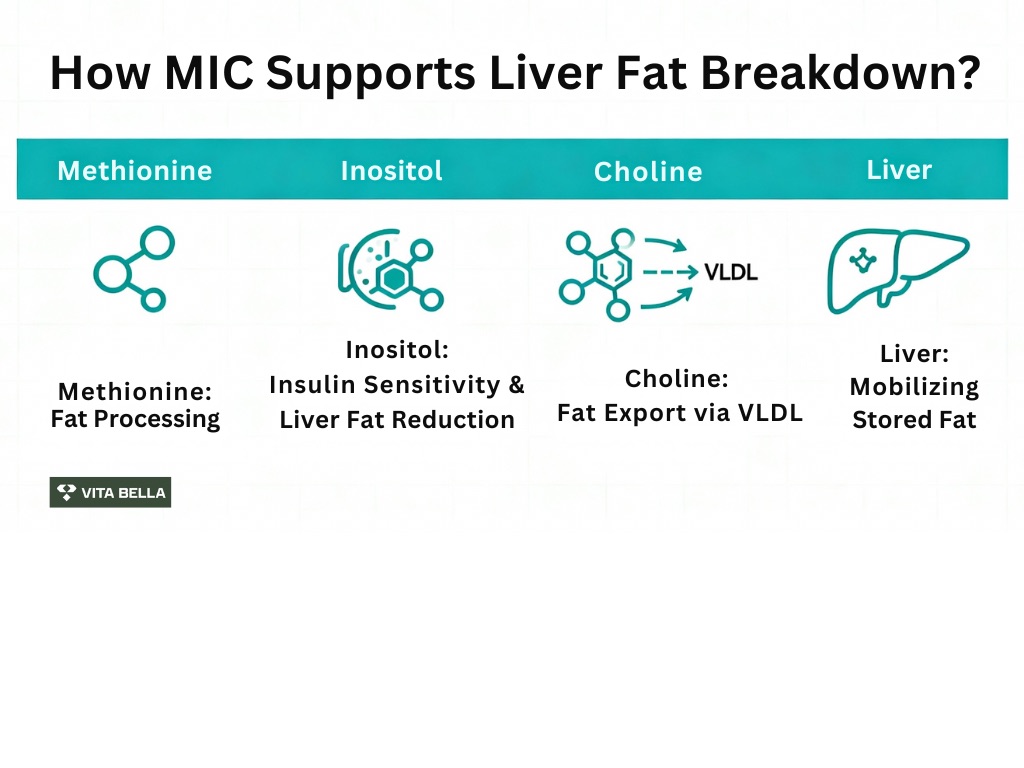
The MIC trio works synergistically because each nutrient supports a different part of fat metabolism. Methionine fuels methylation, inositol improves insulin sensitivity, and choline enables the liver to export fat through VLDL formation. When combined, they create a more substantial lipotropic effect that enhances fat mobilization more effectively than any single nutrient alone. Each nutrient supports liver-fat metabolism through a different mechanism:
Methionine: provides methyl groups for fat processing and detoxification.
Inositol: improves insulin sensitivity and supports lipid metabolism.
Choline: exports fat from the liver through VLDL formation.
These compounds act as lipotropic agents, helping prevent liver fat accumulation and enhancing fat transport. When used together, methionine, inositol, and choline provide the substrates and metabolic support needed to optimize fat metabolism. This synergy explains why mic injections often combine them rather than use a single nutrient alone.
Jumpstart Your Metabolism with Smart Liver Support with Vita Bella
Struggling to lose weight despite consistent effort and discipline? Your liver may be lacking the nutrients required to break down fat. This deficiency slows fat metabolism and promotes stubborn fat storage. The result? A metabolism that feels “stuck” no matter what you do. When your liver can’t keep up, your entire fat-loss journey feels harder than it should.
Vita Bella delivers precision MIC nutrients that jumpstart metabolic function. Our method supports liver performance, fat export, and energy balance. You’ll experience a more efficient, responsive fat-burning process. Jumpstart your metabolism today with Vita Bella’s MIC advantage. Give your body the metabolic reset it needs to work with you, not against you, finally.
Frequently asked questions
Yes, MIC injections support weight loss by supplying methionine, inositol, and choline, three nutrients that assist the liver with fat breakdown and export. Although they are not a standalone fat-loss treatment, these nutrients improve metabolic efficiency, insulin sensitivity, and liver fat clearance, helping individuals overcome plateaus when combined with diet and exercise.
Yes, MIC nutrients are known as lipotropic agents, meaning they help the liver process and transport fat more effectively. Human studies show that higher choline intake reduces the risk of fatty liver, while inositol improves insulin resistance and liver fat grades. By supporting these mechanisms, MIC can enhance liver performance, which is essential for long-term metabolic health.
Yes, MIC injections may be helpful because inositol, one of their key components, has demonstrated significant benefits for improving fasting insulin levels, HOMA-IR, and liver fat in human clinical trials. Since insulin resistance often slows fat loss, supporting insulin sensitivity through MIC can improve metabolic balance and enhance weight-loss outcomes over time.
Yes, women often experience hormonal shifts and nutrient gaps, especially those related to choline and methylation, which can affect liver fat processing. MIC injections provide these essential nutrients to support fat export, improve insulin control, and enhance metabolism. When paired with lifestyle changes, they may help women overcome slow, resistant fat loss linked to metabolic imbalance.
References:
Chai, C., Chen, L., Deng, M.-G., Liang, Y., Liu, F., & Nie, J.-Q. (2023). Dietary choline intake and non-alcoholic fatty liver disease (NAFLD) in U.S. adults: National Health and Nutrition Examination Survey (NHANES) 2017–2018. European Journal of Clinical Nutrition, 77, 1160-1166. https://doi.org/10.1038/s41430-023-01336-1
Morales-Romero, J., Ortíz León, M. C., Hernández-Gutiérrez, H., Bahena-Cerón, R. A., Miranda-Reza, A., Marin-Carmona, J. A., Rodríguez-Romero, E., Mora-Herrera, S. I., Garcia-Román, J., Pérez-Carreón, J. I., Rivadeneyra-Domínguez, E., Riande-Juárez, G., & Garcia-Román, R. (2023). Efficacy of nutrition therapy with food rich in methionine for treating nonalcoholic fatty liver. Archivos Latinoamericanos de Nutrición, 73(2), 122-134. https://doi.org/10.37527/2023.73.2.004
Arefhosseini, S., Roshanravan, N., Tutunchi, H., Rostami, S., Khoshbaten, M., & Ebrahimi-Mameghani, M. (2023). Myo-inositol supplementation improves cardiometabolic factors, anthropometric measures, and liver function in obese patients with non-alcoholic fatty liver disease. Frontiers in Nutrition, 10. https://doi.org/10.3389/fnut.2023.1092544
Guerrerio, A. L., Colvin, R. M., Schwartz, A. K., Molleston, J. P., Murray, K. F., Diehl, A. M., Mohan, P., Schwimmer, J. B., Lavine, J. E., Torbenson, M. S., & Scheimann, A. O. (2012). Choline intake in a large cohort of patients with nonalcoholic fatty liver disease. The American Journal of Clinical Nutrition, 95(4), 892-900. https://doi.org/10.3945/ajcn.111.020156