Testosterone decline in men is a slow, cumulative process that typically begins around age 30 and deepens over decades. Longitudinal research (Travison et al., 2007) confirms that production decreases steadily throughout life without a single abrupt drop. Because the changes are gradual, most men attribute early symptoms to ordinary aging rather than shifting hormone levels. A short hormone assessment shows where you actually stand.
By the time those symptoms become undeniable, the decline may have already accumulated significant health consequences.
Why are testosterone levels declining in men?
The answer combines biology with the modern environment.
Research from Current Diabetes Reviews (Saad et al., 2012) links rising obesity rates, reduced physical activity, chronic stress, and exposure to endocrine-disrupting chemicals to faster hormonal decline. These are compounding low testosterone causes that layer on top of what aging alone would produce.
Excess visceral fat interferes directly with testicular testosterone synthesis. Low testosterone then encourages further fat accumulation. That cycle worsens metabolic health and accelerates the hormonal drop.
Endocrine-disrupting chemicals found in plastics, pesticides, and personal care products mimic or block hormone signals at the receptor level. Chronic stress elevates cortisol, which suppresses the hypothalamic-pituitary signals that drive testosterone production. Over years, these factors compound and push men toward deficiency well before prior generations experienced it.
At what age does testosterone start to decline?
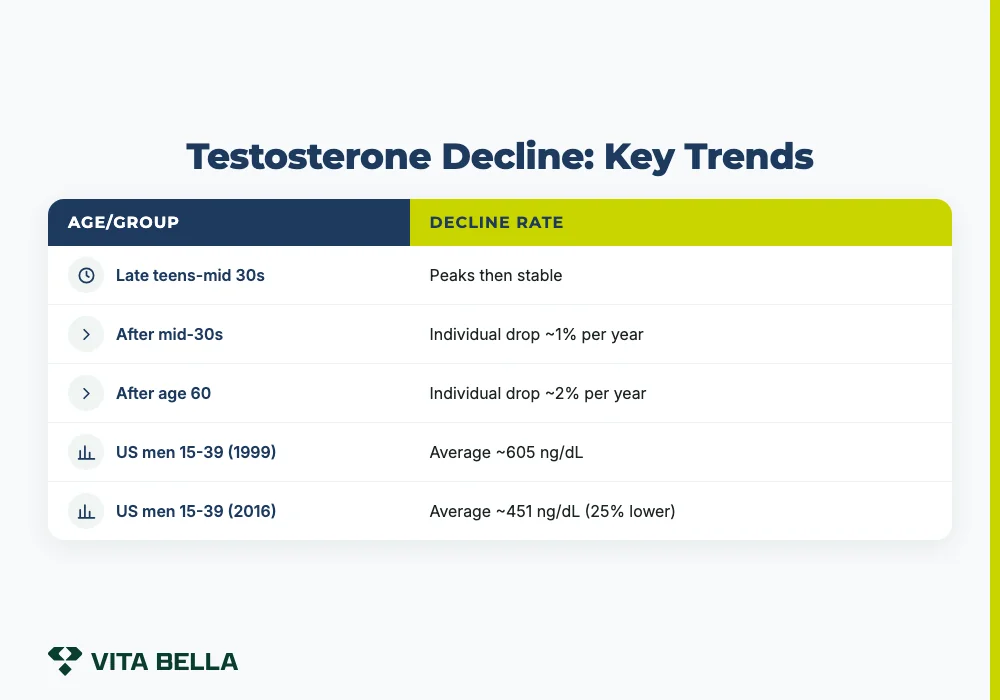
Testosterone peaks in the late teens and early 20s, then holds relatively stable into the mid-30s before beginning a consistent drop.
How fast does testosterone drop with age?
Longitudinal data from the Baltimore Longitudinal Study of Aging (Harman et al., 2001) puts the individual rate at roughly 1% per year after the mid-30s, accelerating to nearly 2% annually past age 60.
The population-level picture is more alarming. Data from Lokeshwar et al. (2020) shows that average testosterone in U.S. men aged 15 to 39 fell from approximately 605 ng/dL in 1999 to roughly 451 ng/dL by 2016. That is a 25% generational drop, and it held even after controlling for obesity and sleep quality.
The table below captures the key testosterone levels by age trends from that research.
| Group | Average testosterone | Rate of change |
|---|---|---|
| U.S. men 15–39, 1999 | ~605 ng/dL | Generational baseline |
| U.S. men 15–39, 2016 | ~451 ng/dL | ~25% lower, lifestyle-independent |
| Men 35–60 | Individual starting point | ~1% per year |
| Men 60 and older | Individual starting point | ~2% per year |
Sources: Harman et al., 2001; Lokeshwar et al., 2020
Men today start adult life with materially lower baseline levels than their fathers did. Stack that against the steady age-related drop, and many now reach clinically deficient levels a decade or more earlier than prior generations.
What are the early signs of low testosterone?
Early signs of low T are easy to dismiss individually. Each has an obvious alternative explanation.
Common low testosterone symptoms include:
- Gradual muscle loss despite consistent resistance training, reflecting reduced anabolic signaling rather than effort.
- Slower recovery after workouts, often attributed to overtraining or age.
- Persistent low motivation, irritability, or mild depression with no clear external cause.
- Increasing abdominal fat, particularly visceral fat, even without meaningful diet changes.
- Poor sleep quality or frequent nighttime waking, which further suppresses overnight testosterone production in a self-reinforcing cycle.
- Difficulty concentrating or persistent mental sluggishness that feels like stress rather than a hormone shift.
The pattern matters more than any single symptom. Gradual worsening across multiple areas over months or years is what points to testosterone decline in men rather than ordinary life circumstances.
The long-term stakes are concrete. Cattabiani et al. (2012) found that persistently low testosterone raises risk of cardiovascular disease, type 2 diabetes, and osteoporosis. Age-related muscle loss accelerates. Cognitive function can decline gradually, well before the effect becomes obvious.
Why "normal" lab results can still mask a problem
Reference ranges for testosterone are built from population averages. When those averages have dropped significantly across a generation, as Lokeshwar et al. (2020) documents, a man can test within the "normal" range while running well below what his body actually needs.
This is one of the least-discussed gaps in how deficiency gets detected. Understanding why "normal" lab values can miss real hormone decline is often the first step toward an accurate picture of where your levels actually stand.
How the testicular microenvironment drives decline
One mechanism behind testosterone decline in men that rarely gets covered involves not the hormone-producing cells themselves, but the environment surrounding them.
Inside the testes, Leydig cells synthesize testosterone. Sertoli cells support sperm development. A network of immune cells, blood vessels, and paracrine chemical signals coordinates the entire production system.
Research in Reproductive Biology and Endocrinology (Cheng et al., 2024) found something counterintuitive: Leydig cells isolated from older men can produce comparable testosterone to those from younger men under controlled laboratory conditions.
This points to the testicular microenvironment itself as a primary driver of age-related output loss. Changes in local signaling, reduced vascular supply, and shifts in immune activity limit testosterone production even when the Leydig cells remain functionally capable.
Source: Cheng et al. (2024), Reproductive Biology and Endocrinology
Can testosterone decline be managed naturally?
For some men, yes. How much depends on how much of the deficit is driven by modifiable factors versus age-related microenvironmental change.
Natural testosterone support starts with the fundamentals. Reducing visceral body fat removes one of the strongest suppressors of testicular output. Consistent resistance training two to four times per week raises both total and free testosterone.
Quality sleep, particularly reaching the deeper sleep stages consistently, supports the overnight production cycle during which most daily testosterone is replenished. Reducing chronic stress lowers cortisol, which competes with the hormonal cascade that triggers testosterone release.
Diet is also a factor. Adequate dietary fat, zinc, and vitamin D are required for testosterone synthesis. For practical guidance on foods shown to support healthy testosterone production, that resource covers specific targets and food sources.
These changes can meaningfully slow or partially address decline in men whose deficiency is substantially lifestyle-driven. For men with confirmed clinical low T, lifestyle change alone is rarely sufficient to fully restore levels or resolve symptoms.
When to consider clinical evaluation and TRT for low T
If you suspect low testosterone, a blood test measuring both total and free testosterone is the starting point. Ideally drawn in the morning, when levels peak naturally. A single reading may not be definitive, since levels can fluctuate with acute illness or stress.
For men with confirmed deficiency, TRT for low T has demonstrated improvements in body composition, insulin sensitivity, energy, and mood in clinical studies. Understanding how TRT compares to other hormone therapies helps clarify which approach fits your situation, goals, and history.
TRT is not the right path for every man. It requires ongoing monitoring, and the decision should be made with a clinician who can evaluate the complete picture rather than a single data point.
Start with a clear picture of where you stand
Testosterone decline in men accumulates quietly. By the time symptoms are undeniable, years of gradual change have often already passed. Acting before that point changes outcomes.
Get Started with a free assessment at Vita Bella and find out where your hormone levels actually stand.
Transform Your Life. You Owe It To Yourself. Get Started
Frequently asked questions
Most men begin experiencing measurable decline in the mid-30s, at roughly 1% per year according to Harman et al. (2001). Symptoms typically do not register until the 40s or later, though today's lower generational baselines mean signs of low T can appear earlier than in previous generations.
Yes. Testosterone influences neurotransmitter activity and cerebral blood flow, both of which affect cognitive function. Men with low T may notice brain fog, slower processing, or difficulty concentrating even when physical symptoms remain mild.
No. The rate of testosterone decline varies based on genetics, body composition, lifestyle, and overall health. Two men the same age can have substantially different levels, and the trajectory depends heavily on how many modifiable risk factors are present.
Yes. Low testosterone can reduce sperm production, impair sperm motility, and disrupt the hormonal environment needed for reproduction. Proper evaluation and appropriate treatment can help restore the hormonal conditions that support fertility.
For men whose low levels are substantially lifestyle-driven, yes. Research supports that weight loss, resistance training, improved sleep, and stress reduction each raise testosterone independently. The effect is most pronounced in men who are overweight, sedentary, or chronically sleep-deprived, and less significant in men with primary testicular dysfunction.
Sources
- Travison TG et al. (2007). A population-level decline in serum testosterone levels in American men. The Journal of clinical endocrinology and metabolism. PubMed
- Saad F et al. (2012). Testosterone as potential effective therapy in treatment of obesity in men with testosterone deficiency: a review. Current diabetes reviews. PubMed