Does melatonin lower testosterone? At typical over-the-counter doses, the limited human research, including a large US population analysis, has not linked melatonin use to lower testosterone in men. Animal and cell studies are mixed, and their species-specific effects have not been shown in men. If symptoms prompted the question, a hormone panel reviewed through provider-led hormone therapy answers it faster than any supplement audit.
What melatonin actually does in your body
Melatonin is produced by the pineal gland and released in a predictable nighttime surge that coordinates sleep timing across the body's tissues. It is also sold over the counter as a dietary supplement in the US, which is where most questions about melatonin and testosterone begin. The key issue is the difference between what the body produces naturally and what a supplement delivers in timing and magnitude.
Endogenous melatonin vs. melatonin supplements
In humans, the pineal gland's nightly signal works mainly as a timekeeping cue; a testosterone-suppressing role has not been shown. Your body produces melatonin in small amounts during darkness to signal sleep onset to the brain and peripheral tissues. A supplement dose differs in magnitude and in timing relative to light exposure, which is why animal studies in photoperiod-sensitive species under controlled light conditions do not map cleanly onto a person using an over-the-counter supplement.
- Endogenous melatonin is produced by the pineal gland in response to darkness and peaks in the middle of the night.
- Supplement doses are typically many times larger than the body's nightly output and are consumed at a fixed clock time rather than in direct response to light cues.
- In humans, the established role of endogenous melatonin is circadian timekeeping and sleep coordination; a direct role in regulating testosterone or gonadotropins has not been established.
- Melatonin is a hormone, but over-the-counter melatonin in the US is regulated as a dietary supplement, so it does not go through the FDA premarket review required for prescription medications.
- Most reproductive research on melatonin draws from photoperiod-sensitive animals, where it drives seasonal breeding cycles, a mechanism with limited human relevance.
Does melatonin lower testosterone? The direct answer
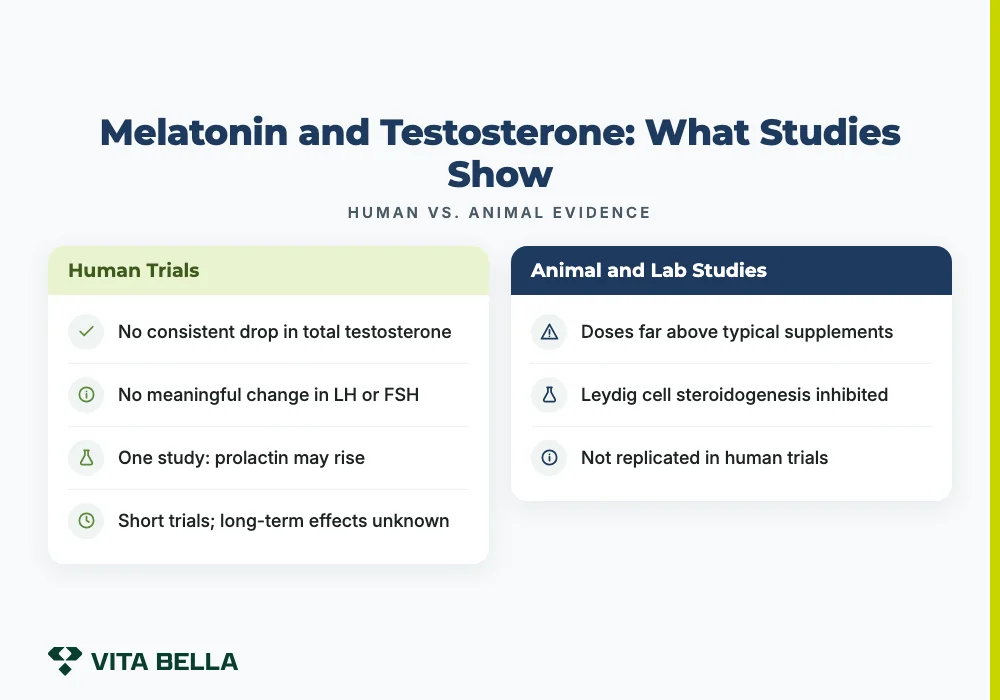
Current human evidence does not show that melatonin supplements reliably lower testosterone at low doses. A more complicated picture emerges in animal and cell culture studies, where effects vary by species, and those results have not been shown in human studies. Most of the human data is observational or comes from very small studies, so any answer here is a limited one.
What human studies found
A 2022 analysis by Zizzo et al. in Urology (PubMed PMID 35963395) used US national health survey data (NHANES 2011 to 2016) from 7,656 men and found no association between recent melatonin use and low total testosterone (below 300 ng/dL). Only about 0.7% of the men reported melatonin use, mostly at low doses, and the study did not measure LH or FSH.
Does taking melatonin lower testosterone at typical supplement amounts? This observational data does not support that conclusion, but it cannot prove cause and effect, and the authors call for further study of higher doses and longer exposure.
What human research has found, and what it has not:
- Observational data from a large US survey has not found an association between mostly low-dose melatonin use and low total testosterone.
- A small double-blind, placebo-controlled trial in six healthy adult men (Luboshitzky et al., 2000) found no change in LH, FSH or testosterone after one month of daily melatonin.
- The available studies do not establish that melatonin benefits testosterone, only that it has not demonstrated suppression at the doses tested.
- Existing human studies are small, short, or observational, so long-term effects remain unresolved.
- These findings also cannot be compared directly with animal research, where species and study conditions differ substantially from typical over-the-counter supplement use.
What animal and lab studies found
A 2018 review by Yu et al., published in Molecules (PMC6017169), examined how melatonin regulates steroid hormone synthesis in male reproduction. In animal and lab studies, the effect depended on the species: melatonin reduced testosterone production in long-day seasonal breeders such as Syrian hamsters and in a mouse Leydig cell line, but increased it in short-day breeders such as sheep and goats.
Leydig cells are the primary testosterone-producing cells in the testes, so this mechanism matters at a cellular level. The critical limitation is that these species-specific, photoperiod-driven findings do not map directly onto men, and the review does not establish that over-the-counter melatonin suppresses testosterone in humans.
The prolactin connection
A small 1984 study by Waldhauser et al., published as an abstract in Pediatric Research, found that a single high dose of melatonin, far larger than typical supplement doses, raised prolactin in healthy adolescent males without changing their testosterone or gonadotropins. One small study does not settle anything, but it raises a different question.
Does melatonin lower testosterone directly? The limited human data suggests it does not at low doses. Does melatonin affect testosterone indirectly, through the prolactin-LH pathway? That question is still open.
Why elevated prolactin matters for men's hormones
Testosterone production follows a signaling chain. The hypothalamus releases GnRH, which signals the pituitary to release LH, and LH travels to the Leydig cells to stimulate testosterone synthesis.
Persistently high prolactin (hyperprolactinemia), from any source, can suppress GnRH signaling from the hypothalamus, which lowers LH and, downstream, testosterone production. That is why clinicians often check prolactin when testosterone is low and LH is low or low-normal.
The Waldhauser study found a modest average prolactin increase (from 4.6 to 7.6 ng/mL) after a single high dose, without a change in testosterone or gonadotropins, so the clinical significance of regular use at typical supplement doses is not established. One study is not a verdict. What it does signal is that anyone managing a hormone protocol should disclose all supplements, including melatonin, so the provider can decide whether prolactin belongs on the next lab panel.
Estrogen, sperm quality and longer-term use
Does melatonin lower testosterone over months of daily use? One small 6-month trial points instead to estrogen and sperm quality as the more open questions. In that double-blind, placebo-controlled crossover study, Luboshitzky et al. (2002, Journal of Andrology) tracked semen quality, estradiol, testosterone and gonadotropins in 8 healthy men.
Six of the men showed no change in semen quality or hormone levels. In the other 2, sperm concentration and motility fell during the melatonin period, along with lower estradiol in blood and seminal fluid. Gonadotropins stayed unchanged in all 8 men. Six months after stopping, one man's semen quality had returned to normal and the other's had not.
The authors called these observations preliminary and suggested that melatonin may inhibit aromatase, the enzyme that converts testosterone into estrogen, in the testes. Findings in 2 men are a signal, not a proven effect. For men with fertility goals, it is one more reason to include melatonin on the supplement list a provider reviews.
Does melatonin mess with testosterone?
Not directly, based on the limited human data covered above. The better-documented link is between sleep itself and testosterone, and the article on how sleep affects testosterone levels covers that relationship in detail.
For melatonin's use as a sleep-timing supplement, the sleep health education page is a useful reference. Whether melatonin makes sense for a specific sleep problem is a decision to make with a licensed provider, not from a supplement label.
Should men on hormone therapy take melatonin?
This is a provider conversation, not a universal yes or no. Does melatonin reduce testosterone in someone already on an active hormone protocol? The current evidence does not establish that it does.
Still, the question is more nuanced for anyone whose hormone levels are being actively managed. The Endocrine Society's clinical practice guideline (Bhasin et al., 2018) recommends that men on testosterone therapy be monitored with a standardized plan that includes evaluating symptoms, adverse effects, and serum testosterone. Any supplement that touches sleep, prolactin, or pituitary signaling belongs in that review.
This article is informational and does not recommend starting or stopping melatonin. The guidance below reflects what a productive provider conversation looks like.
What to discuss with your provider before adding melatonin
- Your current hormone panel values, such as total and free testosterone, plus LH or prolactin if they were measured, give a baseline for evaluating any supplement's effect over time.
- The specific sleep complaint you are addressing matters, since sleep-maintenance problems and sleep-onset problems may have different hormonal roots worth ruling out first.
- All other supplements and medications in your stack should be disclosed, so the provider can review them alongside your labs.
- The timing of any new supplement relative to your next lab draw matters, since adding a variable before labs makes results harder to interpret accurately.
- Ask whether a quarterly check-in is the right time to introduce a new supplement, or whether waiting until labs confirm your current baseline makes more sense.
If you are already managing testosterone levels, a quarterly provider check-in is the right place to review any supplements in your stack. Vita Bella connects members with licensed providers for 1:1 hormone care, and you can bring your full supplement list to every check-in.
How to tell whether your testosterone is actually low
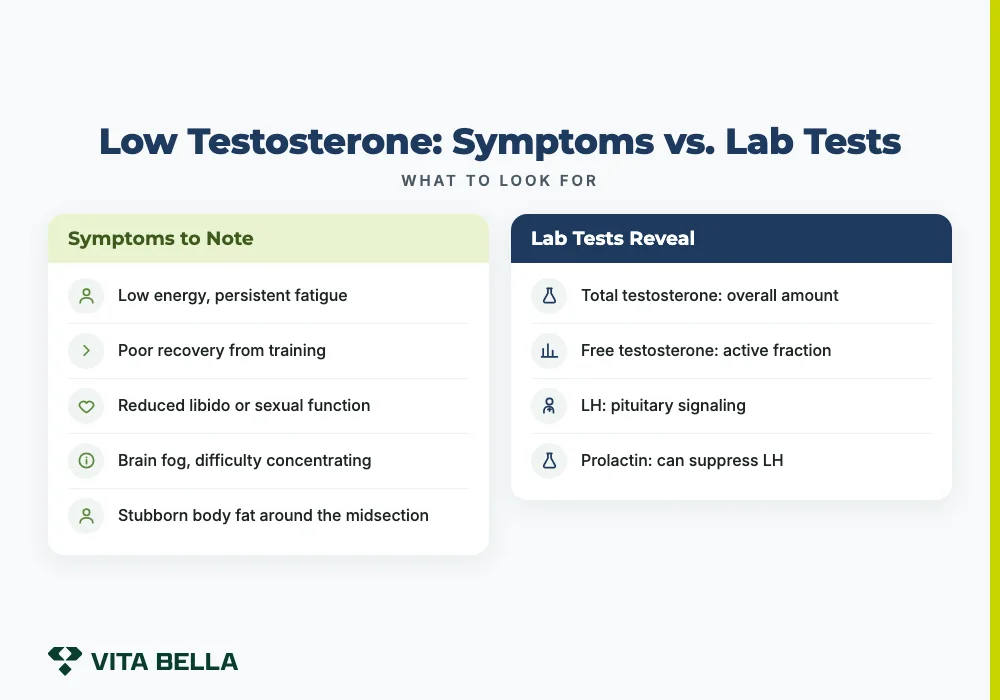
Questions like does melatonin lower testosterone often start with symptoms such as low energy, low libido or poor recovery. Does melatonin decrease testosterone at typical doses? Human evidence does not support that claim.
But the symptoms driving the concern could reflect low testosterone, poor sleep, elevated stress, or a combination of all three. Per the AUA guideline on testosterone deficiency (Mulhall et al., 2018), symptoms alone do not establish a diagnosis; it also requires low total testosterone confirmed on repeat early-morning lab tests.
Symptoms that may signal low testosterone:
- Low energy and persistent fatigue that does not resolve with adequate sleep may indicate reduced testosterone production.
- Poor recovery from training or physical work, including slower muscle repair and prolonged soreness, may reflect a hormonal deficit.
- Reduced libido or changes in sexual function are among the most consistent self-reported indicators of low testosterone in men.
- Brain fog and difficulty concentrating can accompany testosterone decline, particularly in men over 40.
- Mood dips or low motivation that is not explained by life circumstances may have a hormonal component worth investigating.
- Stubborn body fat around the midsection that resists consistent diet and exercise may warrant a hormonal evaluation.
- Strength loss or difficulty maintaining lean muscle despite training may point to a testosterone or anabolic hormonal issue.
What a hormone panel can reveal:
- Total testosterone measures the overall amount in circulation and is the starting point for any evaluation.
- Free testosterone reflects the biologically active fraction not bound to proteins and often tells a clearer story than total T alone.
- LH shows whether the pituitary is signaling properly to the testes and helps distinguish the type of hormonal deficit.
- Prolactin, when persistently high, can suppress LH and lower testosterone indirectly, which is why the AUA guideline recommends checking it in men with low testosterone and low or low-normal LH.
- SHBG affects how much free testosterone is available and can change the interpretation of total testosterone results significantly.
- Estradiol tracks aromatization of testosterone into estrogen, which is relevant to the full hormonal picture, particularly at higher testosterone levels.
For context on what lab results mean beyond the reference range, the article on when "normal" labs still leave you feeling suboptimal covers that distinction in detail. Members ordering labs through a provider-reviewed membership program receive interpretation in the context of their full clinical picture, with labs ordered through Quest Diagnostics and billed separately from the membership fee.
Ready to know where your testosterone actually stands?
Asking whether melatonin can decrease testosterone is less useful than knowing your actual numbers. Vita Bella connects members with licensed providers who review your hormone labs before any protocol begins. Labs are ordered through Quest Diagnostics, billed separately from the membership fee, and reviewed during a 45-minute initial consultation, with quarterly provider check-ins following.
- Provider-supported programs designed around your lab values, not general symptom checklists.
- Discreet shipping from FDA-inspected U.S. pharmacies.
- 1:1 provider care every quarter to monitor and adjust your protocol.
- Free injection supplies.
- Member wholesale pricing on medications, billed separately from the membership fee.
Frequently asked questions
An analysis of US survey data (PMID 35963395) found no association between mostly low-dose melatonin use and low testosterone in men, though it is observational and cannot prove cause and effect. Animal and cell research (Yu et al., PMC6017169) shows inhibitory or stimulatory effects depending on the species, and those findings have not been shown to apply to men. If you have symptoms of low testosterone, labs show where your levels actually stand.
There is no strong human evidence that melatonin supplements reliably raise testosterone. Some animal and cell-culture studies, mostly in seasonally breeding species such as sheep and goats, suggest melatonin can increase testosterone production under certain conditions, but those findings cannot be generalized to humans. A licensed provider can assess your hormone levels and identify what is actually driving your results.
A small 1984 study by Waldhauser et al. in Pediatric Research found that a single high dose of melatonin raised prolactin in healthy adolescent males without changing testosterone or gonadotropins. Chronically elevated prolactin can suppress the LH signal that drives testosterone production in men. A provider can decide whether a prolactin test makes sense based on your other lab results.
At typical supplement doses, current human data does not show that melatonin reliably harms testosterone levels. Concerns about Leydig cell suppression come primarily from studies in seasonally breeding rodents and cell lines, which do not translate directly to over-the-counter use in men. A provider can run a hormone panel to distinguish any supplement effect from an underlying deficiency.
That decision belongs with the provider managing your hormone protocol, who can review your full panel and all active supplements together. Bring your full supplement list to the initial consultation and to quarterly provider check-ins so it can be reviewed alongside your labs. The current research does not settle this question, so an individualized review matters more than any general rule.
Sources
- Zizzo J et al. (2022). Impact of Low-Dose Melatonin Supplementation on Testosterone Levels in U.S. Adult Males. Urology. PubMed
- Waldhauser F et al. (1984). Melatonin does not alter human serum gonadotropin and testosterone levels, but it increases prolactin levels. Pediatric Research (abstract). Nature
- Yu K et al. (2018). Melatonin Regulates the Synthesis of Steroid Hormones on Male Reproduction: A Review. Molecules. PMC
- Bhasin S et al. (2018). Testosterone Therapy in Men With Hypogonadism: An Endocrine Society Clinical Practice Guideline. J Clin Endocrinol Metab. PubMed
- Mulhall JP et al. (2018). Evaluation and Management of Testosterone Deficiency: AUA Guideline. J Urology. PubMed
- Luboshitzky R et al. (2000). Long-term melatonin administration does not alter pituitary-gonadal hormone secretion in normal men. Human Reproduction. PubMed
- Luboshitzky R et al. (2002). Melatonin administration alters semen quality in healthy men. Journal of Andrology. PubMed