
Enclomiphene side effects are generally mild and infrequent, with headaches, hot flashes, and occasional nausea cited most often in published human trials. Serious or treatment-limiting events are rare. Most men who begin this SERM for low testosterone stay on therapy through the initial phase without interruption. If you are exploring hormone therapy options and want to understand the full safety picture before deciding, the clinical data gives you a clearer answer than anecdote does.
How enclomiphene works as a SERM
Enclomiphene is the trans-isomer of clomiphene citrate and belongs to the drug class called selective estrogen receptor modulators, or SERMs. Its mechanism defines the enclomiphene side effects profile. The drug blocks estrogen receptors at the hypothalamus and pituitary, which removes estrogen's suppressive feedback on the hormone axis. In response, the pituitary releases more LH (luteinizing hormone) and FSH (follicle-stimulating hormone), and those signals drive the testes to produce testosterone naturally.
This matters for two reasons. First, the hormone rise comes from within. The body's own axis stays active, so sperm production continues rather than being shut down the way exogenous testosterone shuts it down. Second, enclomiphene acts primarily at the brain-level receptors rather than at peripheral estrogen receptors in tissue. Estradiol rises far less than it does with racemic clomiphene, as a 2024 narrative review by Saffati et al. in Translational Andrology and Urology confirmed across comparative cohorts.
Racemic clomiphene contains two isomers: the trans-isomer (enclomiphene) and the cis-isomer (zuclomiphene). The cis-isomer is weakly estrogenic and lingers in tissue for weeks. Removing it is exactly what separates enclomiphene from its parent compound and, consequently, what shapes a cleaner enclomiphene side effects profile.
For a detailed look at how the drug works pharmacologically and what a provider monitors during treatment, how enclomiphene works and what to expect covers the mechanism in clinical terms.
Enclomiphene side effects at a glance
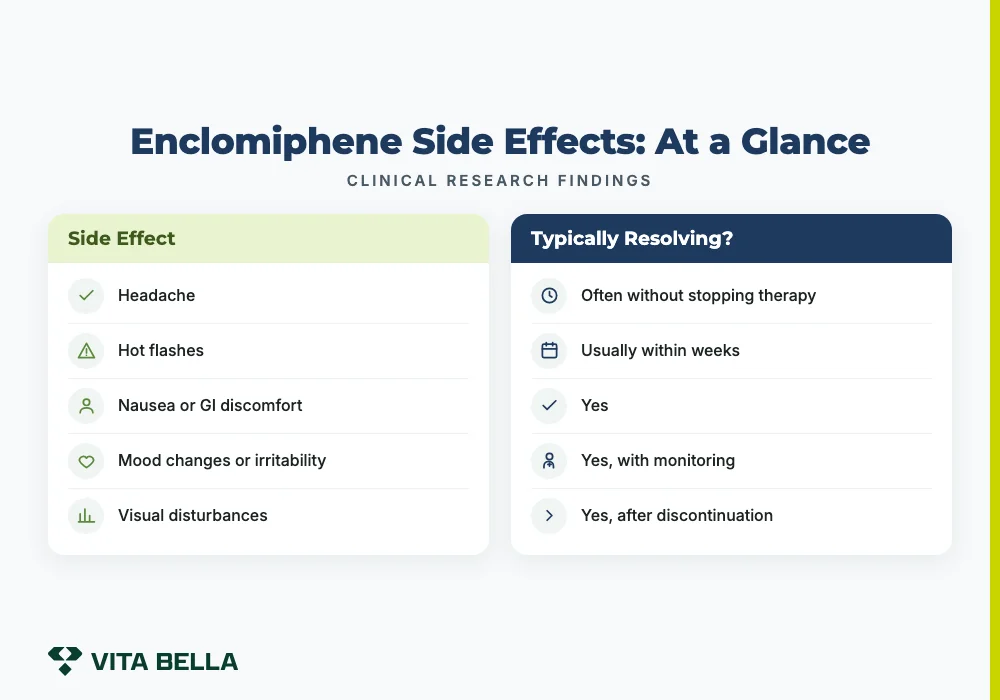
The table below draws directly from peer-reviewed human trial data. Every item on it appeared in at least one published study.
| Side effect | How often reported | Typically self-resolving? |
|---|---|---|
| Headache | Most commonly reported | Yes, often without stopping therapy |
| Hot flashes | Commonly reported | Yes, usually within weeks |
| Nausea or GI discomfort | Less common | Yes |
| Mood changes or irritability | Uncommon | Yes, with monitoring |
| Visual disturbances | Rare | Yes, after discontinuation |
| Elevated estradiol | Less frequent than with clomiphene | Managed with follow-up labs |
| Breast tenderness or gynecomastia | Very rare | Varies |
No treatment-limiting adverse event was classified as severe in the enclomiphene human study literature, per the 2013 pharmacodynamic study by Wiehle et al. in BJU International and the 2024 Saffati et al. review. That track record separates enclomiphene from older hormone agents with heavier safety burdens.
Does enclomiphene cause headaches?
Yes. Enclomiphene headaches are the most consistently reported side effect across published trials, but they fall firmly in the mild-to-moderate category and rarely cause men to stop treatment. In the comparative cohort data analyzed by Saffati et al. (2024), headache appeared more often with enclomiphene than with placebo but did not reach a frequency or severity that drove discontinuation across the reviewed studies.
Why do enclomiphene headaches happen? The leading explanation is vascular. When LH and FSH rise sharply in the first weeks of therapy, testosterone climbs quickly, and the circulatory system adjusts to a new hormonal environment. That adjustment can produce a transient tension-type headache. It is not a sign of toxicity or organ strain.
Timing tells a lot. Enclomiphene headaches cluster in the adjustment phase, typically the first few weeks. Men who move through that period without stopping often find the headaches diminish as hormone levels stabilize. That said, persistence or increasing severity should be reported to your provider rather than dismissed. A licensed provider reviews your testosterone and estradiol from labs and determines whether a dose adjustment is warranted.
One practical note worth making: dehydration amplifies hormonally triggered headaches. Men who are active and do not hydrate adequately during the first weeks of treatment may experience more noticeable enclomiphene headaches than the clinical trial data predicts. Correcting hydration before concluding the drug is the problem is worth doing first.
Enclomiphene headaches also appear less frequently and with less severity than headache complaints reported with racemic clomiphene, where the cis-isomer's prolonged tissue presence is believed to contribute an additional estrogenic load.
Enclomiphene mood swings and emotional changes
Enclomiphene mood swings are uncommon in published data. The mechanism by which they can occur is worth explaining because it shapes how a provider and patient should interpret any emotional changes that appear during treatment.
That distinction matters. In the human studies analyzed by Saffati et al. (2024) and Kaminetsky et al. (2013), mood-related adverse events were infrequent and were not classified as severe. Clomiphene carries a heavier track record of mood complaints, particularly irritability and emotional variability, which most researchers attribute to the cis-isomer acting on estrogen receptors in the central nervous system. Enclomiphene, stripped of that cis-isomer, carries a lower predicted risk of CNS estrogen-related effects.
The more common clinical scenario is actually the opposite of mood worsening. Men entering treatment with untreated secondary hypogonadism often experience low mood, low motivation, and emotional flatness as part of the symptom constellation of low testosterone. As testosterone normalizes over the first weeks of enclomiphene treatment, those symptoms frequently improve. The distinction between mood worsening caused by the drug and mood improving unevenly as the underlying condition resolves is important and not always obvious without labs.
Estradiol is the variable to watch. Even with a drug that raises estradiol less than clomiphene, some men will see estradiol drift upward above a comfortable range if their individual metabolism converts testosterone to estrogen efficiently. When estradiol climbs too high, irritability and mood instability can appear even as total testosterone looks favorable. That is exactly why follow-up labs measure both, not testosterone alone.
If enclomiphene mood swings appear and persist beyond the first few adjustment weeks, inform your provider. Stopping therapy without a lab check and a clinical conversation is rarely the right first move.
Enclomiphene visual disturbances
Enclomiphene visual disturbances are rare, and that rarity is clinically significant when placed next to clomiphene's decades-long record on vision.
Racemic clomiphene carries a documented risk of blurred vision, light sensitivity, floaters, and in uncommon cases persistent visual changes that outlast the drug's use. The proposed mechanism involves the cis-isomer's affinity for estrogen receptors in the retina and visual pathway. Enclomiphene, as the pure trans-isomer, binds far less aggressively at those peripheral sites. The same structural feature that reduces estrogenic side effects elsewhere reduces the visual risk too.
In the enclomiphene human study literature reviewed for this article, visual symptoms appeared infrequently and resolved after discontinuation in every documented case, per Kaminetsky et al. writing in The Journal of Sexual Medicine (2013). No severe or irreversible visual event was attributed to enclomiphene in any peer-reviewed source cited here.
That said, enclomiphene visual disturbances warrant prompt reporting when they do occur. Any visual change during treatment is a signal your provider needs to know about immediately. The evidence suggests enclomiphene visual disturbances are uncommon and short-lived, but no symptom affecting vision should be observed passively without a clinical evaluation.
Can enclomiphene cause erectile dysfunction?
No, enclomiphene does not typically cause erectile dysfunction. The more accurate framing is the opposite: for men whose erectile function is compromised partly by low testosterone, enclomiphene addresses a root cause rather than creating a new one.
Testosterone supports erections through multiple pathways. It maintains nitric oxide synthase expression in penile tissue, supports libido at the level of the central nervous system, and contributes to the vascular tone that erectile function depends on. When testosterone falls below the physiological range, those pathways weaken. Low testosterone is not the only driver of erectile dysfunction, but it is a real contributor in men with secondary hypogonadism.
In the 2016 randomized trial by Kim, McCullough, and Kaminetsky published in BJU International, oral enclomiphene normalized testosterone in obese hypogonadal men and the study reported improvements in subjective sexual function alongside the hormone response. No increased incidence of erectile dysfunction was attributed to enclomiphene in any published human study.
One nuance matters here. If estradiol climbs too high during enclomiphene treatment, it can suppress libido and contribute to softer erections even while total testosterone is rising. Elevated estradiol competes with testosterone signaling at the tissue level and can produce symptoms that look like the drug failing when the actual issue is an estradiol-to-testosterone imbalance. That is why a provider monitors both values at follow-up.
Getting the full picture of what hormone labs mean requires reading them in context, not in isolation. Understanding what the complete hormone panel reveals beyond a single testosterone number is relevant here, and what the complete hormone panel reveals beyond total testosterone explains why one number alone often tells an incomplete story.
Men with erectile dysfunction alongside low testosterone frequently face a mixed picture: hormonal, vascular, and psychological components all potentially at play. Enclomiphene addresses the hormonal piece. Whether additional support is needed is a question for your provider after labs establish the baseline.
Is enclomiphene safer than clomiphene?
Enclomiphene vs clomiphene safety is the most clinically relevant framework for placing enclomiphene in the broader landscape of hormone-modulating options for men. The comparative evidence consistently favors enclomiphene across every adverse event category that has been directly examined in published data.
The molecular reason is specific. Clomiphene citrate is a racemic mixture: roughly half enclomiphene (trans-isomer) and half zuclomiphene (cis-isomer). The trans-isomer drives the therapeutic benefit, stimulating LH and FSH, and then clears from the body relatively quickly. The cis-isomer is weakly estrogenic and has a much longer half-life, persisting in tissue for weeks. Most of clomiphene's estrogen-driven problems trace back to zuclomiphene: gynecomastia, mood instability, visual symptoms, and the disproportionate estradiol elevation that turns some men away from clomiphene use.
Enclomiphene removes the cis-isomer from the equation. The 2024 review by Saffati et al. in Translational Andrology and Urology analyzed comparative cohorts and found that enclomiphene produced lower estradiol elevations and fewer estrogen-driven adverse events than clomiphene across the studies reviewed. That finding is the empirical anchor for enclomiphene vs clomiphene safety comparisons.
Three specific comparisons illustrate the difference:
Gynecomastia. With clomiphene, sustained estradiol elevation increases the risk of breast tissue growth, and the condition is a documented clinical concern. With enclomiphene, estradiol rises less and gynecomastia is classified as very rare in the clinical literature. The mechanism that produces that difference is the absence of the cis-isomer.
Visual symptoms. Enclomiphene visual disturbances are rare and reversible in all documented cases. Clomiphene's visual problems are more frequent and, in a subset of documented cases, have persisted after stopping the drug. On the dimension of visual safety, the enclomiphene vs clomiphene gap is meaningful for clinical decision-making.
Tolerability over time. Kaminetsky et al. in The Journal of Sexual Medicine (2013) described enclomiphene as a practical first-line option partly because its adverse event rate was lower than comparable protocols with other agents. Men are more likely to remain on enclomiphene without treatment interruption than on clomiphene, based on the comparative cohort data.
None of this means enclomiphene is side effect free. It means the side effects enclomiphene does produce tend to be milder, shorter-lived, and more manageable under routine monitoring than what clomiphene historically produces.
Does enclomiphene affect sperm count or fertility?
Enclomiphene and fertility have an unusual relationship: unlike virtually every other testosterone-raising intervention, enclomiphene preserves and in many cases improves sperm production rather than suppressing it.
Standard testosterone replacement therapy (TRT) works by supplying androgens from outside the body. The hypothalamus reads that external testosterone, suppresses GnRH, and LH and FSH fall sharply. Without gonadotropin signal, the testes stop driving spermatogenesis. Sperm suppression can be profound, often dropping counts below fertile range within months of starting therapy. Recovery after stopping TRT takes many months and may not return to pre-treatment levels.
Enclomiphene does the opposite. It raises LH and FSH, which simultaneously drives both testosterone production and spermatogenesis upward. This is the mechanism that makes enclomiphene and fertility compatible rather than in conflict. In a randomized trial published in BJU International (2016), Kim, McCullough, and Kaminetsky showed that oral enclomiphene normalized testosterone in obese hypogonadal men while maintaining sperm count and motility at levels comparable to baseline. In a separate study published in Fertility and Sterility, Wiehle et al. (2014) confirmed that enclomiphene stimulated testosterone production while preventing oligospermia, the clinical term for abnormally low sperm concentration.
Those two findings together are what make enclomiphene and fertility a different clinical story from TRT and fertility. Men on testosterone therapy who want to father children typically face a forced trade-off: the therapy that corrects low testosterone actively undermines the hormonal signals needed for conception. Men on enclomiphene, based on the published trial data, do not face that same trade-off because the therapy works through the very signals that sustain spermatogenesis.
For men weighing how different testosterone-related protocols handle reproductive outcomes, sperm outcomes on testosterone treatment lays out the practical differences between approaches.
One caveat: enclomiphene and fertility outcomes depend on the underlying cause of low testosterone. If low sperm count results from primary testicular failure rather than secondary hypogonadism, enclomiphene's mechanism does not apply. The testes must be capable of responding to gonadotropin stimulation for the drug to work. A provider evaluates this with baseline labs that include LH, FSH, testosterone, and semen analysis before recommending any protocol.
What are the long-term side effects of enclomiphene?
Long-term enclomiphene side effects remain genuinely uncertain, and that uncertainty deserves honest acknowledgment rather than minimization. The published clinical trial literature covers treatment periods ranging from weeks to several months. Multi-year safety data in human subjects does not appear in the peer-reviewed sources reviewed for this article.
What the medium-term data shows is reassuring within its limits. No cumulative toxicity, organ-level damage, or irreversible adverse events appeared in comparative cohorts tracked for up to six months across the studies by Wiehle et al., Kim et al., and the 2024 Saffati et al. analysis. That is a meaningful data point. Hematocrit, which can rise dangerously with exogenous testosterone because androgens stimulate red blood cell production, is not a documented concern with enclomiphene in the same way. The mechanism that keeps enclomiphene's hematocrit profile clean is the same one that makes it structurally different from TRT: the drug does not introduce exogenous androgens. It stimulates the body's own production within a range the body's own axis helps regulate.
Long-term estrogen receptor modulation at the hypothalamic-pituitary level is an area where ongoing monitoring is appropriate. Some men show a gradual upward drift in estradiol over months of treatment even if early readings are clean. No severe estradiol-related adverse events over sustained treatment appeared in the published enclomiphene studies, but the absence of long-term data is not the same as evidence of long-term safety. Those are different claims.
Men asking about long-term enclomiphene side effects should know that the safety profile over time is actively managed through monitoring, not assumed from an initial assessment. A licensed provider schedules follow-up labs every few months, reviews the hormone response alongside any emerging side effects, and adjusts based on what the data shows. That cadence is what makes enclomiphene manageable as a sustained option for appropriate candidates.
Compared to long-term TRT, which carries well-documented considerations around hematocrit elevation, fertility suppression, and testicular atrophy after years of use, enclomiphene's medium-term profile looks favorable. The comparison is imperfect because the evidence windows differ substantially, but the mechanistic differences suggest the long-term risk burden of enclomiphene is lower for men who respond well to it.
Who benefits from SERM therapy for low testosterone
SERM low testosterone treatment with enclomiphene fits a specific clinical profile, and identifying whether a patient fits that profile is a provider's job after reviewing labs. SERM low testosterone protocols do not apply equally to all men with low testosterone, and the distinction matters before starting any therapy.
The ideal candidate has secondary hypogonadism. This means the testes are capable of producing testosterone but are receiving insufficient LH and FSH signal from the hypothalamic-pituitary axis. Lab results in this scenario typically show total testosterone below the normal range alongside LH and FSH levels that are low or inappropriately normal given how low testosterone is. The testes are not the structural problem. The signaling upstream is.
SERM low testosterone treatment does not fit primary hypogonadism, where the testes themselves have failed regardless of how much gonadotropin stimulation arrives. In that scenario, no SERM-driven LH and FSH rise will produce normal testosterone or sperm.
The men who tend to fit the secondary hypogonadism profile where enclomiphene performs well include:
- Men in their 30s through 50s with symptomatic low testosterone and intact testicular function tend to respond well to enclomiphene as a restorative approach.
- Men who want to preserve fertility or are actively trying to conceive have a strong clinical reason to prefer enclomiphene over TRT.
- Men who experienced estrogen-related side effects or tolerability problems with clomiphene may find enclomiphene's lower estrogenic footprint makes a meaningful difference.
- Men who want a reversible starting point can stop enclomiphene and expect the hormonal axis to return toward baseline, which sustained TRT cannot offer without a separate recovery protocol.
Enclomiphene is not the only option, and for some men TRT remains the more appropriate path, particularly when the axis is already significantly suppressed or when the clinical goal is purely symptomatic improvement without fertility considerations. That decision depends on a full lab panel and a clinical conversation, not on symptoms alone.
Monitoring and managing enclomiphene side effects
Monitoring is what keeps the enclomiphene side effects profile manageable in practice. A licensed provider determines the starting dose after reviewing baseline labs that include, at minimum, total testosterone, free testosterone, LH, FSH, estradiol, and hematocrit. A provider determines the appropriate protocol and dose after reviewing labs, adjusting based on how the body responds at each assessment.
Follow-up labs every few months typically cover testosterone, estradiol, LH, FSH, hematocrit, and semen analysis for men where fertility is a goal. Those values tell the provider whether the hormonal axis is responding as expected and whether estradiol is staying in a range that limits estrogenic side effects. Adjustments follow the data, not symptom reports alone.
The enclomiphene side effects most likely to appear, primarily enclomiphene headaches and occasional mild mood changes, tend to show up early and often resolve with time or with a dose review after labs confirm what is driving them. The rare concerns, such as visual symptoms or meaningful estradiol elevation, surface either through a patient's report or through routine bloodwork before they become serious. That is the whole point of the monitoring structure.
What monitoring does not look like: taking the drug without follow-up because early labs looked favorable. Hormone levels shift over time, and the cadence of follow-up labs is built specifically to catch that. A provider who schedules ongoing monitoring is applying the tool that makes the therapy safe over the long run, not adding unnecessary friction to the process.
Ready to find out if enclomiphene fits your situation?
Weighing enclomiphene side effects against the potential benefits is the right question. The answer depends on your labs, your goals, and what a licensed provider sees in your baseline hormone panel. Vita Bella connects men in 47 states with licensed clinicians who read your labs and build a plan specific to your numbers.
Frequently asked questions
Clinical trials consistently report headaches, hot flashes, and occasional nausea as the most common enclomiphene side effects. These typically appear early in treatment and resolve without requiring therapy to stop. Serious or treatment-ending adverse events are rare in the published human study data.
Enclomiphene mood swings are uncommon and typically reflect the adjustment period when hormone levels are shifting rapidly rather than a persistent drug effect. They tend to resolve as testosterone and estradiol stabilize over the first weeks. If they persist, a provider should review your labs before drawing any conclusions about continuing therapy.
Enclomiphene visual disturbances are rare, and every documented case in clinical trials resolved after the drug was discontinued. They are significantly less common and less severe than the visual side effects associated with racemic clomiphene. Any visual change during treatment should still be reported to your provider immediately, regardless of presumed cause.
Yes. Enclomiphene and fertility are compatible because the drug raises LH and FSH rather than suppressing them, and spermatogenesis continues. Clinical trials confirmed that sperm count and motility were maintained or improved during enclomiphene treatment, unlike testosterone replacement therapy, which commonly suppresses sperm production.
Enclomiphene consistently produces lower estradiol elevations and fewer estrogen-driven adverse events than clomiphene across comparative cohort data, per the 2024 review by Saffati et al. The removal of the cis-isomer zuclomiphene is the primary reason, as it addresses the estrogenic effects responsible for most of clomiphene's tolerability problems including visual symptoms and gynecomastia risk.
A provider determines the appropriate dose after reviewing baseline labs. The specific protocol follows from individual data, lab values, symptom profile, and clinical history, not from a generalized starting point.
Sources
- Wiehle, R. D., Fontenot, G. K., Wike, J., Hsu, K., Nydell, J., & Lipshultz, L. (2014). Enclomiphene citrate stimulates testosterone production while preventing oligospermia: A randomized phase II clinical trial comparing topical testosterone. Fertility and Sterility, 102(3), 720-727. PubMed00537-8/fulltext)
- Wiehle, R. D., Cunningham, G. R., Pitteloud, N., Wike, J., Hsu, K., Fontenot, G. K., Rosner, M., Dwyer, A., & Podolski, J. (2013). Testosterone restoration using enclomiphene citrate in men with secondary hypogonadism: a pharmacodynamic and pharmacokinetic study. BJU International, 112(8), 1188-1200. PubMed
- Kim, E. D., McCullough, A., & Kaminetsky, J. (2016). Oral enclomiphene citrate raises testosterone and preserves sperm counts in obese hypogonadal men, unlike topical testosterone: restoration instead of replacement. BJU International, 117(4), 677-685. PubMed
- Saffati, G., Kassab, J., Orozco Rendon, D., Hinojosa-Gonzalez, D. E., Kronstedt, S., Lipshultz, L. I., & Khera, M. (2024). Safety and efficacy of enclomiphene and clomiphene for hypogonadal men. Translational Andrology and Urology, 13(9). PubMed
- Kaminetsky, J., Werner, M., Fontenot, G., & Wiehle, R. (2013). Oral enclomiphene citrate stimulates the endogenous production of testosterone and sperm counts in men with low testosterone: Comparison with testosterone gel. The Journal of Sexual Medicine, 10(6), 1628-1635. PubMed