



Can you have too much fruit? Does the fructose in fruit affect uric acid? And how does fruit sugar metabolism differ from other sugars? To answer these, we must understand how fruit behaves in the body and how the overall diet matters. Fruit is often viewed as a healthier alternative to processed sweets, and for good reason. Whole fruit contains natural sugars (primarily fructose and glucose) packaged with fiber, vitamins, minerals, flavonoids, polyphenols and antioxidants that slow digestion and support metabolic and cardiovascular health.
At Vita Bella, we understand the importance of a balanced diet, and fruit plays a vital role in that. However, with so many conflicting opinions about how much fruit is too much, it’s crucial to track your intake and understand its effects on your body. Our app provides personalized insights, helping you monitor your calorie intake, macros, and metabolic rate while enjoying the benefits of whole fruit. Whether you’re aiming for weight loss or improved metabolic health, Vita Bella’s tools and expert guidance can help you make informed decisions for lasting results.
How Fruit Sugars Are Metabolized Differently From Other Sugars?
Fruit contains fructose, a monosaccharide that is metabolized differently from glucose, but its context within fruit matters dramatically. Unlike added sugars (e.g., table sugar or high‑fructose corn syrup), fructose in whole fruit comes with fiber, polyphenols, and micronutrients that slow absorption. In controlled metabolic studies 1, fructose has been shown to have distinct metabolic pathways compared with glucose:
Glucose largely circulates in the blood and triggers insulin release, making it immediately available as energy.
Fructose, however, is primarily metabolized in the liver and bypasses the insulin pathway, which affects lipid synthesis and uric acid production in some contexts.
This doesn’t mean all fructose is harmful, but it helps explain why added fructose in sugary foods and beverages has much stronger links to metabolic disorders than whole fruit does.
What Health Benefits Does Fruit Offer, According to Human Studies?
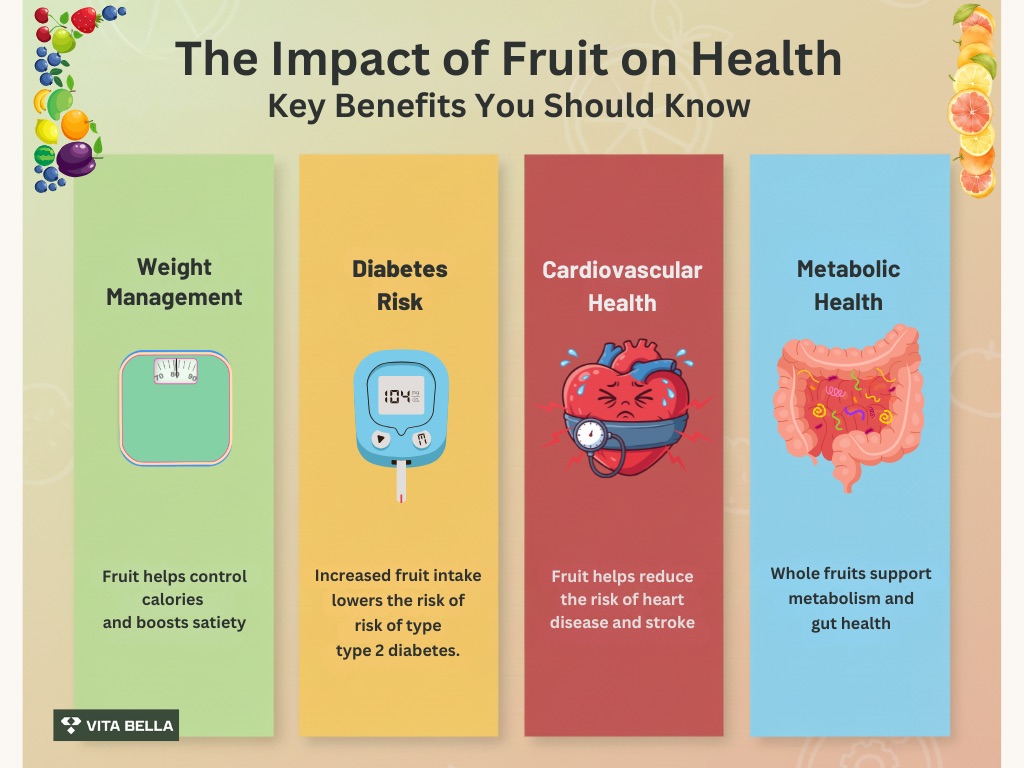
Fruit consumption offers numerous health benefits, including reducing chronic disease risk, supporting weight management, and improving metabolic health due to its rich content of fiber, vitamins, and antioxidants. These multiple health benefits are attributed to the fruit’s fiber content, which slows sugar absorption, supports the gut microbiome, and helps regulate appetite, energy balance, and blood lipid profiles. A large body of human research consistently shows positive effects of whole fruit on chronic disease risk:
1- Impact of Increased Fruit and Vegetable Intake on Weight Loss and Maintenance
In a multicenter RCT 2 with a controlled diet that included fruits and vegetables, increased servings of fruit were associated with modest weight loss and improved weight maintenance over time. It was also shown that increased intake of total fruits and vegetables was associated with a weight loss of 0.3 kg per daily serving during the initial 6 months of the study.
2- Impact of Increased Fresh Fruit Consumption on Type 2 Diabetes Risk
As per research 3, higher consumption of fresh fruit is associated with lower risk of incident type 2 diabetes, particularly among adults without glucose intolerance at baseline, with risk decreasing progressively across intake levels. The most pronounced reduction in diabetes risk was observed among subjects who consumed whole fresh fruit at least 7 times/week. Each 300 g/day higher fruit intake was associated with an 8.2% lower risk of diabetes.
3- Fruit and Vegetable Intake and Its Impact on Cardiovascular Health
Meta‑analyses 4 and observational studies show that fruit and vegetable intake lowers the risk of cardiovascular disease, stroke, and heart failure. It also explains that high adherence to diets rich in plant-based foods, including fruit, vegetables, nuts, whole grains, legumes, low-fat dairy products, and olive oil, and a low intake of sodium, results in a lower risk of cardiovascular and cerebrovascular diseases in a dose-dependent manner.
Does Excessive Intake of Fruits Affect Uric Acid Levels?
Fructose metabolism in the liver can generate uric acid as a byproduct, and biologically, this has been documented in controlled human experiments showing transient rises in serum uric acid after meals rich in fructose. Research 5 shows that uric acid increases in the cell and may transiently rise by 1-2 mg/dL in the circulation. Fructose is metabolized in an uncontrolled way to glycerophosphate and acetyl-CoA, which serve as substrates for triglyceride synthesis.
Epidemiological research 6 also associates high fructose intake (from various sources) with increased risk of gout and hyperuricemia (high blood uric acid) in adults. The association between fructose consumption and risk of gout was low. Food sources in relation to gout and hyperuricemia in diverse populations to determine if and, ultimately, to what extent fructose may mediate the risk of hyperuricemia and gout.
Additionally, components of fruit like vitamin C, polyphenols (e.g., epicatechin), and fiber may interact to lower uric acid or mitigate its impact. Overall, while high amounts of isolated fructose can raise uric acid levels when calories exceed energy needs, whole fruit consumption does not clearly increase the risk of gout or hyperuricemia in most populations.
How Much Fruit Is Too Much?
Most dietary guidelines and research 7 recommend 2–3 servings of fruit per day as part of a balanced diet to support metabolic and cardiovascular health. Whole fruit beyond this amount is not inherently harmful for healthy adults, as long as overall caloric needs are met and the diet remains balanced. The fiber rich fruits can promote regularity and help to protect against constipation.
In prospective studies 3, even higher intakes (e.g., ≥150 g/day) are linked to modestly lower diabetes risk and better metabolic profiles. Rather than “too much fruit” being a universal problem, issues usually arise when fruit is consumed in juice form or when total caloric and sugar intake from all sources significantly exceeds energy expenditure, increasing metabolic risks.
Eat Smart, Lose Weight, Consult with Vita Bella’s Experts
It’s easy to overeat fruit, thinking it’s always a healthy choice, but this can lead to unintended weight gain and metabolic issues. The root cause is often an inaccurate understanding of serving sizes and a lack of macro tracking, which can lead to exceeding your calorie goals without knowing it. Without proper tracking, it’s easy to consume more sugar than intended, which could hinder your progress.
Vita Bella’s app makes tracking your fruit intake and macros simple, giving you clear insights into how much fruit you’re consuming. It allows you to easily adjust your portions and track real-time progress toward your health goals. With personalized meal plans, workout videos, and expert nutrition advice, you can adjust your intake to ensure optimal health and stay on track with your goals. This helps create a balanced approach, ensuring you meet your targets without compromising on nutrition or flavour.
Frequently asked questions
Yes, consuming excessive amounts of fruit can contribute to weight gain if it results in a calorie surplus. While fruit is nutrient-dense and healthy, it still contains natural sugars and calories. If total calorie intake exceeds what your body burns, it can lead to weight gain, even with fruit consumption.
No, eating fruit every day is generally healthy. Whole fruits provide essential vitamins, minerals, fiber, and antioxidants that support overall health. However, it’s important to balance fruit intake with other food groups to ensure a well-rounded, nutrient-rich diet and to avoid excess sugar consumption, which may impact metabolic health.
No, eating whole fruit typically does not cause high uric acid levels. While fructose in fruit can be metabolized into uric acid, whole fruits contain fiber, antioxidants, and other nutrients that help mitigate this effect. Excessive fructose from added sugars, however, may contribute to elevated uric acid levels, leading to health issues.
Yes, tracking your fruit intake can help with weight loss by providing insight into your calorie and macro consumption. While fruit is nutritious, it’s important to monitor portion sizes and balance it with other nutrients. Using an app to track your intake ensures you stay within your calorie goals for effective weight management.
References:
Schaefer, E. J., Gleason, J. A., & Dansinger, M. L. (2009). Dietary fructose and glucose differentially affect lipid and glucose homeostasis. The Journal of Nutrition, 139(6), 1257S–1262S. https://doi.org/10.3945/jn.108.098186
Dreher, M. L. (2018). Whole fruits and fruit fiber emerging health effects. Nutrients, 10(12), 1833. https://doi.org/10.3390/nu10121833
Li, L., Yang, H.-Y., Ma, Y., Liang, X.-H., Xu, M., Zhang, J., Huang, Z.-X., Meng, L.-H., Zhou, J., Xian, J., Suo, Y.-J., Huang, S., Cai, J.-W., Meng, B.-H., Zhao, Z.-Y., Luo, Z.-J., … & the 4C Study Group. (2023). Whole fresh fruit intake and risk of incident diabetes in different glycemic stages: A nationwide prospective cohort investigation. European Journal of Nutrition, 62(2), 771–782. https://doi.org/10.1007/s00394-022-02998-6
Zhang, Y., Ma, Y., Liu, X., Zhang, J., & Zhang, B. (2024). Influence of fermented foods on gut microbiota composition and metabolic health: A comprehensive review. Foods, 13(19), 3149. https://doi.org/10.3390/foods13193149
Cheng, L., Yao, C., Han, Q., Chen, L., Huang, X., & Li, Z. (2020). Dietary patterns and risk of type 2 diabetes: A systematic review and meta‑analysis of cohort studies. Nutrients, 12(10), 3129. https://doi.org/10.3390/nu12103129
Jamnik, J., Rehman, S., Blanco Mejía, S., de Souza, R. J., Khan, T. A., Leiter, L. A., Wolever, T. M. S., Kendall, C. W. C., Jenkins, D. J. A., & Sievenpiper, J. L. (2016). Fructose intake and risk of gout and hyperuricemia: A systematic review and meta‑analysis of prospective cohort studies. BMJ Open, 6(10), e013191. https://doi.org/10.1136/bmjopen‑2016‑013191
Dreher, M. L. (2018). Whole fruits and fruit fiber: Emerging health effects. Nutrients, 10(12), 1833. https://doi.org/10.3390/nu10121833