
Blood work for peptides and TRT gives providers the baseline data to confirm hormone deficiency, rule out contraindications, and tailor a protocol to your biology. Symptoms like fatigue, low libido, and poor recovery overlap with dozens of conditions. A proper lab panel separates real hormone decline from other causes. Vita Bella's hormone therapy programs begin with comprehensive testing because your numbers, not your symptoms alone, define the starting point.
Why baseline labs before TRT and peptides matter
Without a reference point, dosing is guesswork. Side effects go undetected.
The 2018 Endocrine Society Clinical Practice Guideline (Bhasin et al., JCEM) recommends confirming low testosterone with morning measurements of total testosterone alongside associated hormones before initiating TRT. Up to 25% of men receiving testosterone replacement therapy may not have had their levels confirmed beforehand, according to data cited in published guidelines. That gap creates real downstream risk.
Baseline labs catch several issues before they escalate:
- Missed cardiovascular risk. A 2024 meta-analysis in Expert Opinion on Drug Safety (Corona et al.) found that men with pre-existing cardiovascular risk factors face a measurably higher event rate on TRT. Cardiac and metabolic screening belongs in the baseline panel before therapy starts.
- Erythrocytosis risk. TRT raises red blood cell production. Hemoglobin and hematocrit measurements before therapy establish the reference for safe monitoring throughout treatment.
- Metabolic overlap. Research published in Frontiers in Endocrinology (Deepika et al., 2022) showed that baseline testosterone predicts metabolic response to therapy, and men with lower serum testosterone face significantly higher odds of metabolic syndrome and type 2 diabetes.
- Dosing precision. A licensed provider determines the dose after labs. Without a baseline, adjustments are reactive rather than targeted.
For peptide therapy, labs are recommended rather than required. They help individualize dosing, but standard protocols exist and can be refined through clinical response.
What blood tests do you need before starting peptide therapy?
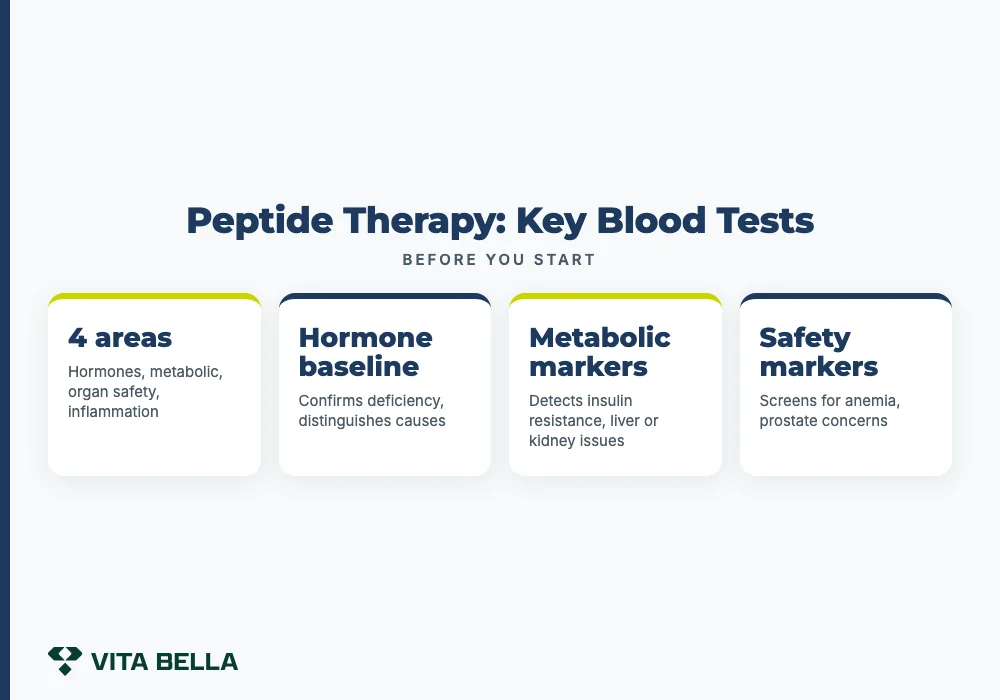
The essential blood tests before starting peptide therapy cover four areas: hormones, metabolic function, organ safety, and inflammation. The exact peptide therapy lab panel varies by peptide, but the table below applies broadly across most protocols.
| Category | Tests | Why it matters |
|---|---|---|
| Hormone baseline | Total testosterone, free testosterone, SHBG, LH, FSH, estradiol | Confirms deficiency; distinguishes primary from secondary causes |
| Metabolic markers | Fasting glucose or HbA1c, lipid panel, comprehensive metabolic panel (CMP) | Detects insulin resistance and liver or kidney impairment |
| Safety markers | Hemoglobin, hematocrit (CBC), PSA | Screens for anemia, erythrocytosis risk, and prostate concerns |
| Thyroid function | TSH, free T4 | Rules out thyroid-driven fatigue or metabolic issues |
| Inflammation | CRP, optionally IL-6 | Relevant when cardiovascular risk is elevated |
Kidney function has specific relevance for blood work for peptides. For patients with renal impairment, accumulation risk rises if dosing is not adjusted; a CMP before starting is a practical safety screen (Di et al., 2015, The AAPS Journal). A 2026 review of injectable peptide therapy in The American Journal of Sports Medicine (Mayfield et al.) found that pre-treatment lab screening improves both safety and clinical decision-making, supporting a panel even when not strictly required.
Understanding how different peptides affect your biology and lab markers matters for interpreting results. Growth hormone secretagogues, for example, influence IGF-1, so a baseline IGF-1 measurement becomes a useful reference if those peptides are part of your protocol.
What labs should you check before starting TRT?
Blood tests before TRT should include at minimum two morning total testosterone measurements, free testosterone, SHBG, LH, FSH, and estradiol. This TRT hormone panel tells providers whether low testosterone is primary, meaning testicular failure, or secondary, meaning pituitary or hypothalamic dysfunction. That distinction shapes the entire treatment plan.
The SHBG free testosterone test deserves particular attention. SHBG binds testosterone and limits its biological activity. A man with low-normal total testosterone and elevated SHBG may carry a clinically low free testosterone level while appearing borderline on standard testing. Thorough testosterone lab testing accounts for both total and free fractions precisely because that difference can determine whether TRT is appropriate.
Beyond the hormone panel, complete blood tests before TRT should include:
- A comprehensive metabolic panel to assess liver and kidney baseline
- Fasting glucose or HbA1c to screen for insulin resistance
- A lipid panel, since TRT affects cardiovascular risk markers over time
- PSA and a digital rectal exam if age-appropriate
- CBC for hemoglobin and hematocrit
Reading those results against optimal rather than population-average ranges often reveals clinically meaningful gaps that standard "normal" cutoffs would miss.
How often should you get labs while on TRT?
For most TRT protocols, labs should be rechecked at three to six months after starting, then annually once levels stabilize. Monitoring frequency also depends on the formulation, since different testosterone preparations reach steady-state at different rates, so follow-up timing should match the pharmacokinetics of the specific form being used.
If total testosterone normalizes but symptoms persist after three to six months, providers should reassess whether the protocol addresses the underlying cause. That reassessment requires lab data. Without it, decisions fall back on symptoms alone.
Ongoing hematocrit monitoring matters throughout. Erythrocytosis can develop months into therapy, not just at the start. The 2024 systematic review by Cannarella et al. in Asian Journal of Andrology confirmed that cardiovascular and thromboembolic risk markers shift over time on TRT, making continued blood work part of long-term safety management. PSA rechecks are part of that ongoing panel as well.
For peptide protocols, monitoring is less standardized. Providers track clinical response and relevant biomarkers, such as IGF-1 for growth hormone secretagogues, adjusting based on what the data shows.
Get the right blood work for peptides and TRT
Starting without blood work for peptides or a testosterone replacement therapy baseline means your first months are spent reacting instead of optimizing. Vita Bella orders labs through Quest Diagnostics, reviewed by your provider before the first consultation, and billed separately from your membership. That baseline is what turns a generic protocol into a personalized one.
Frequently asked questions
Labs confirm whether testosterone deficiency is real, establish safety benchmarks for organ function and cardiovascular risk, and give your provider a reference for monitoring. The 2018 Endocrine Society guidelines emphasize that symptoms alone are not sufficient to diagnose testosterone deficiency or justify TRT.
Most therapeutic peptides do not appear on standard drug screens or routine panels. Growth hormone secretagogues influence IGF-1 and growth hormone levels, which a provider can measure directly when tracking therapy response.
A standard baseline hormone panel includes total testosterone, free testosterone, an SHBG free testosterone test, LH, FSH, and estradiol. Providers typically add PSA, thyroid markers (TSH, free T4), CBC, and a metabolic panel to complete the safety screening before therapy begins.
Labs are recommended rather than required for peptide therapy. A baseline panel helps confirm organ function and individualizes dosing, but standard starting protocols exist and can be adjusted based on clinical response and provider assessment.
Sources
- Bhasin S et al. (2018). Testosterone Therapy in Men With Hypogonadism: An Endocrine Society Clinical Practice Guideline. The Journal of Clinical Endocrinology and Metabolism. PubMed
- Corona G et al. (2024). Cardiovascular safety of testosterone replacement therapy in men: an updated systematic review and meta-analysis. Expert Opinion on Drug Safety. PubMed
- Cannarella R et al. (2024). Testosterone replacement therapy and vascular thromboembolic events: a systematic review and meta-analysis. Asian Journal of Andrology. PubMed
- Mayfield CK et al. (2026). Injectable Peptide Therapy: A Primer for Orthopaedic and Sports Medicine Physicians. The American Journal of Sports Medicine. PubMed
- Deepika F et al. (2022). Baseline testosterone predicts body composition and metabolic response to testosterone therapy. Frontiers in Endocrinology. PubMed
- Di L et al. (2015). Strategic approaches to optimizing peptide ADME properties. The AAPS Journal. PubMed