
Anavar (oxandrolone) and TRT are not interchangeable protocols. TRT is a long-term treatment for men with diagnosed hypogonadism; oxandrolone is a short-term clinical agent prescribed for specific conditions such as injury recovery and involuntary muscle loss. A licensed provider determines whether either, or anavar and TRT together, is appropriate after reviewing lab work and medical history. If low testosterone is the underlying concern, a structured TRT evaluation is where that assessment begins, not a conversation about adjunct agents.
What is oxandrolone (Anavar), and how is it used clinically?
Oxandrolone is a prescription synthetic anabolic agent with established clinical indications. Its clinical applications are specific and narrow, developed through decades of controlled research in medical contexts. This is not a supplement, a performance aid, or a functional replacement for testosterone therapy; it is a prescription compound with short-term clinical uses backed by peer-reviewed evidence.
Approved clinical use cases for oxandrolone include:
- Supporting lean tissue preservation during burn patient recovery, documented in a 2025 systematic review by Lou et al. in the World Journal of Emergency Surgery and a 2020 meta-analysis by Ring et al. in the Journal of Burn Care and Research
- Managing involuntary weight loss associated with muscle-wasting conditions, supported by the same clinical evidence base
- Short-term use in injury and post-surgical recovery contexts, under direct provider supervision with defined duration limits
- Not indicated as a primary hormone-replacement agent and not prescribed for performance or body composition goals
The distinction between clinical and non-clinical use shapes every part of this article. Providers evaluating anavar and TRT together do so from within the clinical frame, for patients with identified medical needs. Outside that frame, neither the evidence base nor the provider oversight structure exists to support the combination.
Why testosterone therapy is the foundation, not a starting point for comparison
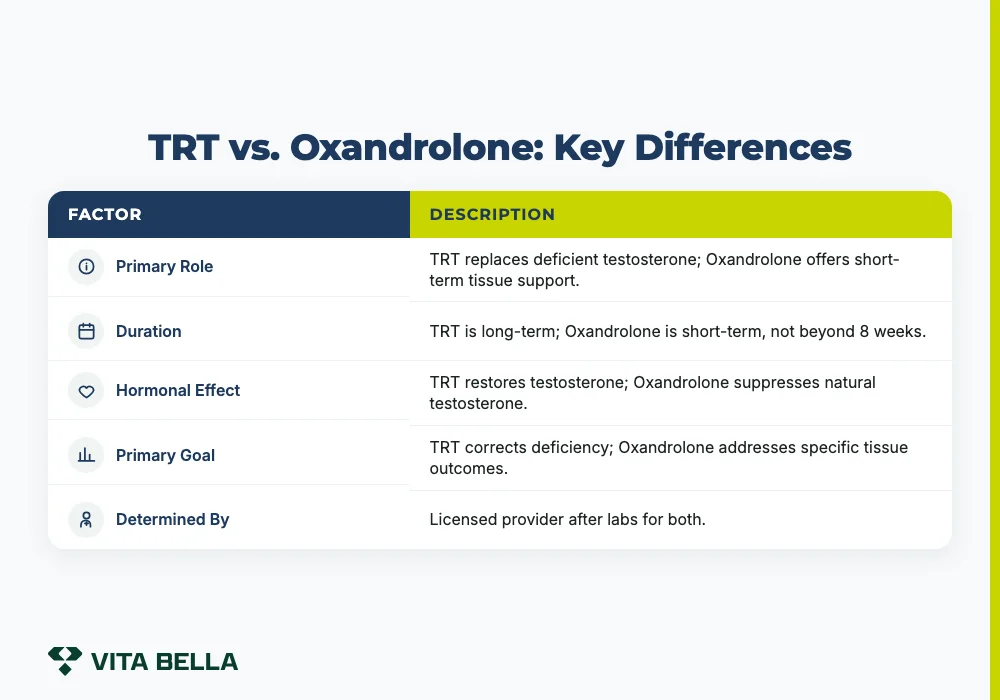
TRT addresses a primary hormonal deficiency. Oxandrolone addresses tissue-level outcomes in specific, short-term scenarios. Treating them as alternatives misrepresents how each is prescribed, why each requires a different monitoring structure, and what the provider is actually managing when using one or both.
A 2024 evidence synthesis by Cruickshank et al. in Health Technology Assessment reviewed TRT's effects and safety for hypogonadal men, establishing testosterone replacement as a sustained, monitored intervention for a diagnosed deficiency. Oxandrolone is not in that clinical category. It does not correct a testosterone deficiency; it acts through androgen receptors independently and suppresses endogenous testosterone production in the process.
| Factor | TRT | Oxandrolone |
|---|---|---|
| Primary role | Replaces deficient testosterone in hypogonadal men | Short-term tissue support under specific clinical scenarios |
| Duration | Long-term, ongoing with regular monitoring | Short-term, not beyond 8 weeks under clinical guidance |
| Hormonal effect | Restores testosterone to physiological range | Suppresses endogenous testosterone production |
| Primary goal | Correct a diagnosed hormonal deficiency | Address a specific, provider-identified tissue-level outcome |
| Who determines this | Licensed provider after labs | Licensed provider after labs |
For most men, a comprehensive hormonal support program covers the clinical foundation before any additional considerations are relevant. Labs and a provider review determine what applies.
Anavar alone vs. Anavar with TRT: key clinical differences
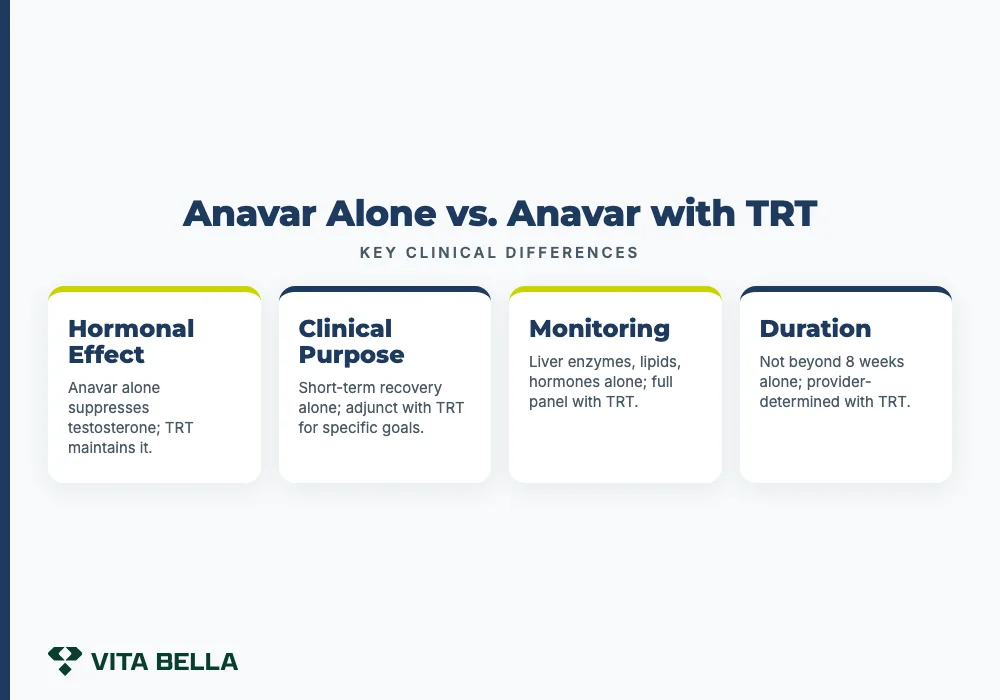
When the question is framed as "anavar vs testosterone," it implies two compounds competing for the same clinical role. The more accurate framing for clinical decision-making is what oxandrolone does when testosterone is absent versus what it does within a managed TRT protocol. Those are two distinct clinical pictures with different risk profiles and different monitoring requirements.
| Factor | Oxandrolone alone | Oxandrolone within a TRT protocol |
|---|---|---|
| Hormonal effect | Suppresses endogenous testosterone; creates a net hormonal deficit | Testosterone is maintained by TRT; endogenous suppression is already managed |
| Clinical purpose | Short-term tissue recovery under specific clinical indications | Adjunct to address provider-determined clinical goals alongside managed TRT |
| Monitoring required | Liver enzymes, lipids, hormone panel | Full hormone panel, liver enzymes, hematocrit, lipids |
| Duration | Short-term, not beyond 8 weeks | Determined by provider based on patient response and labs |
| Who determines this | Licensed provider after labs | Licensed provider after labs |
TRT and anavar together represents a scenario where the hormonal foundation is managed before the additional agent is introduced. Anavar alone means HPG suppression has no compensating testosterone source. No responsible provider protocol introduces oxandrolone without confirmed testosterone management already in place. That is what makes anavar and TRT a defined clinical scenario rather than an improvised one.
Who may be a candidate for short-term oxandrolone with TRT?
A provider considers oxandrolone as a short-term adjunct only for specific clinical scenarios. It is not a standard component of every TRT protocol. Eligibility depends entirely on a patient's labs, history, and the clinical need the provider identifies.
Candidate criteria a provider evaluates before considering oxandrolone with TRT:
- Confirmed hypogonadism already managed with TRT and stable testosterone levels documented by current labs
- Documented involuntary muscle loss or injury recovery need that falls within oxandrolone's approved clinical indications
- Lab values within acceptable range for liver function and a complete lipid panel, reviewed before any protocol begins
- No contraindications based on cardiovascular history or other relevant clinical factors in the patient's record
- A provider-assessed risk-benefit review with a short-term duration agreed upon in advance, not an open-ended prescription
The typical anavar and TRT candidate is someone already in a structured testosterone protocol who has a specific, provider-identified clinical need. This does not apply to someone using anavar with TRT for goals that fall outside approved clinical indications. That distinction is not a technicality; it defines whether the evidence base and the monitoring framework apply to the situation.
If you are already on TRT and want to understand whether your current protocol is optimized, a Vita Bella provider reviews your labs and history before any changes are made. Get Started
Lab monitoring: what to check before, during, and after
No aspect of anavar and TRT protocols carries more clinical weight than lab monitoring. A 2024 evidence synthesis by Cruickshank et al. in Health Technology Assessment identifies the laboratory framework that makes testosterone management clinically sound; a 2025 review by Naelitz et al. in Nature Reviews Urology addresses fertility and spermatogenesis considerations in men of reproductive age on TRT. Adding oxandrolone expands that checklist in specific ways.
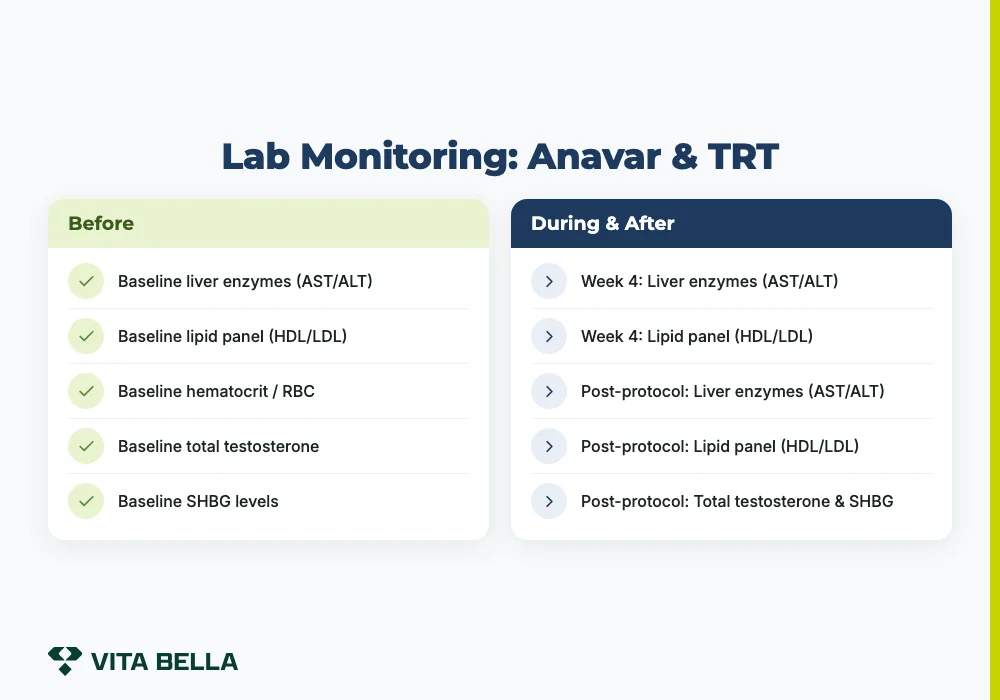
Before starting, a provider needs complete baseline data to identify any pre-existing conditions that affect the risk profile. At week 4, a mid-protocol check catches liver or lipid changes early enough to act on them. After completing the short course, a full post-protocol review confirms outcomes and establishes the post-treatment baseline for ongoing care.
| Biomarker | Why it matters | Before | Week 4 | After |
|---|---|---|---|---|
| AST/ALT (liver enzymes) | Oxandrolone is hepatotoxic; baseline identifies pre-existing elevation before treatment starts | ✓ | ✓ | ✓ |
| Lipid panel (HDL/LDL) | Oxandrolone reduces HDL; cardiovascular risk requires tracking throughout | ✓ | ✓ | ✓ |
| Hematocrit / RBC | Elevated risk with anabolic agents; TRT compounds this baseline | ✓ | ✓ | ✓ |
| Total testosterone | Confirms TRT coverage is maintained during oxandrolone use | ✓ | ✓ | |
| SHBG | Affects free testosterone availability; shifts with oxandrolone use | ✓ | ✓ |
SHBG deserves particular attention in any anavar and TRT protocol. Oxandrolone reduces SHBG, which shifts the free-to-total testosterone ratio even when total testosterone stays stable on TRT. A deeper explanation of how SHBG affects testosterone availability is at sex hormone-binding globulin and why total testosterone alone is incomplete. For a full map of which markers matter across hormone and peptide protocols, the essential lab testing guide for hormones and peptides covers the complete picture.
Lab work is not administrative overhead in an anavar and TRT protocol. It is how a provider determines who benefits and who should not be on it in the first place.
What to expect in the first 8 weeks under provider care
Eight weeks is the clinical ceiling for oxandrolone in a provider-supervised protocol. Setting this expectation directly matters because duration is one of the defining differences between clinical use and unsupervised use.
What a provider monitors and adjusts during the 8-week window:
- Labs at baseline and week 4 to flag liver enzyme elevation or lipid changes before they become clinically significant
- Symptom check-ins to assess clinical response and identify any adverse effects that would prompt a protocol review
- Testosterone levels at defined intervals to confirm TRT remains effective while oxandrolone is active
- End-of-course lab review before any continuation decision; no continuation is assumed appropriate without current labs
The 8-week limit is not arbitrary. Hepatotoxicity risk from oral anabolic compounds accumulates over time, and the point at which risk begins to outweigh benefit is grounded in the clinical evidence for the specific indications where oxandrolone has a research record. A provider who extends beyond 8 weeks without current labs and a clear clinical rationale is operating outside the safety parameters that define supervised use.
At the end of the course, the provider reviews labs and clinical response before deciding any next step. The exit point is built in from the start. A defined short-term intervention with a scheduled end is fundamentally different from open-ended use, and that distinction matters for both safety and clinical accountability.
Risks and how providers manage them
The primary risk categories for anavar and TRT protocols are hepatotoxicity, HDL reduction, testosterone suppression, and hematocrit elevation. Each is manageable with monitoring and protocol design. None is manageable by ignoring it.
Risks and the provider monitoring response for each:
- Hepatotoxicity: Oxandrolone is metabolized in the liver. AST and ALT at baseline, week 4, and post-protocol give the provider an early signal to discontinue and reassess if levels rise beyond acceptable range.
- HDL reduction: The lipid panel tracks HDL trajectory across the protocol. If HDL drops significantly, a provider may address cardiovascular risk through dietary guidance, activity adjustments, or a protocol modification.
- HPG axis suppression: TRT already manages endogenous testosterone suppression in patients who are on it. The risk is most acute for patients not on managed testosterone who take oxandrolone alone, which is the core reason the anavar and TRT framing is the clinically appropriate one.
- Hematocrit elevation: TRT alone raises hematocrit in some men. Adding oxandrolone to that baseline requires active tracking. Hematocrit monitoring is standard in any well-managed anavar and TRT protocol.
- Full lipid panel imbalance: LDL and total cholesterol are tracked alongside HDL. The complete picture prevents a provider from acting on a single marker while missing broader cardiovascular risk trends.
Ring et al. (2020) and Lou et al. (2025) document these risk categories in the clinical populations where oxandrolone has the most research. The consistent finding is that risk management is a function of monitoring frequency and defined protocol duration, not a reason to forgo oversight entirely.
For men focused on supporting the body's own testosterone production rather than adding an external anabolic agent, providers may evaluate natural testosterone production support options. That is a separate clinical track with its own indication criteria and evaluation process.
How Vita Bella approaches TRT and oxandrolone
Vita Bella's provider model begins with labs and a complete provider review before any protocol decision is made. No treatment starts without a baseline panel from Quest Diagnostics, a reviewed medical history, and a 45-minute initial consultation with the provider the patient selects. There is no AI in the clinical care pathway. Human clinical support is available around the clock.
What a Vita Bella provider reviews before any oxandrolone protocol:
- Baseline lab panel through Quest Diagnostics, covering liver function, lipids, hematocrit, testosterone, and SHBG
- Current TRT protocol documentation and confirmed testosterone levels from recent labs
- Medical history review, including cardiovascular history and any factors that affect candidacy for a short-term addition
- A defined duration plan with a monitoring schedule agreed upon before the protocol begins, not after
For patients who qualify, member wholesale pricing applies to medications. Free injection supplies and discreet shipping from FDA-inspected, state-licensed U.S. pharmacies are part of the membership.
Vita Bella protocol steps:
- Take the intake quiz at /form2/ to share your goals and health background
- Provider-reviewed labs from Quest Diagnostics before any treatment decision is made
- 45-minute initial consultation with the provider you choose, covering labs, history, and what a protocol would involve
- Quarterly 1:1 check-ins to review labs and adjust protocols as needed; free injection supplies and discreet shipping included
Ready to talk to a provider about your options?
Oxandrolone and testosterone therapy both require provider oversight, lab-confirmed eligibility, and a defined clinical rationale. There is no shortcut to either. If you want to understand what your labs say about your hormone health and whether your current protocol is optimized, a Vita Bella provider reviews everything before making any recommendation. You pick your provider, and nothing moves forward without your full baseline panel.
Get Started or take the 60-second quiz to see which program fits your goals.
Frequently asked questions
A licensed provider may prescribe oxandrolone alongside TRT for specific clinical reasons, such as injury recovery or involuntary muscle loss. This is not a standard component of TRT and requires a provider review of your labs and medical history before any protocol decision is made.
Yes. Oxandrolone suppresses the hypothalamic-pituitary-gonadal axis, reducing the body's natural testosterone output. This is why it is prescribed alongside testosterone when clinically indicated, not as a standalone hormone agent.
Oxandrolone has established clinical indications that address recovery from severe burns and manage involuntary weight loss associated with muscle-wasting conditions. Clinical use is short-term and provider-supervised; the research base is in medical populations, not performance contexts.
Clinical guidance and the Vita Bella provider model treat oxandrolone as a short-term agent, not to exceed 8 weeks, with labs reviewed before, during, and after the course. Duration is determined by the provider based on the patient's response and current lab values.
Before any oxandrolone protocol, a provider reviews liver enzymes (AST/ALT), a full lipid panel, hematocrit, total testosterone, and SHBG. These establish baselines and identify any contraindications before treatment starts.
Sources
- Lou J et al. (2025). Oxandrolone for burn patients: a systematic review and updated meta-analysis of randomized controlled trials from 2005 to 2025. World Journal of Emergency Surgery. PubMed
- Cruickshank M et al. (2024). The effects and safety of testosterone replacement therapy for men with hypogonadism: the TestES evidence synthesis and economic evaluation. Health Technology Assessment. PubMed
- Ring J et al. (2020). Oxandrolone in the Treatment of Burn Injuries: A Systematic Review and Meta-analysis. Journal of Burn Care and Research. PubMed
- Naelitz BD et al. (2025). Testosterone replacement therapy and spermatogenesis in reproductive age men. Nature Reviews Urology. PubMed