



Most people don’t realize their health struggles aren’t from a lack of care but from relying on just one pair of medical eyes when their body is far more complex than that. For long-term metabolic, hormonal, and overall wellness, a single provider can unintentionally leave critical gaps. A collaborative healthcare team brings together multiple expert perspectives. This integrated approach leads to more precise care, better coordination, and consistently stronger health outcomes.
Your body doesn’t operate in isolation, so why should your healthcare? At Vita Bella, we unite medical, hormonal, nutritional, and lifestyle expertise under one vision. This team-based approach is designed to close gaps, optimize outcomes, and support long-term wellness. When every expert works together, your health works better. Learn what comprehensive care can do for you.
What Happens When Hormonal and Metabolic Care Goes Beyond Primary Care?
Primary care training focuses on generalist medicine, which means detailed hormonal regulation and advanced metabolic management are often beyond the scope of a typical visit. When care is integrated with specialists, measurable improvements occur. Systematic reviews 1 of models that include endocrinologists and hormone experts show significantly better control of metabolic health markers, such as HbA1c (a measure of long-term blood glucose), blood pressure, and LDL cholesterol, compared with usual primary care alone.
This is a powerful reminder that bringing depth to your team can produce measurable benefits. A systematic review examining multidisciplinary primary care teams found that more than half of human studies 2 reported improved clinical outcomes when care was truly collaborative, compared with when providers worked in isolation.
This trend spans routine care, chronic disease management, and lifestyle-focused interventions. One of the most compelling roles on a health team is the registered dietitian, whose expertise in nutrition leads to meaningful, evidence-based improvements in health outcomes. A meta-analysis 3 shows that registered dietitians provide medical nutrition therapy that has been proven to improve glycemic control, body weight, waist circumference, and cardiometabolic risk factors in adults.
How Multidisciplinary Care Turns Nutrition and Hormone Science into Results?
Where primary care often touches on diet broadly, dietitians dive deep into personalized food-based strategies tied to objective outcomes. Longer-term human studies 4 that blend nutrition coaching with specialist follow-up further highlight the value of a multidisciplinary team. In a 24-month intervention, patients receiving dietitian-led coaching alongside hormone expert care had statistically significant improvements in weight, waist circumference, and HbA1c compared with standard care.
When specialists work together, the whole becomes greater than the sum of its parts. Multidisciplinary interventions involving physicians, dietitians, nurses, and allied health professionals significantly reduce cardiovascular risk factors in patients with diabetes, reinforcing the value of coordinated care. This demonstrates not just short-term change, but sustained improvements in metabolic health when experts coordinate care.
Why Teamwork Matters in Practical Terms?
Teamwork matters because health systems are interconnected, not isolated. When providers collaborate, care becomes consistent, personalized, and efficient rather than fragmented. Collaborative care isn’t just a buzzword. It changes how you experience the healthcare system and how your body responds to medical guidance. Here’s how each expert adds value:
1- Primary Care Providers (PCPs)
PCPs are often the first health care professionals to see patients who experience symptoms of a mental health disorder. PCPs act as central coordinators; they track preventative markers, manage acute illnesses, prescribe baseline medications, and refer you to appropriate specialists. This continuity forms the stable backbone of your health journey. Primary care physicians reflect perhaps the dominant and crucial position that physicians have in many health care systems.
2- Hormone Providers
Hormone providers take additional training to learn the ins and outs of hormone therapy. Hormones are complex chemical messengers that influence metabolism, mood, energy, and body composition. Their training goes beyond general practice, enabling them to interpret nuanced lab results and manage conditions such as thyroid dysfunction, insulin resistance, and adrenal imbalance with precision. In integrated care models, their involvement improves disease markers more than generalist care alone.
3- Registered Dietitians (RDs)
Dietitians translate metabolic science into actionable eating plans. They tailor nutrition advice to your metabolism, goals, preferences, and medical conditions. It has been shown that professional nutrition guidance yields better weight and cardiometabolic outcomes than general advice alone. Their expertise allows them to tailor nutrition advice specifically to an individual's metabolism, goals, preferences, and medical conditions.
4- Exercise Professionals / Personal Trainers
Movement specialists structure exercise plans that complement your metabolic and hormonal goals. It was consistently noted that tailored exercise improves insulin sensitivity, enhances body composition, and supports long-term adherence to healthy habits, especially when part of a coordinated team approach.
5- Mental Health and Behavioral Specialists
The link between stress and mental health is undeniable. Stress, sleep, and psychological health directly interact with hormones like cortisol and insulin. Behavioral therapists and psychologists help individuals implement sustainable lifestyle changes. While many primary care visits cannot address behavior change in depth, multidisciplinary teams bridge that gap.
How can patients and clinicians make collaborative care work for them?
Collaborative care is not about redundant opinions; it’s about synergistic expertise. To benefit from team-based care, patients and clinicians alike can aim for open communication and shared decision-making. Patients should feel empowered to actively participate in their care plan, while clinicians collaborate to create a comprehensive, patient-centered approach. To benefit from team-based care, patients and clinicians alike can aim for:
Regular team discussions, whether formal or informal, so that each provider knows the latest findings and decisions.
Goal alignment setting shared, personalized goals that are measurable and meaningful.
Patient-centered planning: your values and lifestyle shape the care plan, not just the disease
Get Your Health Team Together, Start Healing with Vita Bella
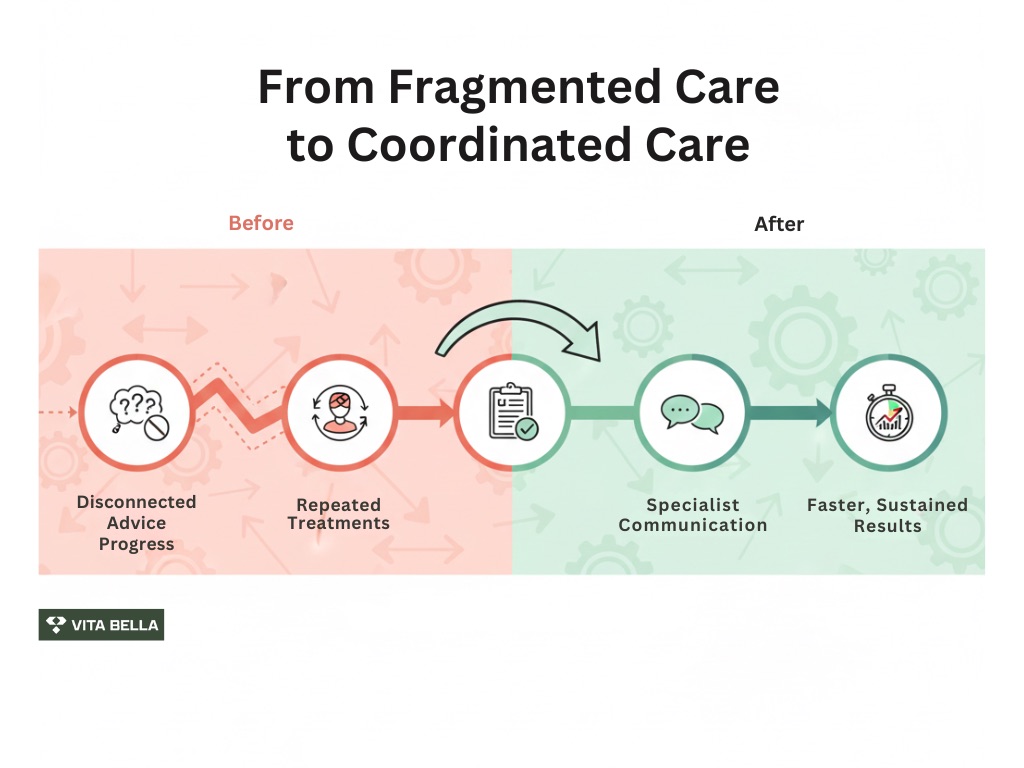
Many health plans manage symptoms, not systems, leaving patients frustrated. Hormones, metabolism, and lifestyle factors are often addressed separately, creating blind spots. That piecemeal approach slows results and can even mask underlying issues. Without a coordinated strategy, patients often cycle through repeated treatments with minimal improvement.
Vita Bella eliminates fragmentation with a team-based model. Our specialists communicate continuously to craft comprehensive, personalized plans. Every decision is informed and aligned, covering all aspects of your health, including nutrition, exercise, and hormone balance. With our collaborative approach, gaps in care are closed, redundancies are minimized, and every step is purposeful. This is where transformative, sustained results begin. Get your membership now to help you achieve your optimal health.
Frequently asked questions
Yes, human studies consistently show that multidisciplinary care improves clinical outcomes compared with primary care alone. While primary care is essential for general and acute health issues, adding specialists such as hormone experts, dietitians, and exercise professionals provides deeper expertise, leading to better metabolic control, improved adherence, and more personalized long-term health strategies.
Yes, collaborative care models involving hormone specialists and lifestyle professionals demonstrate significant improvements in metabolic markers, including HbA1c, weight, waist circumference, and cardiovascular risk factors. These benefits arise because hormone regulation is complex and requires specialized interpretation, lifestyle alignment, and continuous monitoring that a single provider may not be able to deliver on their own.
Yes, evidence shows that registered dietitians provide more effective, personalized nutrition interventions than general dietary advice alone. Dietitians translate clinical and metabolic data into actionable nutrition plans, leading to measurable improvements in weight, glycemic control, and cardiometabolic health, particularly when integrated into a collaborative healthcare team.
No, when care is collaborative and well-coordinated, it actually reduces the number of conflicting recommendations. Shared communication, unified treatment goals, and integrated health records allow each provider to work from the same information, ensuring consistent guidance. This coordinated approach improves patient confidence, engagement, and adherence to long-term treatment and lifestyle plans.
References:
Zarora, R., Immanuel, J., Chivese, T., MacMillan, F., & Simmons, D. (2022). Effectiveness of integrated diabetes care interventions involving diabetes specialists working in primary and community care settings: A systematic review and meta‑analysis. International Journal of Integrated Care, 22(2), 11. https://doi.org/10.5334/ijic.6025
Li, M., Tang, H., & Liu, X. (2023). Primary care team and its association with quality of care for people with multimorbidity: A systematic review. BMC Primary Care, 24, Article 20. https://doi.org/10.1186/s12875-023-01968-z
Dudzik, J. M., Senkus, K. E., Evert, A. B., Raynor, H. A., Rozga, M., Handu, D., & Moloney, L. M. (2023). The effectiveness of medical nutrition therapy provided by a dietitian in adults with prediabetes: A systematic review and meta‑analysis. The American Journal of Clinical Nutrition, 118(5), 892–910. https://doi.org/10.1016/j.ajcnut.2023.08.022
Battista, M.‑C., Labonté, M., Ménard, J., Jean‑Denis, F., Houde, G., Ardilouze, J.‑L., & Perron, P. (2012). Dietitian‑coached management in combination with annual endocrinologist follow‑up improves global metabolic and cardiovascular health in diabetic participants after 24 months. Applied Physiology, Nutrition, and Metabolism, 37(4), 610–620. https://doi.org/10.1139/h2012‑025