

Not a Weight-Loss Drug
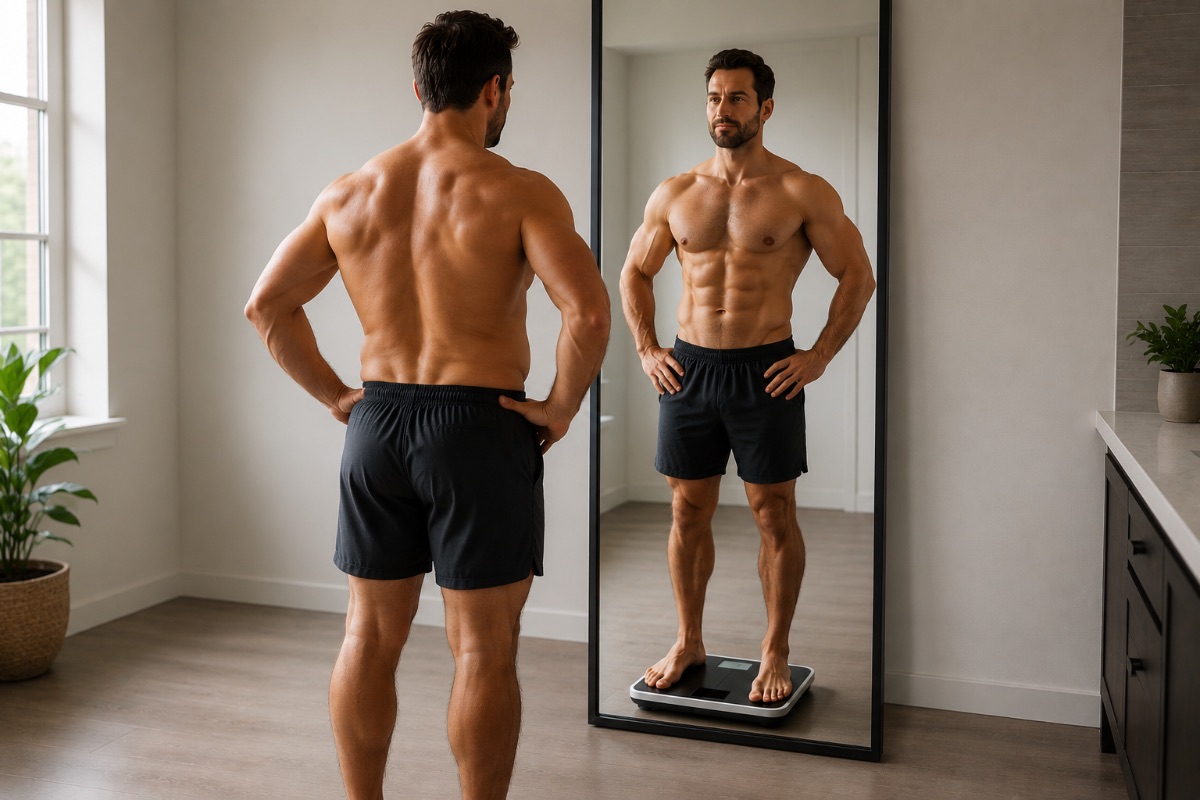
Testosterone therapy is approved to treat testosterone deficiency, not obesity. It does not work like a GLP-1 medicine that slashes appetite and calories. What it does change, in people who are low, is how the body partitions tissue: more lean mass and less fat mass. Those two shifts can cancel each other on the bathroom scale. That is why “I gained five pounds after starting testosterone” can still mean a better body, not a worse one.
Clinicians who only watch weight or BMI will miss the point. Dual-energy X-ray absorptiometry (DEXA) and similar scans separate fat from lean tissue. Trials that use those tools tell a different story from trials that report only pounds on a scale.
Why Muscle Can Look Like Weight Gain
Lean tissue is denser than fat. Adding two or three pounds of muscle while losing a similar amount of fat can leave body weight flat or even slightly higher. Muscle also uses more energy at rest than fat does. The difference is modest—on the order of several extra calories per kilogram of lean mass per day—but it adds up when training and food intake stay consistent. Over months, a higher lean-mass “engine” makes it easier to keep fat off after a diet. That is a different claim from “testosterone melts fat by itself.”
Dieting without enough testosterone often strips muscle along with fat. That lower lean mass then lowers daily energy use, which is one reason lost weight returns. Therapy that protects muscle during a calorie deficit changes the quality of the loss even when the scale number looks similar to diet alone.
What the Main Human Studies Found in Men
A 2016 randomized trial in obese men with low-to-low-normal testosterone put everyone on a very-low-energy diet for 10 weeks, then a maintenance phase, with intramuscular testosterone undecanoate or placebo for 56 weeks. Both groups lost lean mass during the crash diet. During maintenance, the testosterone group regained about 3.3 kg of lean mass; placebo did not. At the end, the testosterone group had lost more fat (about 2.9 kg extra versus placebo) and more visceral fat on CT, with 3.4 kg more lean mass preserved. The authors concluded that weight loss on testosterone was almost exclusively fat.
A 2016 meta-analysis of 59 randomized trials found that testosterone supplementation did not reliably change body weight, waist circumference, or BMI. It did reduce fat mass and increase lean mass, and it improved fasting glucose and insulin resistance, especially in younger men and those with metabolic disease. That pattern—little change on the scale, better composition—is the consistent signal across the literature.
Other pooled analyses in middle-aged and older men report fat-free mass gains on the order of about 3.5lbs to 7.7lbs, with intramuscular injections often producing larger lean-mass increases than skin gels. Strength improvements are smaller and more variable than the composition changes. The T-Trials in older men with low testosterone also showed lean-mass gains and modest fat reductions as secondary findings. Testosterone is not a substitute for lifting weights; it works better when training is already in place.
Women and Body Composition
Most large replacement trials are in men with documented low testosterone. In women, doses and goals differ, and male replacement doses are not appropriate for routine fat-loss use. A 10-week randomized study of 10 mg daily testosterone cream in young, physically active women raised lean mass by about 2lbs versus little change on placebo and improved running time to exhaustion. Those studies show that androgens shift composition in women too. They are not a reason to use high-dose testosterone as a weight-loss tool.
How to Use This Information
Judge progress by waist measurement, how clothes fit, training strength, and a body-composition scan—not by scale weight alone in the first months. Pair therapy with enough protein and two to four days of resistance training so the extra androgen signal has something to build. Recheck testosterone, estradiol, and hematocrit on a schedule set by the prescribing clinician. Men with a very high BMI may see smaller lean-mass gains than leaner hypogonadal men; food intake and activity still do most of the work.
Testosterone will not replace a structured calorie plan or a GLP-1 medication if large weight reduction is the primary goal. It can make the weight that comes off more likely to be fat and the weight that stays more likely to be muscle. That is a composition effect. It is useful. It is not a shortcut around training and diet.
When deficiency is confirmed and supervised hormone or peptide care is appropriate, clinicians experienced in this work can be reached through resources such as Vita Bella.
For men and women already reviewing labs and body-composition data who want a coordinated hormone plan alongside training and nutrition, the same teams at Vita Bella can help with monitoring and follow-up.
References
1. Ng Tang Fui M, Prendergast LA, Dupuis P, et al. Effects of testosterone treatment on body fat and lean mass in obese men on a hypocaloric diet: a randomised controlled trial. BMC Med. 2016;14:153. doi:10.1186/s12916-016-0700-9
2. Corona G, Giagulli VA, Maseroli E, et al. Testosterone supplementation and body composition: results from a meta-analysis study. Eur J Endocrinol. 2016;174(3):R99-R116. doi:10.1530/EJE-15-0262
3. Skinner JW, Otzel DM, Bowser A, et al. Muscular responses to testosterone replacement vary by administration route: a systematic review and meta-analysis. J Cachexia Sarcopenia Muscle. 2018;9(3):465-481. doi:10.1002/jcsm.12291
4. Snyder PJ, Bhasin S, Cunningham GR, et al. Effects of testosterone treatment in older men. N Engl J Med. 2016;374(7):611-624. doi:10.1056/NEJMoa1506119
5. Hirschberg AL, Elings Knutsson J, Helge T, et al. Effects of moderately increased testosterone concentration on physical performance in young women: a double-blind, randomised, placebo-controlled study. Br J Sports Med. 2020;54(10):599-604. doi:10.1136/bjsports-2018-100525
6. Tienforti D, et al. Metabolic features of assigned female at birth transgender people on gender-affirming hormone therapy: a meta-analysis. J Endocrinol Invest. 2025.
7. Bhasin S, Brito JP, Cunningham GR, et al. Testosterone therapy in men with hypogonadism: an Endocrine Society clinical practice guideline. J Clin Endocrinol Metab. 2018;103(5):1715-1744. doi:10.1210/jc.2018-00229