

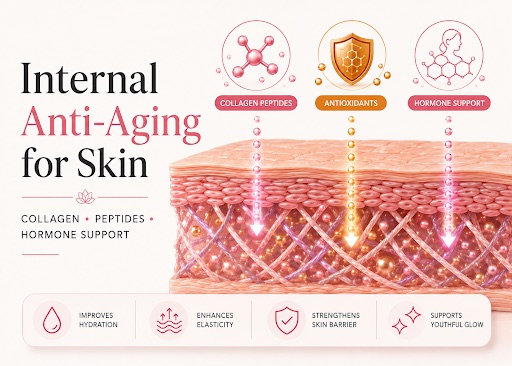
Most anti-aging routines focus on creams and serums. However, skin aging begins much deeper. Declining collagen production, oxidative stress, cellular damage, and hormonal changes gradually affect elasticity, hydration, and firmness. Systemic approaches that use internal peptides, antioxidants, and hormone support can target the biological causes of aging and promote healthier, more youthful-looking skin from within.
At Vita Bella, we focus on science-based skin health strategies that address the biological factors involved in skin aging. Peptides, antioxidants, balanced hormone function, and targeted supportive therapies may help support collagen production, hydration, and skin resilience. When combined with a healthy lifestyle and quality skincare routine, these therapies can help you maintain healthier-looking skin and long-term skin health.
Why Is Internal Collagen Support More Effective Than Topical Solutions for Skin Elasticity?
Internal collagen support is often more effective for skin elasticity because it targets the dermal matrix, where collagen, elastin, and other structural proteins maintain skin firmness. Unlike topical products, which primarily affect the skin’s surface, oral collagen peptides deliver essential amino acids throughout the body. Consequently, they support the biological processes responsible for skin strength, hydration, and long-term resilience from within.
Key mechanisms behind internal collagen support include:
Providing glycine, proline, and hydroxyproline, the primary amino acids required for collagen synthesis
Supporting fibroblast activity, which drives the production of new collagen fibers
Enhancing the integrity of the extracellular matrix (ECM) that maintains skin structure
Improving skin hydration by strengthening the dermal support network
Reducing age-related declines in collagen density
Supporting elastin function for improved flexibility and skin recoil
Complementing antioxidant defenses that protect collagen from oxidative damage
Promoting healthier connective tissue remodeling
Helping maintain skin thickness and dermal strength over time
Supporting overall skin resilience against environmental and biological stressors
These benefits make internal strategies particularly valuable for age-related skin changes.
A randomized, placebo-controlled study published in Skin Pharmacology and Physiology [1] found that women who consumed specific bioactive collagen peptides daily for eight weeks experienced significantly greater improvements in skin elasticity than those receiving a placebo. These findings suggest that oral collagen supplementation may help support skin structure and elasticity from within, highlighting its potential role in a comprehensive skin-health strategy.
Which Peptides Can Help Promote Youthful, Firm Skin from Within?
Peptides support skin rejuvenation through systemic bioactivity, where ingested peptides circulate and influence fibroblast function, collagen turnover, and extracellular matrix repair. Oral peptides work internally and provide sustained biological signaling. They help improve skin elasticity, hydration, and dermal strength from deeper structural layers.
These peptides enhance cellular communication pathways that regulate tissue repair and regeneration. In addition, they support antioxidant defenses and hormonal balance, both essential for maintaining youthful skin architecture. As a result, they complement topical treatments by addressing intrinsic aging mechanisms rather than only providing temporary surface-level improvements, leading to more stable and long-term skin benefits.
Research shows that a 2023 randomized controlled trial published in Food & Function [2] found that oral collagen peptide supplementation significantly improved skin hydration, elasticity, wrinkling, and desquamation compared with placebo. These findings suggest that bioactive collagen peptides can support skin health from within and may serve as a valuable component of a comprehensive skin-aging strategy.
How Do Antioxidants Protect Collagen and Slow Visible Signs of Skin Aging?
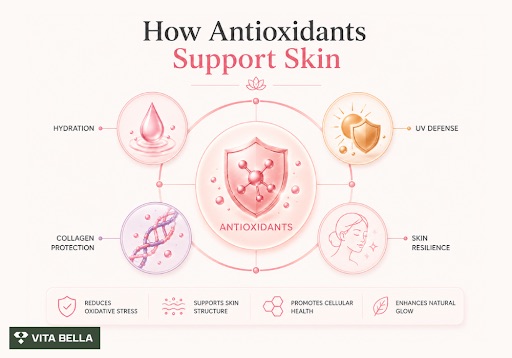
Antioxidants protect collagen by neutralizing reactive oxygen species (ROS) that accelerate breakdown of collagen, elastin, and extracellular matrix proteins. As oxidative stress rises with age, it triggers matrix metalloproteinases (MMPs), which degrade dermal structure and reduce firmness. Therefore, systemic antioxidant intake supports internal defense systems, improves fibroblast function, and helps maintain hydration and elasticity. This approach works alongside peptides and hormonal balance to strengthen skin from within rather than relying only on topical protection.
Research supports the role of antioxidants in maintaining skin health from within. A comprehensive review and meta-analysis published in Antioxidants [3] found that antioxidant-rich foods and supplements improved skin hydration, skin density, epidermal thickness, and resistance to UV-induced damage while helping reduce oxidative stress. These benefits may help support skin structure and overall skin resilience over time. As a result, antioxidant support can complement broader anti-aging strategies focused on collagen maintenance and cellular health.
What Role Does Hormonal Balance Play in Maintaining Hydrated and Youthful-Looking Skin?
Hormonal balance plays a critical role in maintaining hydrated, elastic, and youthful skin by regulating collagen synthesis, sebum production, and epidermal regeneration. Estrogen supports dermal matrix integrity and moisture retention, while thyroid hormones control cellular metabolism and repair speed. Meanwhile, IGF-1 influences tissue renewal. Therefore, systemic hormonal stability, combined with peptides and antioxidants, helps preserve skin structure and hydration from within effectively.
Estrogen and Dermal Collagen Maintenance
Estrogen enhances fibroblast activity and promotes synthesis of collagen types I and III, which maintain skin firmness and thickness. When estrogen declines with age, collagen breakdown accelerates, leading to dryness and wrinkles. Supporting hormonal balance through nutrition, lifestyle, and systemic anti-aging strategies helps slow these structural changes and improves long-term skin hydration and elasticity.
Thyroid Hormones and Skin Metabolic Turnover
Thyroid hormones regulate keratinocyte turnover and epidermal renewal, directly affecting skin smoothness and radiance. Low thyroid activity slows regeneration, resulting in rough, dry, and dull skin. Maintaining healthy thyroid function supports proper skin metabolism, improves hydration balance, and enhances overall dermal recovery, especially when combined with systemic peptide and antioxidant support.
Growth Hormone and Skin Regeneration Pathways
Growth hormone promotes collagen production, dermal repair, and tissue regeneration through IGF-1 signaling. Declining levels reduce skin thickness and elasticity over time. Systemic support through sleep quality, nutritional balance, and peptide-based strategies helps maintain these regenerative pathways, improving overall skin resilience and youthful appearance.
Research shows that hormonal changes play an important role in skin aging. A recent review in Cosmetics [4] reported that declining estrogen levels are associated with reduced collagen synthesis, decreased skin thickness, lower hydration, and increased wrinkle formation. The authors also noted that growth factors such as IGF-1 contribute to skin regeneration and tissue repair, highlighting the importance of maintaining hormonal and cellular health for long-term skin quality.
Transform Your Skin With Science-Backed Peptides, Collagen Support, and Hormone Optimization
You may notice that your skin no longer looks as firm, smooth, or radiant as it once did. Changes in collagen production, cellular repair, and hormone levels can gradually affect skin texture and elasticity from within. While topical products can support daily skincare, they often cannot address the internal factors that influence long-term skin health.
At Vita Bella, we take a personalized approach to healthy aging by evaluating factors that influence skin quality and creating customized skin health plans. Our goal is to support collagen health, cellular function, hormone balance, and overall skin resilience. Contact us today to schedule a consultation and learn which treatments may be right for your goals.
Frequently asked questions
Antioxidants cannot fully reverse established skin aging, but they significantly slow progression and improve skin quality. They reduce oxidative stress, protect collagen from degradation, and enhance cellular repair mechanisms. When combined with peptides and hormonal balance, antioxidants contribute to improved elasticity, reduced fine lines, and better long-term dermal resilience.
Most collagen and bioactive peptide supplements are considered safe for long-term use when taken at recommended doses. They are broken into amino acids during digestion and used naturally by the body. However, quality source, purity, and individual health conditions should be considered to ensure optimal safety and effectiveness.
Yes, hormonal changes affect skin differently due to variations in estrogen, testosterone, and growth hormone levels. Women experience more rapid collagen loss during menopause due to estrogen decline. Men often show gradual thinning of skin linked to testosterone and IGF-1 reduction, affecting elasticity, hydration, and repair capacity.
Healthy lifestyle choices such as adequate sleep, balanced nutrition, stress control, and sun protection significantly support natural collagen production. However, with aging, natural synthesis declines. Therefore, peptides and antioxidants may complement lifestyle measures rather than replace them, especially for maintaining long-term skin firmness and hydration.
Topical skincare remains important even with internal strategies. Internal peptides, antioxidants, and hormones improve structural skin health, while topical products protect against environmental damage and support surface hydration. Together, both approaches create a synergistic effect, improving skin texture, barrier function, and long-term anti-aging results more effectively.