Can stress lower testosterone? For chronic stress, the evidence suggests an association, not proven cause and effect: sustained high cortisol is tied to weaker GnRH and LH signaling and lower T. Acute stress may briefly raise T instead. For men with fatigue or low libido, a provider-led hormone therapy evaluation starts with labs showing where your levels stand.
Does stress actually lower testosterone?
For chronic stress, the evidence suggests an association, not a proven cause. So does stress lower testosterone in every man? Not necessarily. Individual responses vary, and one proposed explanation is the interaction between the HPA and HPG axes described below.
What happens to testosterone during acute stress?
Testosterone may briefly rise during acute stress. In a study of 58 medical students, men's salivary testosterone increased under exam stress (Afrisham et al., 2016). Findings on acute stress and testosterone are mixed, though.
How chronic stress may suppress T: the HPA-HPG axis
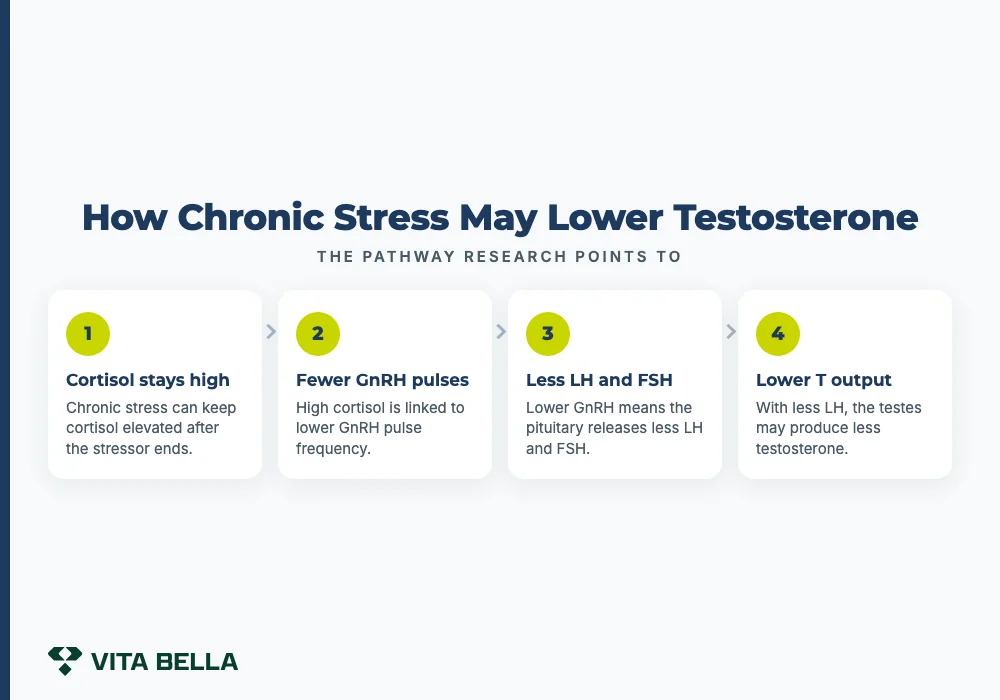
The hypothalamic-pituitary-adrenal (HPA) axis governs the stress response. The hypothalamic-pituitary-gonadal (HPG) axis governs testosterone production. These two systems overlap in the hypothalamus, and sustained HPA activation may suppress HPG signaling. The proposed cortisol and testosterone mechanism runs in steps, though it is an association, not a chain proven in every man.
How chronic stress may affect your hormones:
- Cortisol output can stay elevated well beyond the original stressor.
- The hypothalamus may reduce GnRH signaling in response to high cortisol.
- Lower GnRH causes the pituitary to release less LH and FSH.
- Reduced LH signals the testes to produce less testosterone.
- Disrupted sleep may blunt the normal overnight rise in testosterone.
Does cortisol lower testosterone directly?
Cortisol appears to act at more than one level. High cortisol is associated with lower T, and one commonly proposed route is indirect: sustained cortisol is linked to fewer GnRH pulses from the hypothalamus, which means a weaker LH signal reaching the testes.
In a study in men, Cumming et al. (1983) found that raising cortisol quickly lowered testosterone without changing LH, which points to a direct effect on the testes. Individual responses vary, which is why bloodwork matters more than any general estimate.
The link between testosterone and cortisol may also run the other way, with low T affecting mood and how you handle stress, though this two-way loop is not well established in human studies. That direction is a separate question, covered in the connection between low T and mental health.
Stress, sleep, and testosterone: how they interact
Can stress lower testosterone through disrupted sleep?
Can stress lower testosterone through sleep disruption alone? Possibly. Testosterone normally rises during overnight sleep, and stress often shortens or fragments sleep, which may blunt that nightly rise.
De Nys et al. (2022) found in a systematic review that physical activity programs lowered cortisol and improved sleep quality, which suggests cortisol and sleep are closely linked. Most trial participants were women with breast cancer, though, so the findings may not apply directly to men.
How do you know if stress is lowering your testosterone?
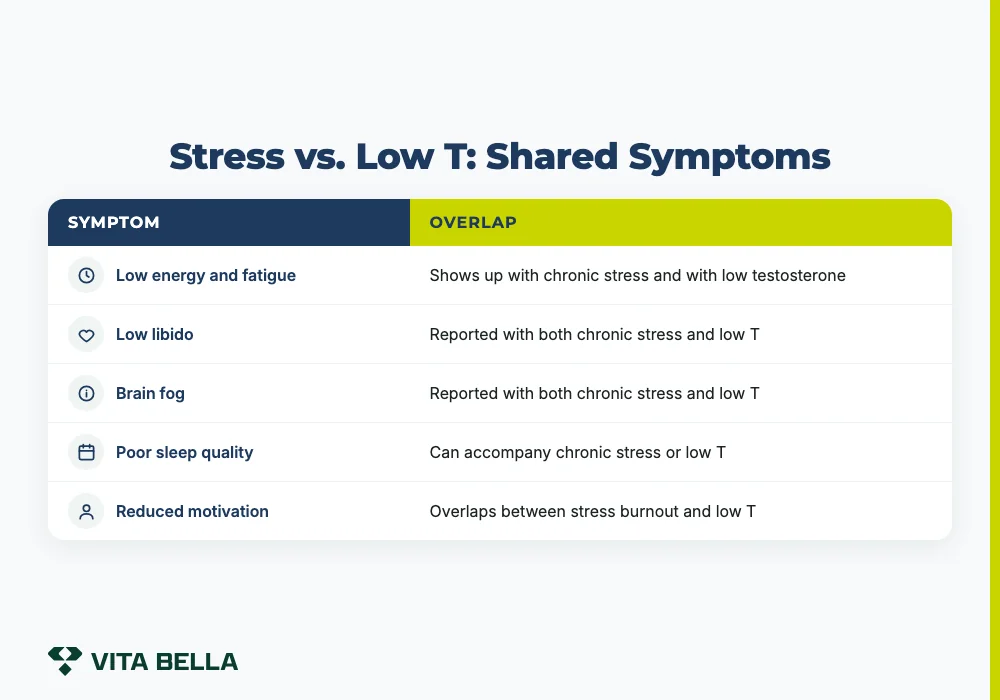
Symptoms alone cannot tell you. The overlap between chronic stress and low testosterone is too large to untangle without bloodwork.
Symptoms that point to both
| Chronic stress / burnout | Low testosterone | Appear in both |
|---|---|---|
| Racing thoughts, irritability | Reduced muscle mass | Low energy and fatigue |
| Difficulty switching off | Decreased morning erections | Low libido |
| Headaches, tension | Loss of strength | Brain fog |
| Appetite changes | Increased body fat | Poor sleep quality |
| Anxiety spikes | Mood flatness | Reduced motivation |
Fatigue, low libido, brain fog, and poor sleep show up with both stress and testosterone problems, which is why self-diagnosis keeps men stuck. Both guidelines cited below make lab testing, not symptoms alone, the required next step. A full breakdown of low testosterone symptoms shows the pattern, but only bloodwork reviewed by a licensed provider can confirm it.
What you can do about it
Lifestyle changes cannot confirm a hormone problem, but the habits below target the stress side; broader lifestyle habits that sabotage your testosterone levels have their own guide. If you already suspect low T, a provider-led evaluation through Vita Bella membership starts with labs, ordered by your provider and billed separately.
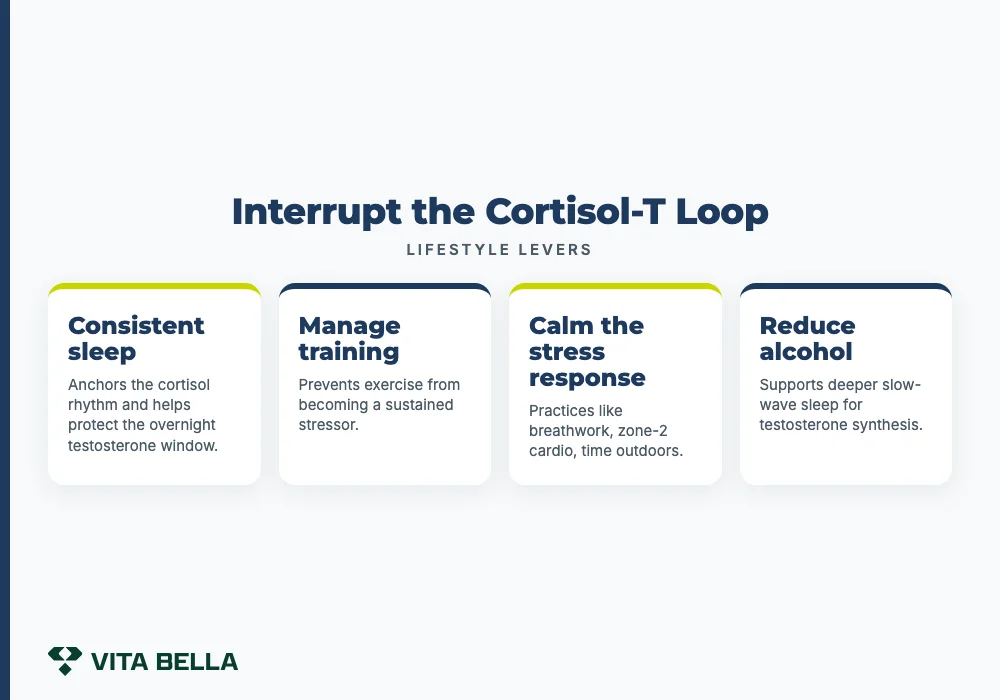
Habits that target the stress side:
- A consistent sleep schedule supports normal overnight hormone rhythms, including the nightly rise in testosterone.
- Managing training load helps keep exercise from becoming one more stressor; in the Moyers et al. (2023) meta-analysis in Biological Psychology, more physical activity was linked to a slightly healthier daily cortisol rhythm.
- Mindfulness-based practice and relaxation training produced modest cortisol reductions in the randomized trials pooled by Rogerson et al. (2024).
- Cutting back on alcohol supports less fragmented sleep, which matters because testosterone normally rises overnight.
The metabolic side of the same pattern is covered in how stress and cortisol affect weight loss.
When to stop guessing and check your labs
Can stress lower testosterone enough to matter clinically? Only a lab panel reviewed by a licensed provider can answer that for your situation.
A guideline-based evaluation centers on total testosterone, with free testosterone, SHBG, LH, and FSH measured when needed. Total T sets the baseline, free T reflects what tissues can use, SHBG explains the gap between the two, and LH and FSH help show whether the problem starts in the testes or upstream in the pituitary or hypothalamus.
The Endocrine Society (Bhasin et al., 2018) and the AUA (Mulhall et al., 2018) both start with a morning total testosterone level confirmed on a repeat test, then add other markers when results call for them. Reading these results is covered in when "normal" labs still leave you feeling suboptimal.
Ready to know where your testosterone stands?
Stress and low testosterone share enough symptoms that self-assessment gives men nowhere to go. A lab panel reviewed by a licensed provider is the only reliable way to see where your levels actually are. Members get wholesale pricing on medications, billed separately from the membership fee.
Frequently asked questions
Chronic stress is associated with lower T, but whether levels stay low long-term has not been well studied and likely varies between men. Labs taken after a prolonged stressful period give a provider the clearest picture of where your testosterone stands.
High cortisol is associated with lower testosterone. The best-described route is indirect: weaker GnRH signals mean the pituitary releases less LH and FSH, so the testes get a weaker signal to make testosterone. Cortisol may also act on the testes directly, and the effect varies between men, so labs matter more than any general estimate.
Anxiety activates the same HPA-axis stress response as other stressors, which can elevate cortisol and, if sustained, may suppress testosterone, either by weakening the GnRH and LH signal or by acting on the testes directly. Individual responses vary, and only labs can confirm whether your testosterone is actually affected.
Psychological stress management, especially mindfulness and relaxation training, modestly lowered cortisol in the Rogerson et al. (2024) meta-analysis. That review did not measure testosterone, so whether lowering stress raises T has not been established; a lab panel shows where your levels stand far more reliably than any symptom checklist.
Fatigue, low libido, brain fog, and poor sleep appear with both stress burnout and low testosterone, so symptoms alone cannot separate them. The right next step is a lab panel ordered and reviewed by a licensed provider.
Sources
- Rogerson O et al. (2024). Effectiveness of stress management interventions to change cortisol levels: a systematic review and meta-analysis. Psychoneuroendocrinology. PubMed
- Bhasin S et al. (2018). Testosterone Therapy in Men With Hypogonadism: An Endocrine Society Clinical Practice Guideline. Journal of Clinical Endocrinology and Metabolism. PubMed
- De Nys L et al. (2022). The effects of physical activity on cortisol and sleep: A systematic review and meta-analysis. Psychoneuroendocrinology. PubMed
- Mulhall JP et al. (2018). Evaluation and Management of Testosterone Deficiency: AUA Guideline. Journal of Urology. PubMed
- Moyers SA et al. (2023). Physical activity and cortisol regulation: A meta-analysis. Biological Psychology. PubMed
- Cumming DC, Quigley ME, Yen SS (1983). Acute suppression of circulating testosterone levels by cortisol in men. Journal of Clinical Endocrinology and Metabolism. PubMed
- Afrisham R et al. (2016). Salivary testosterone levels under psychological stress and its relationship with rumination and five personality traits in medical students. Psychiatry Investigation. PubMed