CJC-1295 ipamorelin is a paired peptide stack that prompts the body's own growth hormone release rather than supplying GH from outside. Unlike traditional hormone therapy, which often bypasses the pituitary, this combination targets two separate GH receptors at once, amplifying the body's own pulsatile GH release. A licensed provider evaluates your labs and symptoms, then designs a protocol matched to your physiology. The practical result is a more complete GH signal than either peptide generates on its own.
How CJC-1295 ipamorelin works
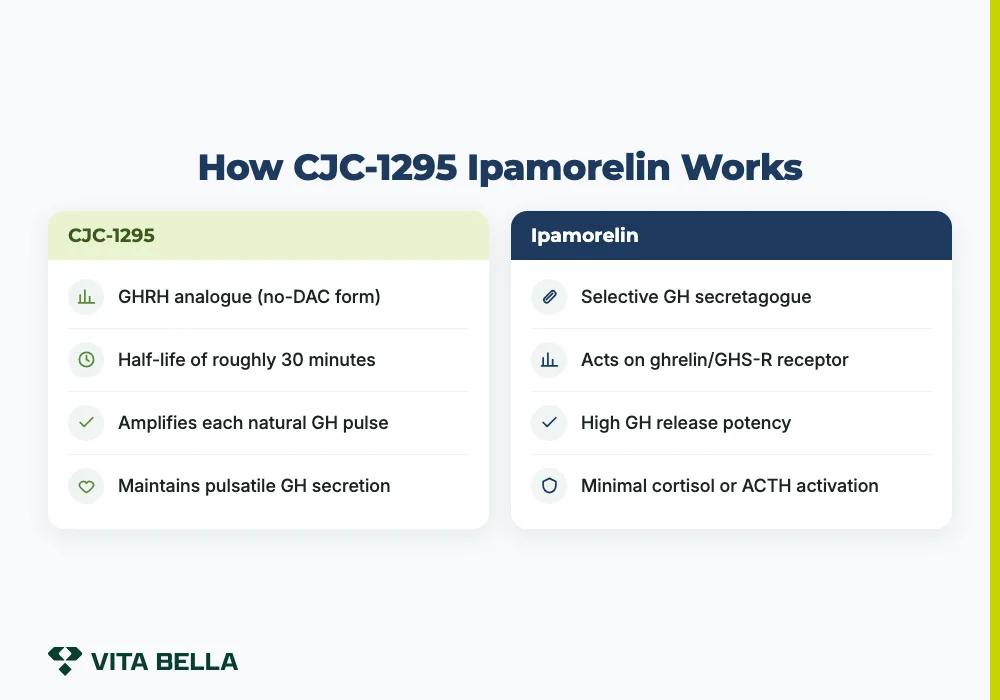
CJC-1295 is a growth hormone-releasing hormone (GHRH) analogue that comes in two forms: with DAC, which binds serum albumin and lasts for days, and without DAC — the form used in provider protocols — with a half-life of roughly 30 minutes. A 2006 study by Teichman et al. in the Journal of Clinical Endocrinology and Metabolism found that a single injection of the DAC version raised GH 2- to 10-fold and increased IGF-1 by 1.5- to 3-fold over baseline for several days, and with repeated dosing IGF-1 stayed above baseline for up to 28 days. Those pharmacokinetics belong to the DAC form only: the no-DAC form clears within the hour, so IGF-1 changes build from repeated pulses across a course of therapy. Ionescu and Frohman (2006) confirmed that pulsatile GH secretion is preserved throughout, which matters clinically because flat continuous GH can desensitize receptors over time.
Ipamorelin is a selective growth hormone secretagogue acting on the ghrelin/GHS-R receptor. Raun et al. (1998) in European Journal of Endocrinology documented high GH release potency with minimal activation of cortisol or ACTH. That selectivity is a practical advantage. Older GH-releasing peptides raise appetite and cortisol alongside GH; ipamorelin largely avoids that.
Combined, these are complementary signals. CJC-1295 raises the basal level over days and weeks. Ipamorelin adds sharp peaks at each dose. The resulting pattern more closely mimics natural pituitary output than either compound alone.
What are the benefits of combining CJC-1295 with ipamorelin?
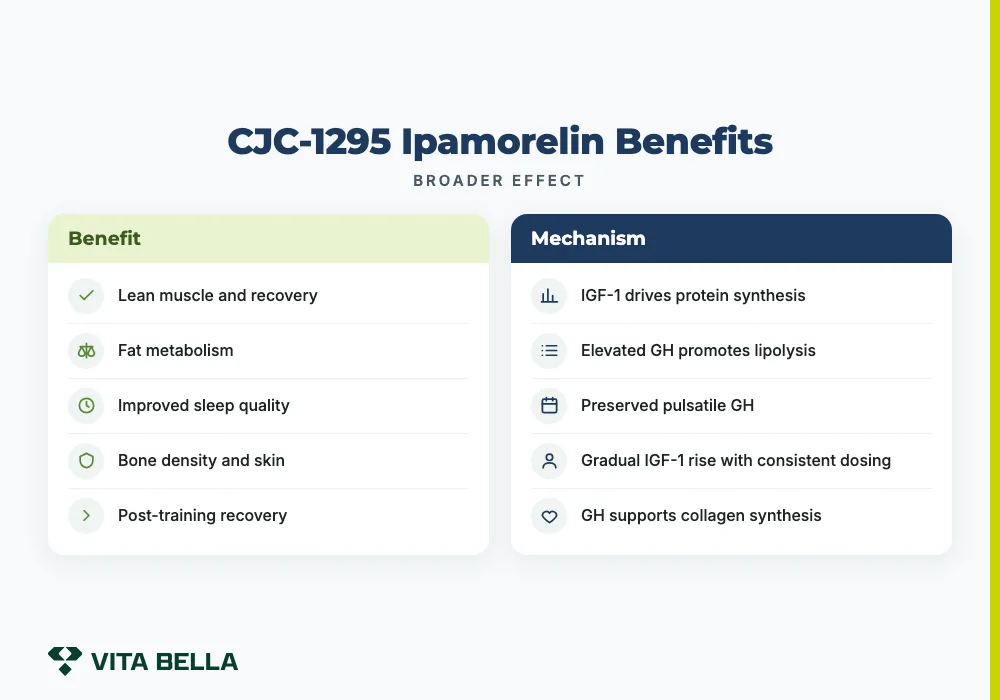
The CJC-1295 ipamorelin combination produces a broader effect than either peptide alone. The table below summarizes the core GHRH peptide benefits the research supports:
| Benefit | Mechanism | Research basis |
|---|---|---|
| Lean muscle and recovery | IGF-1 drives protein synthesis and accelerates tissue repair | Teichman et al., 2006; Ionescu & Frohman, 2006 |
| Fat metabolism | Elevated GH promotes lipolysis | Raun et al., 1998 |
| Sleep quality | Preserved pulsatile GH aligns with deep sleep repair cycles | Ionescu & Frohman, 2006 |
| Bone density and skin | Long-term IGF-1 elevation is associated with improved skin elasticity and bone health | Alba et al., 2006 |
| Post-training recovery | GH supports collagen synthesis and cellular regeneration | Ionescu & Frohman, 2006 |
Sleep quality typically improves before body composition shifts. Most users notice better mornings within two weeks before physical changes become visible. That pattern reflects the amplified GH pulses taking effect early, with IGF-1 changes accumulating gradually across weeks of consistent dosing.
Anti-aging peptide therapy with the CJC-1295 ipamorelin stack differs from exogenous HGH in a clinically meaningful way: it keeps the pituitary in the loop. The hypothalamic-pituitary axis continues regulating GH output, reducing receptor desensitization risk across a longer program. Muscle recovery peptides work because GH and IGF-1 are upstream signals for nearly every tissue repair process, from muscle fiber rebuilding to collagen synthesis in tendons and joints.
How long does it take to see results from CJC-1295 and ipamorelin?
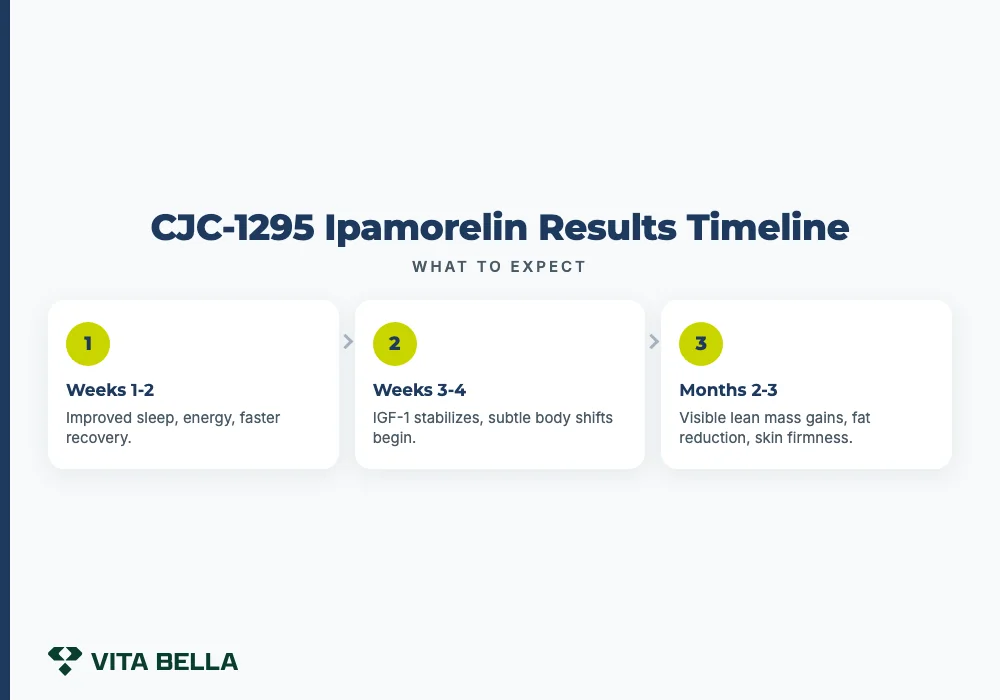
Most people notice early signs within one to two weeks. Meaningful body composition changes follow at three to four weeks. The ipamorelin results timeline breaks down roughly like this:
Weeks 1-2: Sleep depth improves first. Morning energy follows. Post-workout soreness resolves faster. These early changes reflect ipamorelin's acute GH pulses at each dose.
Weeks 3-4: IGF-1 stabilizes at elevated levels as CJC-1295's action builds. Body composition shifts begin, subtle at first. Active users report noticeably shorter recovery windows between training sessions.
Months 2-3: Lean mass gains and fat reduction become visible. Skin firmness often improves. Weeks of repeated, amplified GH pulses are now compounding into cumulative effects.
The research anchors this progression. Teichman et al. (2006) documented IGF-1 elevation persisting up to 28 days with repeated dosing of the DAC version of CJC-1295 — a duration that does not transfer to the no-DAC form used in provider protocols. Gobburu et al. (1999) showed ipamorelin's GH peak arrives approximately 40 minutes post-dose and clears within a few hours, consistent with the rapid early changes users notice. Baseline hormone levels, age, body composition, and training load all shape how quickly the full effect materializes.
What is the best time to take CJC-1295 and ipamorelin?
There is no universal timing answer. Timing is a clinical decision based on your lab values, daily schedule, and individual GH response pattern.
The reasoning providers use is consistent. GH naturally peaks during deep sleep stages. Many protocols direct at least one dose before bed to align the induced GH pulse with that natural window. Fasting state is also relevant: elevated blood glucose blunts GH release, so providers typically instruct patients to avoid eating one to two hours before injecting.
For active people, timing around training can extend recovery benefits. But workout timing versus sleep timing involves trade-offs that depend on individual GH patterns and lifestyle. Your first lab panel gives the provider a baseline. The first monitoring period lets them fine-tune the schedule based on actual response.
How do you dose CJC-1295 and ipamorelin together?
A licensed provider determines the dose after labs. No uniform protocol applies across patients.
Before writing a schedule, a provider reviews IGF-1, GH patterns, body composition, kidney and liver function, and symptom severity. Gobburu et al. (1999) used pharmacokinetic-pharmacodynamic modeling to quantify how significantly individuals differ in GH response to the same ipamorelin input. That variability is well documented. It is why self-directed dosing of the CJC-1295 ipamorelin combination carries real clinical risk.
Clinical trials by Teichman et al. (2006) and Ionescu and Frohman (2006) monitored GH and IGF-1 at multiple timepoints to establish effective ranges. Your provider follows the same approach, using your labs rather than population averages. For a closer look at how providers structure and adjust programs over time, our guide to multi-peptide program structure covers the key variables.
Lab draws at defined intervals during the program allow the provider to track IGF-1, confirm the target range is met, and adjust if values drift.
Can CJC-1295 and ipamorelin increase height?
Not in adults. Height depends on open epiphyseal (growth) plates, which close in the late teens for most people. After closure, elevated GH and IGF-1 affect bone density and tissue composition. They do not drive vertical growth.
In patients with documented GH deficiency and still-open growth plates, GH therapy can normalize growth. That is a separate pediatric clinical indication. Alba et al. (2006) studied CJC-1295 in a GH-deficient mouse model and found growth normalization, not supraphysiologic enhancement. Adult anti-aging peptide therapy protocols target body composition, recovery, and aging. Height is not a clinically relevant endpoint for adults on CJC-1295 ipamorelin programs.
CJC-1295 ipamorelin vs. other growth hormone peptides
Compared to common alternatives, the CJC-1295 ipamorelin stack stands out through receptor specificity and pulsatility preservation.
Sermorelin is also a GHRH analogue but shorter-acting. It requires more frequent dosing to maintain stable IGF-1 elevation. A direct comparison of tesamorelin and sermorelin covers the GHRH peptide class and how half-life differences affect clinical outcomes and patient experience.
Recombinant HGH supplies exogenous growth hormone directly, bypassing pituitary control. It produces higher peak GH but without physiological pulsatility. Teichman et al. (2006) highlighted this distinction as clinically relevant for longer-term programs where receptor sensitivity matters.
GHRP-6 is the closest alternative to ipamorelin in the GH-releasing peptide class. Camanni et al. (1998) documented that GHRP-6 activates cortisol and drives appetite significantly more than ipamorelin. That side-effect profile is why ipamorelin has largely replaced GHRP-6 in clinical practice for recovery and anti-aging applications.
Who is a candidate for CJC-1295 ipamorelin therapy?
Peptide therapy for recovery is appropriate when symptom patterns align with GH decline and labs confirm it.
Typical candidates include adults over 30 with slow post-training recovery, those with IGF-1 values at the low end of the reference range or below, and people experiencing poor sleep, low energy, and body composition changes that do not respond proportionally to diet and training effort. For people managing joint injuries or chronic tissue stress, GH's role in collagen synthesis makes CJC-1295 ipamorelin relevant beyond aesthetic goals. Muscle recovery peptides address these applications directly.
People who are not candidates include those with active malignancy, since GH signaling can influence tumor growth, as well as those with uncontrolled diabetes or certain pituitary conditions. A provider rules these out during the initial consultation and lab review.
For people also managing body composition during a GLP-1 program, preserving muscle during GLP-1 weight loss covers how growth hormone peptides interact with caloric restriction and why muscle retention is harder without GH support.
Ready to start CJC-1295 ipamorelin therapy?
If recovery is stalling, sleep is not restoring, and body composition is shifting despite real effort, your GH axis may be the underlying factor. Labs tell the story. Get Started with a brief intake quiz to find out whether CJC-1295 ipamorelin therapy fits your profile.
Frequently asked questions
CJC-1295 and ipamorelin target two separate GH pathways at once. In its no-DAC form, CJC-1295 amplifies each GH pulse for roughly half an hour after injection, while ipamorelin triggers the pulse itself; only the separate DAC version sustains levels for days. Together they support lean muscle retention, faster tissue repair, fat metabolism, and improved sleep quality.
Most users notice improved sleep and faster post-training recovery within one to two weeks. Visible body composition changes typically develop over three to four weeks as IGF-1 stabilizes from CJC-1295. Longer-term outcomes depend on baseline hormone levels, age, and training consistency.
A licensed provider determines the dose and schedule after reviewing baseline labs, including IGF-1 and GH panel values. Individual GH responses vary significantly, as documented in pharmacokinetic-pharmacodynamic research. No standard protocol applies across patients, and monitoring continues through the program to allow adjustments based on lab values.
Not in adults. Growth plates close in the late teens, after which elevated GH and IGF-1 affect bone density rather than bone length. Height-related GH therapy is a separate clinical area and does not apply to adult recovery or anti-aging peptide protocols.
Sources
- Teichman, S. L., et al. (2006). A single injection of CJC-1295 increases GH and IGF-1 secretion in healthy adults. Journal of Clinical Endocrinology and Metabolism. PubMed
- Raun, K., et al. (1998). Ipamorelin, the first selective growth hormone secretagogue. European Journal of Endocrinology. PubMed
- Ionescu, M., & Frohman, L. A. (2006). Pulsatile secretion of GH persists during continuous stimulation by CJC-1295. Journal of Clinical Endocrinology and Metabolism. PubMed
- Alba, M., et al. (2006). Once-daily administration of CJC-1295 normalizes growth in the GHRH knockout mouse. American Journal of Physiology, Endocrinology and Metabolism. PubMed
- Teichman, S. L., et al. (2006). Prolonged stimulation of GH and IGF-1 secretion by CJC-1295 in healthy adults. Journal of Clinical Endocrinology and Metabolism. DOI
- Gobburu, J. V., et al. (1999). Pharmacokinetic-pharmacodynamic modeling of ipamorelin in human volunteers. Pharmaceutical Research. PubMed
- Camanni, F., Ghigo, E., & Arvat, E. (1998). Growth hormone-releasing peptides and their analogs. Frontiers in Neuroendocrinology. PubMed