
Elamipretide benefits come from one mechanism: protecting the inner mitochondrial membrane so cells can produce ATP reliably under metabolic stress. SS-31 accumulates inside mitochondria. It binds cardiolipin, reduces reactive oxygen species at their source, and restores bioenergetic output across organ systems, providing direct mitochondrial energy support where it matters most. At Vita Bella, SS-31 peptide therapy is evaluated against your actual labs before any protocol is set.
What is elamipretide used for?
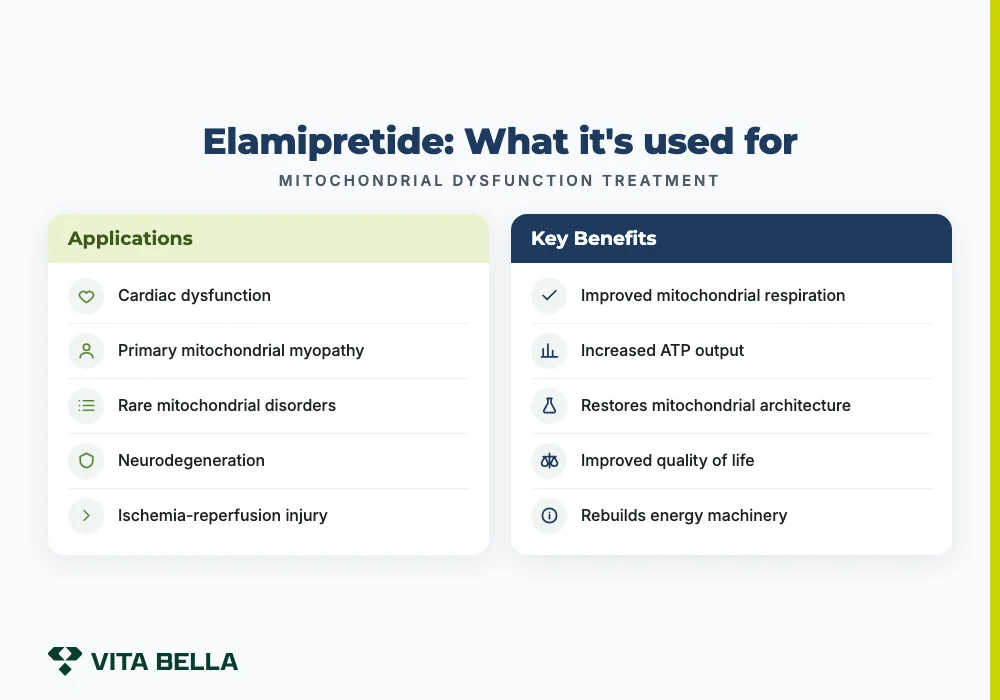
Elamipretide is a mitochondrial dysfunction treatment, not a general wellness supplement. A 2025 review in the International Journal of Molecular Sciences (Tung, 2025) identifies it as a tetrapeptide engineered to restore mitochondrial architecture, with therapeutic relevance across several disease categories including heart failure, primary mitochondrial myopathies, sarcopenia, neurodegeneration, and ischemia-reperfusion organ injury. Research on elamipretide benefits has focused on three key areas:
| Application | Evidence type | Key finding |
|---|---|---|
| Cardiac dysfunction | Human tissue and translational studies | Improved mitochondrial respiration and ATP output in failing heart tissue (Chatfield et al., 2019) |
| Primary mitochondrial myopathy | Randomized clinical trial (MMPOWER-3) | Evaluated efficacy and safety in adults with confirmed mitochondrial disease (Karaa et al., 2023) |
| Rare mitochondrial disorders | Expanded-access case series | Improved quality of life in patients with ophthalmic mitochondrial symptoms (Ansari & Koenig, 2024) |
Across all three, the shared driver is failing ATP production at the cellular level. Where mitochondria break down, elamipretide benefits center on rebuilding the machinery that generates energy.
How does SS-31 improve mitochondrial function?
The mechanism centers on SS-31 cardiolipin binding, a direct interaction with the phospholipid that anchors the inner mitochondrial membrane's respiratory complexes. When cardiolipin degrades, membrane architecture collapses. Electron transport efficiency drops. ATP output falls.
SS-31 acts as a mitochondria targeted antioxidant and structural stabilizer at four points in that cascade:
- ROS reduction: SS-31 lowers intramitochondrial reactive oxygen species, reducing oxidative damage to lipids, proteins, and mitochondrial DNA.
- Cristae stabilization: Binding cardiolipin preserves the folded inner-membrane structures that house the electron transport chain.
- ETC efficiency: Protected respiratory complexes transfer electrons more reliably, raising ATP synthesis under metabolic stress.
- Membrane potential: Stabilized membranes resist swelling and maintain the voltage gradient required for ATP production.
A 2019 study in JACC: Basic to Translational Science (Chatfield et al.) documented these effects in failing human heart tissue, showing measurable improvements in mitochondrial respiration after SS-31 exposure.
What does SS-31 peptide do for aging?
Mitochondrial quality declines with age. That decline cuts ATP availability in muscle, brain, and organs. Fatigue, sarcopenia, and slower cellular repair follow. As a cellular energy peptide, SS-31 addresses the bioenergetic root of the problem rather than treating downstream symptoms, and aging models show improvements in mitochondrial quality markers, enhanced muscle endurance, and restored aspects of cellular repair.
These elamipretide benefits make SS-31 relevant beyond patients with diagnosed mitochondrial disease. Research on age-related cellular energy loss and NAD+ decline shows a parallel mechanism: multiple aging pathways converge on the same ATP shortfall.
Clinical evidence for elamipretide benefits
The evidence base for elamipretide benefits spans preclinical models, human tissue studies, and controlled clinical trials, with a consistent biological signal across tissue types.
Preclinical data are reproducible. Multiple studies show SS-31 improves mitochondrial respiration, reduces oxidative markers, and restores ATP in aged and diseased cells, findings summarized in Ansari and Koenig's 2024 expanded-access case series in Clinical Case Reports.
The strongest clinical data come from MMPOWER-3, a randomized trial published in Neurology (Karaa et al., 2023) that enrolled adults with confirmed primary mitochondrial myopathy and systematically assessed efficacy and safety. An earlier 2018 dose-escalation study in Neurology by the same group defined the initial tolerability profile (Karaa et al., 2018).
In cardiac tissue, Chatfield et al. examined myocardial samples from end-stage heart failure patients. SS-31 improved oxygen flux and bioenergetic metrics directly in that tissue. A 2024 study in Biochimica et Biophysica Acta: Bioenergetics (Granata et al.) independently linked mitochondrial bioenergetic dysfunction to cardiac tissue pathology, reinforcing the mechanistic rationale.
For context on how providers build multi-compound programs around compounds like SS-31, the overview of structured peptide program design covers how protocols are sequenced and adjusted over time.
Elamipretide SS-31 dosage: how a provider sets it
Elamipretide SS-31 dosage is not a fixed number. Clinical trials used repeated subcutaneous or intravenous administration with schedules that varied by indication, patient baseline, and study design (Karaa et al., 2018). A licensed provider determines the dose after reviewing labs and organ function panels. Self-dosing is not appropriate for a compound at this stage of clinical development.
What a provider weighs when setting the dosing protocol:
- Type and severity of mitochondrial dysfunction determine the therapeutic target.
- Target organ system (cardiac, musculoskeletal, or neurological) shapes the dosing approach.
- Baseline metabolic, renal, and hepatic function markers inform safety thresholds.
- Clinical response during the initial treatment period guides any adjustments.
Bioenergetic changes can appear within days to weeks. Functional gains, such as improved endurance and organ protection, typically develop over weeks to months, consistent with translational and clinical data (Karaa et al., 2018).
What are the side effects of elamipretide therapy?
The elamipretide benefits documented in trials come with a positive early safety profile. SS-31 has been well tolerated across study cohorts, with few and generally mild adverse events in clinical and expanded-access reports (Ansari & Koenig, 2024). MMPOWER-3 provided the most systematic safety data in a defined patient population (Karaa et al., 2023).
Recommended monitoring includes metabolic panels and organ function tests covering kidney, liver, and cardiac markers where relevant. Large-scale, long-term data across diverse populations remain limited, as noted in Sabbah's 2021 review in Heart Failure Reviews. Broader controlled trials are still needed to fully characterize contraindications and long-term risk.
What is elamipretide's regulatory status?
In September 2025, elamipretide received accelerated approval from the FDA under the brand name Forzinity, indicated to improve muscle strength in patients with Barth syndrome, a rare mitochondrial disorder. It is the first mitochondria-targeted therapy to reach FDA approval. For uses beyond Barth syndrome, elamipretide remains investigational and has been studied under research protocols, including expanded-access programs for patients with rare mitochondrial disorders (Ansari & Koenig, 2024). Where it is prescribed for those broader uses, it is compounded and dispensed through licensed compounding pharmacies.
That regulatory status makes provider oversight essential. A licensed clinician evaluates whether the compound fits your clinical picture, orders relevant labs, and adjusts the protocol based on your response over time.
Get started with a provider evaluation
Mitochondrial dysfunction presents as fatigue, poor recovery, and reduced endurance. Labs are what separate those symptoms from other causes. If the clinical evidence for elamipretide benefits fits your situation, Get Started with a licensed provider evaluation to determine whether SS-31 peptide therapy belongs in your protocol.
Frequently asked questions
Elamipretide is used as a mitochondrial dysfunction treatment in conditions where cellular energy failure drives symptoms, including heart failure, primary mitochondrial myopathy, and rare mitochondrial disorders. It targets the inner mitochondrial membrane to restore ATP production and reduce oxidative damage.
SS-31 binds cardiolipin in the inner mitochondrial membrane, stabilizing the structures that house the electron transport chain. That stabilization reduces reactive oxygen species, raises ATP output, and preserves the membrane potential required for efficient energy production.
Clinical and expanded-access studies report mostly mild adverse events with generally good tolerability across study cohorts. Monitoring during therapy includes metabolic panels and organ function tests; long-term safety data across larger populations are still being gathered.
Elamipretide received accelerated approval from the FDA in September 2025 under the brand name Forzinity, for improving muscle strength in patients with Barth syndrome. Other uses remain investigational and are available through compounding channels, prescribed by licensed providers who evaluate individual eligibility based on labs and clinical history.
SS-31 targets age-related mitochondrial decline by reducing reactive oxygen species, preserving inner-membrane structure, and restoring ATP production in muscle and other tissues. That makes it relevant to fatigue, sarcopenia, and reduced exercise tolerance linked to declining mitochondrial function.
Sources
- Tung, C. (2025). Elamipretide: A Review of Its Structure, Mechanism of Action, and Therapeutic Potential. International Journal of Molecular Sciences. PubMed
- Sabbah, H. N. (2021). Elamipretide for Barth syndrome cardiomyopathy: gradual rebuilding of a failed power grid. Heart Failure Reviews. PubMed
- Ansari, S., & Koenig, M. K. (2024). Expanded-access use of elamipretide improves quality of life in patients with rare mitochondrial disorders characterized by ophthalmic symptoms. Clinical Case Reports. PubMed
- Chatfield, K. C. et al. (2019). Elamipretide improves mitochondrial function in the failing human heart. JACC: Basic to Translational Science. PubMed
- Karaa, A. et al. (2023). Efficacy and Safety of Elamipretide in Individuals with Primary Mitochondrial Myopathy: The MMPOWER-3 Randomized Clinical Trial. Neurology. PubMed
- Karaa, A. et al. (2018). Randomized dose-escalation trial of elamipretide in adults with primary mitochondrial myopathy. Neurology. PubMed
- Granata, S. et al. (2024). Mitochondrial bioenergetic dysfunction linked to myxomatous mitral valve degeneration explored by PBMCs metabolism analysis. Biochimica et Biophysica Acta: Bioenergetics. PubMed