

Testosterone Replacement Therapy (TRT) offers substantial benefits for men with low testosterone, improving mood, energy, libido, bone density, and muscle mass. However, one significant downside often under‑discussed is its impact on fertility. Because exogenous testosterone suppresses the body’s natural hormonal regulation via the hypothalamic–pituitary–gonadal (HPG) axis, TRT can lead to decreased sperm production, testicular atrophy, and, in many cases, infertility.
At Vita Bella, we understand the importance of maintaining fertility while undergoing Testosterone Replacement Therapy (TRT). While TRT is effective in restoring testosterone levels, it can disrupt sperm production and fertility. That’s why we offer comprehensive solutions, including hCG and enclomiphene, to help you preserve your reproductive health during therapy. Trust Vita Bella to support your journey to optimal health and fertility, no compromises needed. Let us help you navigate TRT while maintaining your ability to conceive.
How Does TRT Disrupt Fertility Through the Negative Feedback Loop?
TRT introduces exogenous testosterone into the bloodstream. This signals the hypothalamus and pituitary to reduce secretion of gonadotropin‑releasing hormone (GnRH), luteinizing hormone (LH), and follicle‑stimulating hormone (FSH). With low LH and FSH, the testes receive little stimulation. As a result, their endogenous testosterone production, especially intratesticular testosterone (ITT), drops precipitously.
A review1 explains that high ITT is essential for sperm production (spermatogenesis). When synthetic testosterone is administered exogenously, the hypothalamic-pituitary axis experiences negative feedback that inhibits GnRH, which in turn inhibits FSH and LH synthesis. Exogenous testosterone treatments have the potential to significantly impair spermatogenesis at ITT values below 20 ng/mL, perhaps leading to azoospermia (little to no sperm production).
Studies2 show exogenous testosterone alone can suppress ITT by up to 94%. Clinically3, this can result in reduced sperm count or even azoospermia (no sperm), a significant concern for men who want to preserve fertility. More than a thousand Chinese patients were shown to benefit from TRT preparation (testosterone undecanoate) as a contraceptive, and 93%–99% of men showed azoospermia after three months of treatment. Thus, while TRT may restore “normal” serum testosterone levels and improve symptoms of hypogonadism, it often does so at the expense of sperm production and reproductive potential.
How Does hCG Support Fertility While on TRT?
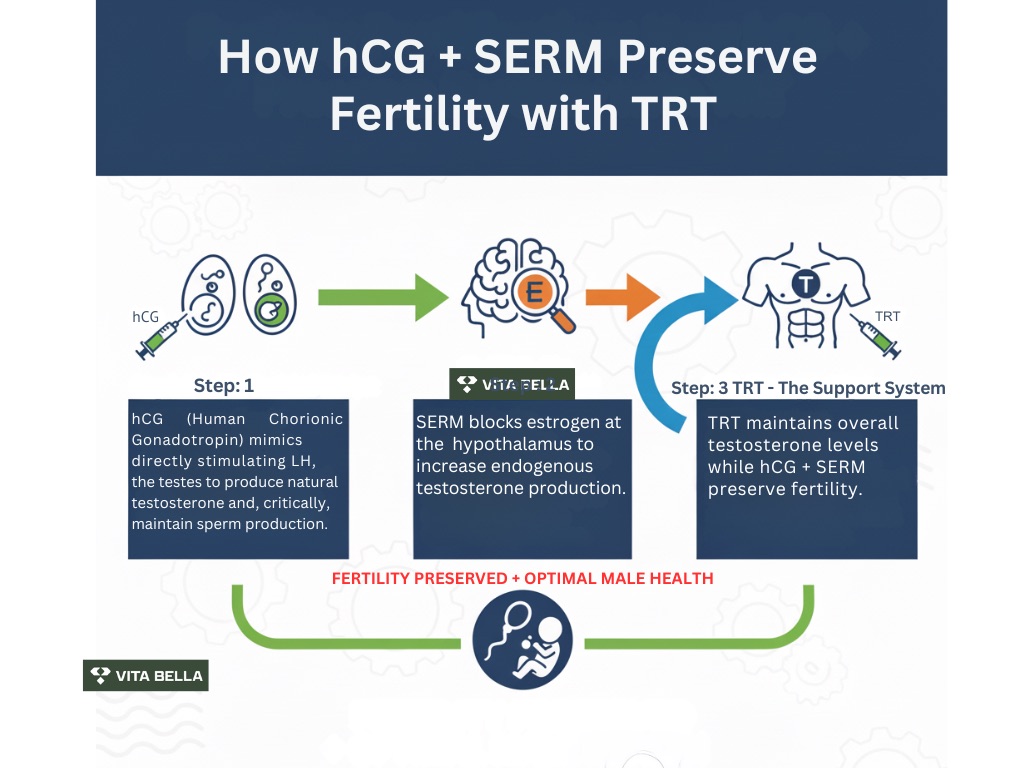
Not all hope is lost. One of the most studied and practical strategies to preserve fertility during TRT is the use of hCG. This hormone mimics LH, thereby stimulating the testes to produce endogenous testosterone and maintain spermatogenesis. hCG helps preserve testicular function, preventing atrophy and supporting sperm production. The key findings include:
In one retrospective study4 of hypogonadal men on TRT + low‑dose hCG (500 IU every other day), semen parameters (volume, density, motility) remained stable over more than a year; no patient became azoospermic, and 9 of 26 men achieved pregnancy with their partner.
A classic study5 in healthy men demonstrated that low‑dose hCG (125–500 IU every other day) maintained ITT close to or above baseline, despite suppressed gonadotropins and exogenous testosterone.
A comprehensive review6 concluded that by co‑administering hCG with TRT, spermatogenesis can often be preserved, making fertility preservation a realistic goal for men requiring TRT.
What are the Benefits of hCG with TRT?
Combining hCG with TRT ensures more comprehensive hormonal support. hCG helps maintain fertility during TRT by stimulating the testes to produce testosterone and sperm, preventing testicular atrophy. It also supports natural testosterone production, improving hormonal balance. The benefits of combining hCG with TRT are outlined in the following points:
Maintains intratesticular testosterone (the key driver of sperm production) even when the HPG axis is suppressed.
Prevents testicular atrophy and preserves semen parameters (sperm count, motility, volume) during TRT.
Offers a viable path for men wanting to treat hypogonadism without sacrificing fertility.
Is SERM Therapy (Enclomiphene / Clomiphene) an alternative or complementary option to hCG with TRT?
Some men, especially those concerned about fertility, might consider alternatives to classical TRT. One option is oral SERM therapy, using enclomiphene citrate (or its racemic mixture clomiphene). A 2016 study7 found that oral enclomiphene in obese hypogonadal men increased total testosterone (TT), LH, and FSH while preserving sperm concentration in the normal range, unlike transdermal testosterone, which lowered sperm counts.
A recent meta-analysis of randomized trials8 compared SERM therapy (clomiphene/enclomiphene) versus topical testosterone and placebo. It found that SERM therapy significantly raised TT by 274 ng/dL compared with placebo, improved LH and FSH, and maintained or improved semen parameters when compared to testosterone gel.
Can combining hCG and SERM be a comprehensive fertility-preserving strategy?
For men on TRT (or coming off it) who wish to conceive, combining hCG with a SERM may maximize the odds of maintaining or restoring fertility. A 2021 study9 evaluated the combined therapy of hCG + clomiphene citrate over 12 months in men with hypogonadism. Nearly half (47.4%) showed restored normal hormone secretion and improved sperm production.
This combination works synergistically: hCG maintains intratesticular testosterone (supporting sperm production), while SERM stimulates LH/FSH release, promoting natural hormone production and reducing reliance on exogenous testosterone or hCG alone. In practice, this “dual‑therapy” or “fertility‑preserving TRT” approach offers a way for men to manage hypogonadism symptoms while keeping their reproductive capacity intact.
Achieve Peak Testosterone and Secure Your Fertility via Vita Bella
Testosterone replacement therapy (TRT) is an effective treatment for low testosterone, but it can cause fertility issues. Many men find that TRT suppresses their sperm count, which is a primary concern if they wish to have children. As a result, the long-term effects of TRT on fertility can be troubling, especially for those considering starting a family.
Vita Bella offers a unique approach by combining hCG and SERM with TRT. This combination helps maintain fertility by stimulating sperm production and preventing testicular atrophy while still allowing for optimal testosterone levels. The addition of hCG and SERM ensures that the body’s natural functions are supported, avoiding the side effects commonly seen with TRT alone. With Vita Bella, you can have the best of both worlds: enhanced testosterone and preserved fertility.
Frequently asked questions
Yes, TRT can significantly impact fertility by disrupting the negative feedback loop of the hypothalamic-pituitary-gonadal axis, leading to reduced sperm production and testicular atrophy. This happens because external testosterone suppresses the body’s natural production of LH and FSH, which are essential for spermatogenesis. As a result, men on TRT may experience decreased sperm count or even infertility.
Yes, hCG can help preserve fertility during TRT by stimulating the testes to produce testosterone and sperm. It mimics LH, which is crucial for maintaining spermatogenesis. Administering hCG alongside TRT can prevent testicular atrophy and improve sperm production, allowing men to support reproductive health during therapy. This approach offers a viable solution to combat fertility issues associated with TRT.
Yes, fertility can be restored after stopping TRT, but it requires careful management. Using treatments like hCG and enclomiphene helps stimulate the body’s natural testosterone production and supports sperm production. Recovery may take several months, and sperm count improvements are often gradual, depending on individual factors and treatment adherence. With the right approach, many men can restore their fertility before attempting to conceive.
Yes, combining hCG and enclomiphene can be an effective strategy for preserving fertility during TRT or recovering fertility after stopping TRT. hCG stimulates the testes, while enclomiphene boosts natural testosterone production by increasing LH and FSH. This combination helps restore hormonal balance and spermatogenesis, improving chances of conception. It is particularly beneficial for men looking to minimize the impact of TRT on their fertility while maintaining treatment.
References:
Crosnoe, L. E., Grober, E., Ohl, D., & Kim, E. D. (2013). Exogenous testosterone: a preventable cause of male infertility. Translational Andrology and Urology, 2(2), 106–113. https://doi.org/10.3978/j.issn.2223-4683.2013.06.01
Ramasamy, R., Armstrong, J. M., & Lipshultz, L. I. (2015). Preserving fertility in the hypogonadal patient: An update. Asian Journal of Andrology, 17(2), 197–200. https://doi.org/10.4103/1008-682X.142772
Hsieh, T.-C., Pastuszak, A. W., Hwang, K., & Lipshultz, L. I. (2013). Concomitant intramuscular human chorionic gonadotropin preserves spermatogenesis in men undergoing testosterone replacement therapy. The Journal of Urology, 189(2), 647–650. https://doi.org/10.1016/j.juro.2012.09.043
Coviello, A. D., Matsumoto, A. M., Bremner, W. J., Herbst, K. L., Amory, J. K., Anawalt, B. D., Sutton, P. R., Wright, W. W., Brown, T. R., Yan, X., Zirkin, B. R., & Jarow, J. P. (2005). Low‑Dose Human Chorionic Gonadotropin Maintains Intratesticular Testosterone in Normal Men with Testosterone‑Induced Gonadotropin Suppression. The Journal of Clinical Endocrinology & Metabolism, 90(5), 2595–2602. https://doi.org/10.1210/jc.2004-0802
Ramasamy, R., Armstrong, J. M., & Lipshultz, L. I. (2015). Preserving fertility in the hypogonadal patient: an update. Asian Journal of Andrology, 17(2), 197–200. https://doi.org/10.4103/1008-682X.142772
Kim, E. D., McCullough, A., & Kaminetsky, J. (2016). Oral enclomiphene citrate raises testosterone and preserves sperm counts in obese hypogonadal men, unlike topical testosterone: restoration instead of replacement. BJU International, 117(4), 677–685. https://doi.org/10.1111/bju.13337
Hohl, A., Chavez, M. P., Pasqualotto, E., Ferreira, R. O. M., van de Sande‑Lee, S. V., & Ronsoni, M. F. (2025). Clomiphene or enclomiphene citrate for the treatment of male hypogonadism: a systematic review and meta‑analysis of randomized controlled trials. Archives of Endocrinology and Metabolism, 69(5), e250093. https://doi.org/10.20945/2359-4292-2025-0093
Trinh, T. S., Nguyen B. Hung, Le T. T. Hien, Ngo A. Tuan, Dinh C. Pho, Quan A. Dung, Duc A. Do, Ha D. Quang, Hoang V. Ai, & Pham N. Hung. (2021). Evaluating the combination of human chorionic gonadotropin and clomiphene citrate in treatment of male hypogonadotropic hypogonadism: A prospective study. Research and Reports in Urology, 13, 357–366. https://doi.org/10.2147/RRU.S315056